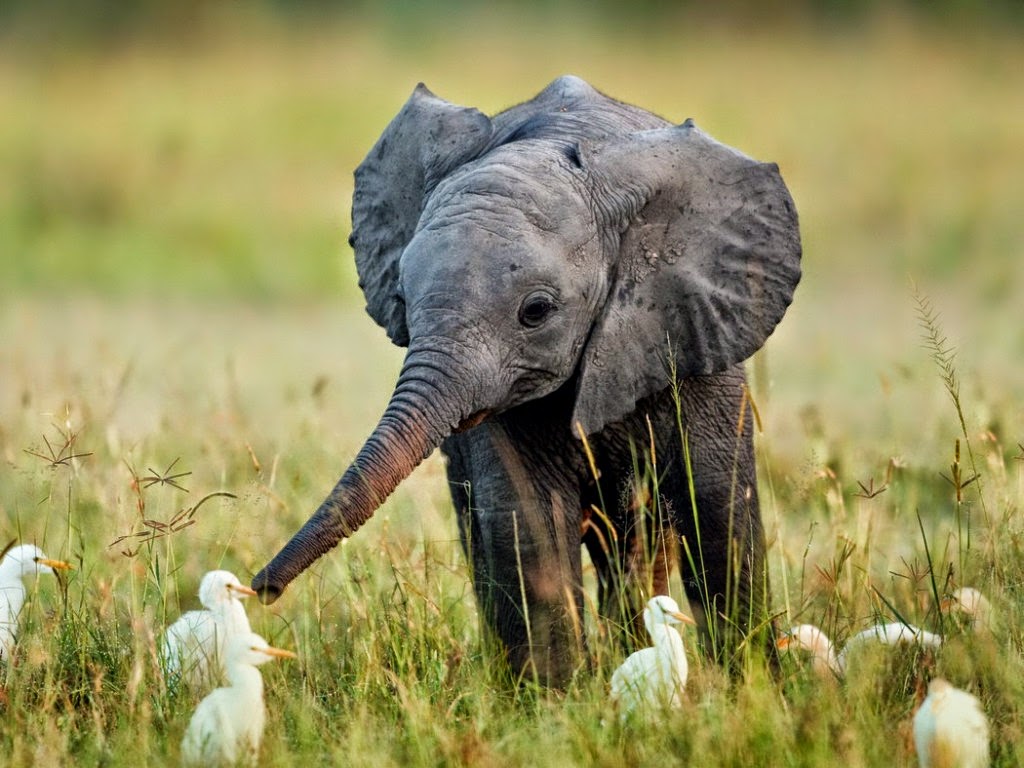
When a baby elephant sees the sea for the first time!
Comment
August 13, 2014

The same wind that uproots trees
makes the grass shine.
The lordly wind loves the weakness
and the lowness of grasses.
Never brag of being strong.
The axe doesn’t worry how thick the branches are.
It cuts them to pieces. But not the leaves.
It leaves the leaves alone.
― Rumi
Although anger and hatred, like compassion and love, are part of our mind, still I believe the dominant force of our mind is compassion and human affection. Therefore, usually I call these human qualities spirituality. Not necessarily as a religious message or religion in that sense. Science and technology together with human affection will be constructive. Science and technology under the control of hatred will be destructive.
If we practice religion properly, or genuinely, or religion is not something outside but in our hearts. The essence of any religion is good heart. Sometimes I call love and compassion a universal religion. This is my religion. Complicated philosophy, this and that, sometimes create more trouble and problems. If these sophisticated philosophies are useful for the development of good heart, then good: use them fully. If these complicated philosophies or systems become an obstacle to a good heart then better to leave them. This is what I feel.
If we look closely at human nature affection is the key to a good heart. I think the mother is a symbol of compassion. Every one has a seed of good heart. The only thing is whether we take care or not to realize the value of compassion. ~Dalai Lama
“We admire elephants in part because they demonstrate what we
consider the finest human traits: empathy, self-awareness, and social
intelligence. But the way we treat them puts on display the very worst
of human behavior.” ~Graydon Carter, Editor of Vanity Fair
The
escalation of poaching, habitat loss, human-elephant conflict and
mistreatment in captivity are just some of the threats to both African
and Asian elephants. Working towards better protection for wild
elephants, improving enforcement policies to prevent the illegal
poaching and trade of ivory, conserving elephant habitats, better
treatment for captive elephants and, when appropriate, reintroducing
captive elephants into natural, protected sanctuaries are the goals that
numerous elephant conservation organizations are focusing on around the
world.
World Elephant Day asks you to experience elephants in
non-exploitive and sustainable environments where elephants can thrive
under care and protection. On World Elephant Day, August 12, express
your concern, share your knowledge and support solutions for the better
care of captive and wild elephants alike.
“Elephants are simply
one more natural resource that is being caught up in human greed on the
one hand and human need on the other. We somehow need people to become
reacquainted with nature or they can have no clue as to the
interrelatedness of cause and effect.” ~Dr. Stephen Blake, Max Planck Institute for Ornithology
I try always to express the value of having a good heart. This simple aspect of human nature can be nourished to great power. With a good heart and wisdom you have right motivation and will automatically do what needs to be done. If people begin to act with genuine compassion for every one, we can still protect each other and the natural environment. This is much easier than having to adapt to the severe and incomprehensible environmental conditions projected for the future. ~Dalai lama
The “Aldabra giant tortoise” from the islands of the Aldabra Atoll in the Seychelles, is one of the largest tortoises in the world. Many of these Tortoises live over 100 years.
The Aldabras you are looking at here are on the famous “Prison Island” (aka Changuu) of Zanzibra, Tanzania…. Here is the story…. In 1919 the British governor of Seychelles sent a gift of four Aldabra Giant Tortoises to Changuu from the island of Aldabra.[1] These tortoises bred quickly and by 1955 they numbered around 200 animals. However people began to steal the tortoises for sale abroad as pets or for food and their numbers dropped rapidly. By 1988 there were around 100 tortoises, 50 in 1990 and just seven by 1996.[2] A further 80 hatchlings were taken to the island in 1996 to increase the numbers but 40 of them vanished. The Zanzibar government, with assistance from the World Society for the Protection of Animals built a large compound for the protection of the animals and by 2000 numbers had recovered to 17 adults, 50 juveniles and 90 hatchlings. The species is now considered vulnerable and has been placed on the IUCN Red List by the International Union for Conservation of Nature. More tortoises, mainly juveniles, continue to be brought to the island from other locations for conservation.

http://leelavadeeflower.blogspot.com/2014/08/with-good-heart-and-wisdom.html
This post has been reshared 15 times on Google+
View this post on Google+
Nature…trees, flowers, grass…grow in silence.
We need silence to be able to touch souls.
~Wilbur Pierce