With the rain forests, the oceans
we drink from the oceans.
They are part of our own body.
~Thich Nhat Hanh
This post has been reshared 6 times on Google+
View this post on Google+
~Thich Nhat Hanh
This post has been reshared 6 times on Google+
View this post on Google+

Stop thinking too much about the future. A certain amount of planning is good, but there are many, many things that are out of your control. You cannot control what will happen in 5 or 10 years. When it comes down to it, you don't even know what might happen tomorrow. Make a conscious decision to stop worrying so much. When you find yourself obsessing, do something to bring about greater mindfulness, like stepping outside and breathing fresh air for a few moments.
Accept pain. When life brings tragedy, being in the moment means experiencing pain instead of trying to ignore it or make it go away as fast as possible. Allowing yourself to feel negative emotions – fear, guilt, anxiety, sadness, and anger – is an important part of living in the present.
Try not to let your emotions get wrapped up in past occurrences or worries about the future.
Breathe. Taking several deep breaths can help you return to the present moment. During those times when your thoughts are jumping from problem to problem and you can't seem to focus on the present, stop and breathe. Take five deep breaths, inhaling deeply through your nose and exhaling through your mouth. Focus on your breath as it enters and leaves your body.
Source: wikiHow
http://leelavadeeflower.blogspot.com/2014/09/breathing-fresh-air-for-few-moments.html
This post has been reshared 21 times on Google+
View this post on Google+
Jardine River turtles have been spotted in far north Queensland, Australia for the first time in nearly two decades. (Sept. 4)
Avoid Swearing / Shouting – Many people think that this calms them down because it releases bottled up energy / anger. This is a common misconception. Yes. Release your anger. Do not hold it in all the time or you will explode. Do not take out your bottled up anger on those around you. Swearing only hypes you up more. You think you feel better but really, all you’ve done is put yourself in a destructive habit. If you need to shout, find a place of solitude and let out your anger. Cry. Do not punch a wall. Find a pillow or something that you won’t cause any harm to and scream into if you must. Just avoid taking your anger out on others because then guilt will stress you even more. Talk about your problems as they occur; don’t put it off. Taking care of the problem now, can eliminate the possibility of blowing up later because your anger was taken out a long time ago with civilized discussion. Source: wikiHow

Beth Greenfield, Senior Writer
Yahoo, Sep 5, 2014
You can’t really eat too many bananas — especially if you’re a woman over the age of 50, according to the findings of a new study regarding potassium intake and stroke prevention. Published on Thursday in the journal Stroke, researchers discovered that women in that age group who ate high-potassium foods were 12 percent less likely to suffer from a stroke in general and 16 percent less likely to suffer from an ischemic stroke (one caused by a blood clot) than women who didn’t. Finally, the high-potassium women were 10 percent less likely to die — from any cause — than those who ate low amounts of the healthy mineral.
“Potassium has long been associated with lower blood pressure,” said Sylvia Wassertheil-Smoller, lead researcher and principal investigator at the Women’s Health Initiative of Yeshiva University’s Albert Einstein College of Medicine in New York. But, she told Yahoo Health, “We think it goes above and beyond that, to a cellular level. Potassium is used in cellular function, and could be positively affecting the cells that line blood vessels.”
One unexpected finding in the study, Wassertheil-Smoller noted, was that the relationship between potassium intake and stroke prevention was the strongest in women without hypertension. “That was surprising and really interesting,” she said. “So we think it’s good to up your potassium intake before hypertension has a chance to develop.”
The researcher said she could not leap to any conclusions about how a high potassium intake might protect men from strokes, since the research focused only on women. But, she said, “We think it does apply to men, as, in general and on average, men eat more potassium than women because they tend to consume more calories.” Also, the researchers only focused on dietary sources of potassium — which include foods such as bananas, spinach, dates, yogurt, potatoes, and salmon — and so could not comment on the impact of potassium supplements on stroke prevention.
For the study, researchers studied 90,137 postmenopausal women between the ages of 50 and 79 for an average of 11 years. The subjects consumed an average of 2,611 milligrams of potassium daily — well below the USDA recommended 4,700 mg and even the World Health Organization’s (WHO) 3,500 mg a day. Only three percent, in fact, actually exceeded the USDA recommendation. Based on the data, Wassertheil-Smoller suggests eating even more than that average. “We would say at least stick to the WHO recommendation — which equals 12 bananas a day,” she said with a laugh. But, she quickly added, “You don’t have to just eat bananas. A serving of spinach is probably twice that of a banana. Potassium is sort of everywhere, you just have to read labels to make sure.”


By Pete Thomas, GrindTV
September 05, 2014
Photos of odd-looking crustacean, reeled in off Florida, go viral; experts believe it’s some kind of mantis shrimp, whose remarkable power might astonish you
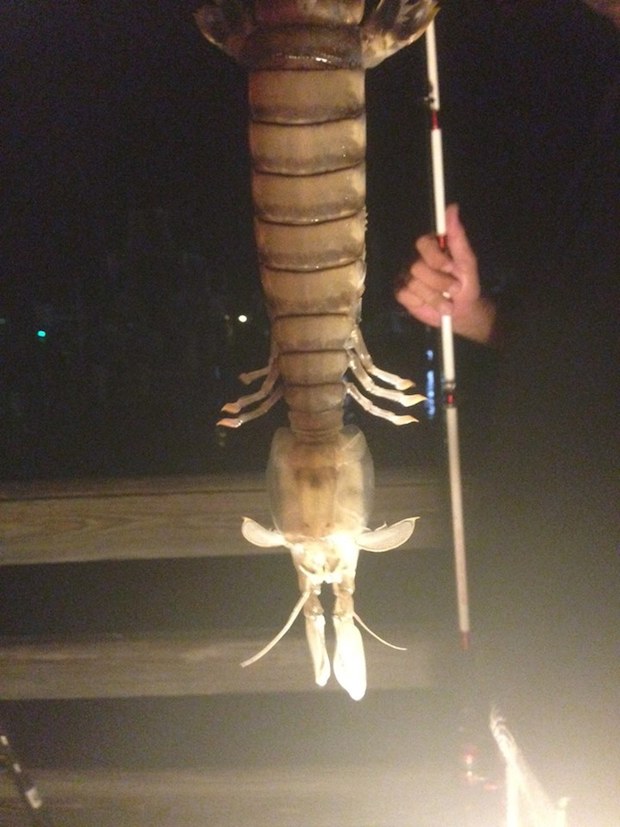
A Florida angler has reeled in a mysterious creature that looks to be a cross between a lobster and shrimp, and photos of this odd-looking crustacean, dangling from a fishing line, have captivated the Internet audience.
Steve Bargeron snapped the photos after watching another fisherman reel the 18-inch critter out of the water. Both had been fishing from a dock in Fort Pierce.
Shrimp-like creature
Another view of what’s believed to be a large mantis shrimp; photo by Steve Bargeron
Bargeron sent the images to the Florida Fish and Wildlife Conservation Commission, which on Thursday posted them on its Facebook page. By Friday morning the post had been shared nearly 3,000 times, and received hundreds of comments.
“That’s exactly why I don’t go into the ocean,” one person wrote.
The FWC did not identify the critter, but based on its appearance and Bargeron’s description—when it was pulled out of the water it was violently snapping its tail—the agency believes it’s “some type of mantis shrimp.”
If that’s true, the fisherman who caught the shrimp was smart to have grabbed it by its back, like one might grab a lobster, and fortunate not to have been injured.
The mantis shrimp is in a class of its own in terms of power. Within its shell are hinged arm-like claws, with fist-like clubs at their ends. They lash out with the speed of a .22-caliber bullet—the fastest punch in the world—and literally smash the shells of prey.
The claws can shatter clam shells, crack open crab shells, and even deliver a knockout blow to an octopus.