Kitty…
Comment
March 4, 2015
As every cat owner knows, nobody owns a cat.
~Ellen Perry Berkeley


Just get happy now! “But I can’t until I get a better job” Just get happy now! “But I can’t until I get more money” Just get happy now! “But I can’t until my body looks better”…
…If you’re waiting around for someone or something to change, before you can feel better, you’re in deep doo-doo! Everything you ever wanted is for one reason only, you think in the having of it, it’ll make you feel better…just find a way, anyway to get happy now, and what you want will be able to come into your experience. Like attracts like. You can’t be happy now, if you’re angry at yourself for not having it. ~ Abraham/Esther Hicks
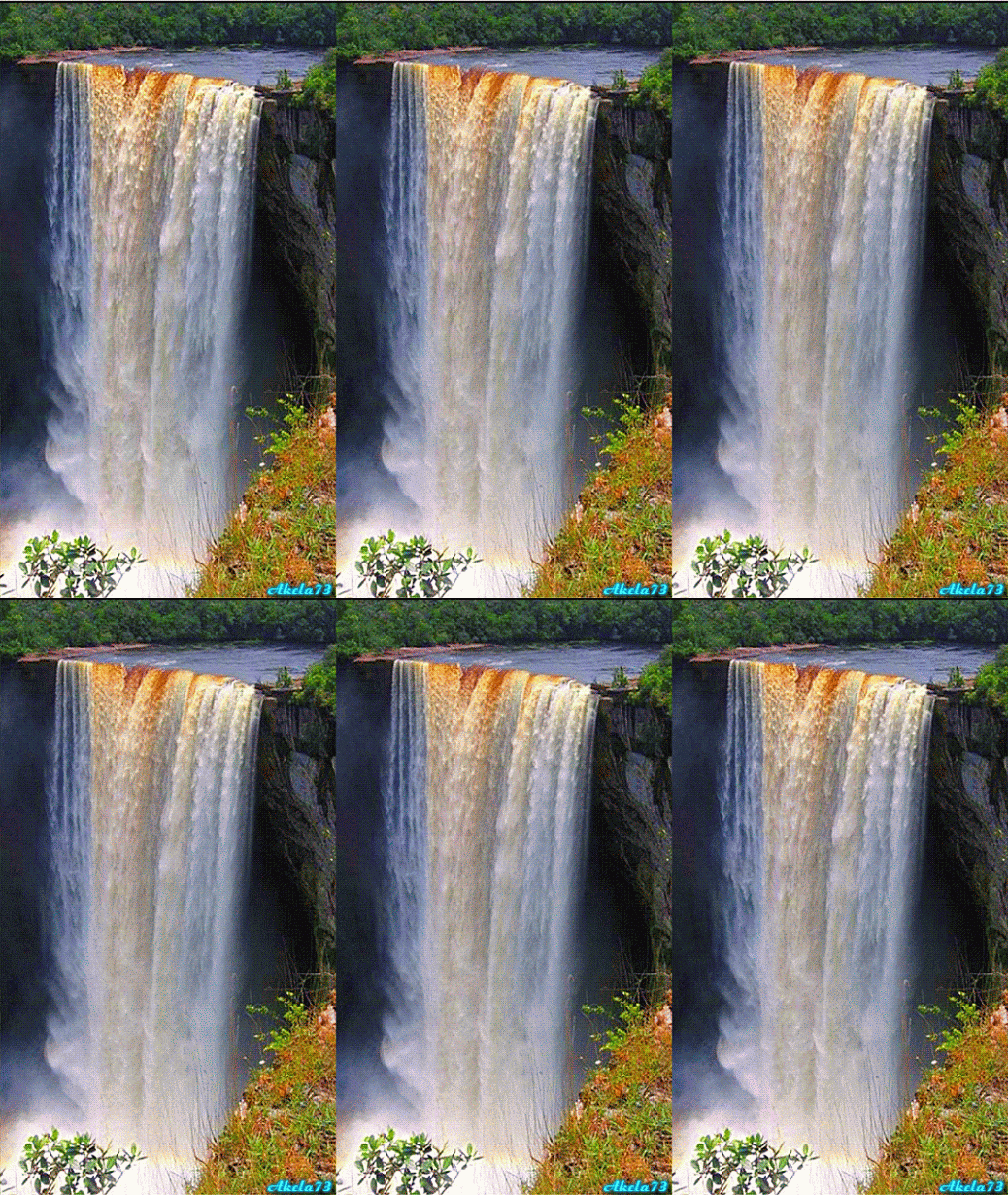
The best day of your life is the one on which you decide your life is your own. No apologies or excuses. No one to lean on, rely on, or blame. The gift is yours – it is an amazing journey – and you alone are responsible for the quality of it. This is the day your life really begins. ~ Bob Moawad

Empty pockets never held anyone back.
Only empty heads and empty hearts can do that.
~ Norman Vincent Peale


As every cat owner knows,
nobody owns a cat.
~Ellen Perry Berkeley
http://leelavadeeflower.blogspot.com/2015/03/kitty.html
+164 This post has been reshared 26 times on Google+

Just get happy now! “But I can’t until I get a better job” Just get happy now! “But I can’t until I get more money” Just get happy now! “But I can’t until my body looks better”…
…If you’re waiting around for someone or something to change, before you can feel better, you’re in deep doo-doo! Everything you ever wanted is for one reason only, you think in the having of it, it’ll make you feel better…just find a way, anyway to get happy now, and what you want will be able to come into your experience. Like attracts like. You can’t be happy now, if you’re angry at yourself for not having it. ~ Abraham/Esther Hicks
http://leelavadeeflower.blogspot.com/2015/03/if-youre-waiting-around.html
+92 This post has been reshared 6 times on Google+
Do everything with a mind that lets go. Don’t accept praise or gain or anything else. If you let go a little you a will have a little peace; if you let go a lot you will have a lot of peace; if you let go completely you will have complete peace. ~Ajahn Chah

This is my simple religion. There is no need for temples;
no need for complicated philosophy. Our own brain,
our own heart is our temple; the philosophy is kindness.
~Dalai Lama


A Tale of Self Sacrifice.
At one time, the Bodhisattva took birth as a large Elephant. He lived in a forest far from civilization. The forest contained a lake that was both deep and wide and the entire wilderness was surrounded on all sides by an expansive desert. This beautiful oasis was well suited for the elephant as well as other smaller creatures. Delicious fruit grew on the trees, young shrubs carpeted the earth, and the whole area was bordered with high mountains. The Elephant lived alone as an ascetic and sustained his large body only on leaves and lotus roots, dedicating his time to contemplation on the virtues of contentment and tranquility.
One day while wandering along the forests edge, the Bodhisattva Elephant heard the cries of humans coming from the desert. Their cries began to get louder; surely they were approaching the oasis.
Urged by compassion, he ran towards them swiftly and when they came into sight he saw that it was a large group of men, women, and children, all nearly dead from starvation and thirst. Noticing that they were fearful of him, he called out in a human voice and stated that they need not be frightened. Upon hearing such peaceful and comforting words the people regained their composure and humbly greeted him.
The elders explained that they had been banished by an angry king and that many of them had already died in the desert. The kind Elephant realized that all the fruit in the forest would not be enough to feed them for even a day. He resolved that he must offer his own flesh as food and his organs and intestines as bags to carry water on their journey. He then instructed the people on how to find the great lake and said that just beyond it they would find the corpse of an elephant that had fallen from a mountaintop, not telling them that it would be his own corpse. As the group set out towards the water, he quickly, by another route, started to ascend the mountain. Upon reaching the top he then, feeling great joy and oblivious of the impending painful death below, hurled himself over the edge of the precipice. The impact sounded like an earthquake throughout the entire forest. Continue reading
 By Ven. Dr. K. Sri Dhammananda Maha Thera
‘When I am gone, my Teaching shall be your Master and Guide.’
Three months before His passing away the Buddha addressed His disciples and said: ‘I have delivered sermons to you during these forty-five years. You must learn them well and treasure them. You must practise them and teach them to others. This will be of great use for the welfare of the living and for the welfare of those who come after you’.
‘My years are now full ripe; the life span left is short. I will soon have to leave you. You must be earnest. O monks, be mindful and of pure virtue! Whoever untiringly pursues the Teaching, will go beyond the cycle of birth and death and will man an end of Suffering.’
When Ananda asked the Buddha what would become of the Order after He pass away, the Buddha replied, ‘What does the Order expect of me, Ananda? I have preached the Truth without any distinction; for in regard to the Truth, there is no clenched hand in the Teachings of the Buddha‚. It may be, Ananda, that to some among you, the thought will come ‘The Master’s words will soon end; soon we will no longer have a master.’ But do not think like this, Ananda. When I am gone, my Teaching and the disciplinary code shall be your Master.’
The Buddha further explained: ‘If there is anyone who thinks, ‘It is I who will lead the brotherhood’, or ‘The Order is dependent on me, it is I who should give instructions’, the Buddha does not think that He should lead the order or that the Order is dependent on Him. I have reached the end of my days. Just as a worn-out cart can only be made to move with much additional care, so my body can be kept going only with much additional care. Therefore, Ananda, be a lamp and refuge unto yourselves. Look for no other refuge. Let the Truth be your lamp and your refuge. Seek no refuge elsewhere.’
At the age of eighty, on His birthday, He passed away without showing any worldly supernatural powers. He showed the real nature of component things even in His own life.
When the Buddha passed away into Nibbana, one of His disciples remarked, ‘All must depart—all beings that have life must shed their compounded forms. Yes, even a Master such as He, a peerless being, powerful in Wisdom and Enlightenment, even He must pass away.’
The parting words of the Buddha:
‘Appamadena Sampadetha Vaya Dhamma Sankhara’.
‘Work diligently. Component things are impermanent.’