

1. Ministering to the Sick and the Terminally Ill
    Comment

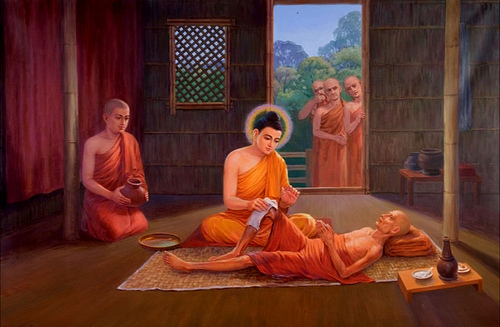
    “He who attends on the sick attends on me,” declared the Buddha, exhorting his disciples on the importance of ministering to the sick. This famous statement was made by the Blessed One when he discovered a monk lying in his soiled robes, desperately ill with an acute attack of dysentery. With the help of Ananda, the Buddha washed and cleaned the sick monk in warm water. On this occasion he reminded the monks that they have neither parents nor relatives to look after them, so they must look after one another. If the teacher is ill, it is the bounden duty of the pupil to look after him, and if the pupil is ill it is the teacher’s duty to look after the sick pupil. If a teacher or a pupil is not available it is the responsibility of the community to look after the sick (Vin.i,301ff.).

    On another occasion the Buddha discovered a monk whose body was covered with sores, his robe sticking to the body with pus oozing from the sores. Unable to look after him, his fellow monks had abandoned him. On discovering this monk, the Buddha boiled water and washed the monk with his own hands, then cleaned and dried his robes. When the monk felt comforted the Buddha preached to him and he became an arahant, soon after which he passed away (DhpA.i,319). Thus the Buddha not only advocated the importance of looking after the sick, he also set a noble example by himself ministering to those who were so ill that they were even considered repulsive by others.

    The Buddha has enumerated the qualities that should be present in a good nurse. He should be competent to administer the medicine, he should know what is agreeable to the patient and what is not. He should keep away what is disagreeable and give only what is agreeable to the patient. He should be benevolent and kind-hearted, he should perform his duties out of a sense of service and not just for the sake of remuneration (mettacitto gilanam upatthati no amisantaro). He should not feel repulsion towards saliva, phlegm, urine, stools, sores, etc. He should be capable of exhorting and stimulating the patient with noble ideas, with Dhamma talk (A.iii,144). Continue reading


  2. Dogs drinking style

    Comment

    A dog wags his tail in three very different moods and only one is happy. When it’s unusually high and stiff, the dog is agitated and ready to protect his turf. A tail held low and wagged very quickly shows a scared and submissive dog. A happy dog wags his tail in its natural, mid-level position — and his ears, mouth, and body will look relaxed, too. Puppies don’t wag their tails before they are about three weeks old — and some don’t start until seven weeks old. Vets believe tiny puppies are capable, but they’re too busy sleeping and eating to bother. As they become more alert, tail wagging starts as a kind of sign language: a peace sign to rambunctious littermates or when begging for food. Dogs almost never wag their tails when alone. Source: webmd

  3. Distance…

    Comment

    Distance and the lack of understanding can kill any relationship
    or friendship with no effort put into it on both ends.
    ~Unknown 

  4. Even if no one is watching

    Comment

    Whenever we do something good in life, even if no one is watching,
    we rise a little in our own eyes. Keep rising always. ~Anmol Andore

  5. Universal responsibility

    Comment

    I believe that to meet the challenge of our times, human beings will have to develop a greater sense of universal responsibility. We must all learn to work not just for our own self, family, or nation, but for the benefit of all humankind. Universal responsibility is the key to human survival. It is the best foundation for world peace, the equitable use of natural resources, and through concern for future generations, the proper care of the environment. ~His Holiness the Dalai Lama

    April 17, 2015.

    April 17, 2015.

  6. The Naga fireballs

    Comment

    5 natural events that science can’t explain

    The Naga fireballs

    Each year, hundreds of fireballs spontaneously explode out of Thailand’s Mekong River. Known as “bung fai paya nak” or “Naga fireballs,” they have appeared on the “late autumn night of the full moon at the end of the Buddhist Lent for as long as anyone can remember,” according to a 2002 Time magazine story about the phenomenon. Some believe the balls come from the breath of Naga, a mythical serpent that haunts the river. (Locals use old grainy pictures and postcards of the mythical beast to prove its presence to tourists.) Others believe the fireballs are actually pockets of methane bubbling up from the river, but many locals remain convinced that the fireballs are of a supernatural origin.

    Link source

  7. Nothing but flowers

    Comment

    All are nothing but flowers
    In a flowing universe.

    ~Nakagawa Soen-Roshi

    Air Plant. Photo credit: Randy Neufeldt

    Air Plant. Photo credit: Randy Neufeldt

  8. Love still stands when all else has fallen

    Comment

    Love knows no limit to its endurance, no end to its trust, no fading of its hope; it can outlast anything. Love still stands when all else has fallen. ~Blaise Pascal

    April 17, 2015.

    April 17, 2015.

  9. Dancing dog

    Comment

    When your dog locks eyes with you, it may genuinely be a look of love, and not simply a form of begging. Dogs can develop this atypical behavior with close human companions — while between dogs or with a strange person, a direct stare is a threat. Of course not every glance from Fido is loving — he may simply want your dinner. Or, if his body is tense and ears flattened, he may be telling you to back off. Dogs can sniff out a dangerous drop in blood sugar in a diabetic owner and alert the person to take action by pawing, licking, whining, or barking. A few dogs have even been trained and placed as diabetic service dogs. Their nose for hypoglycemia (low blood sugar) is correct 90% of the time, according to their trainers. Source: webmd

  10. You may think…

    Comment

    You may think that I forgot you.
    You may think that I don’t care,
    and you may think that
    I’m not thinking of you.
    Well, you’re wrong.
    You’re still in My Dreams.

    Sucheta, Mobiles

Hermit of Tbeng Mountain

Sachjang Phnom Tbeng សច្ចំ​​ ភ្នំត្បែង is a very long and interesting story written by Mr. Chhea Sokoan, read by Jendhamuni Sos. You can click on the links below to listen. Part 1 | Part 2

List of Khmer songs