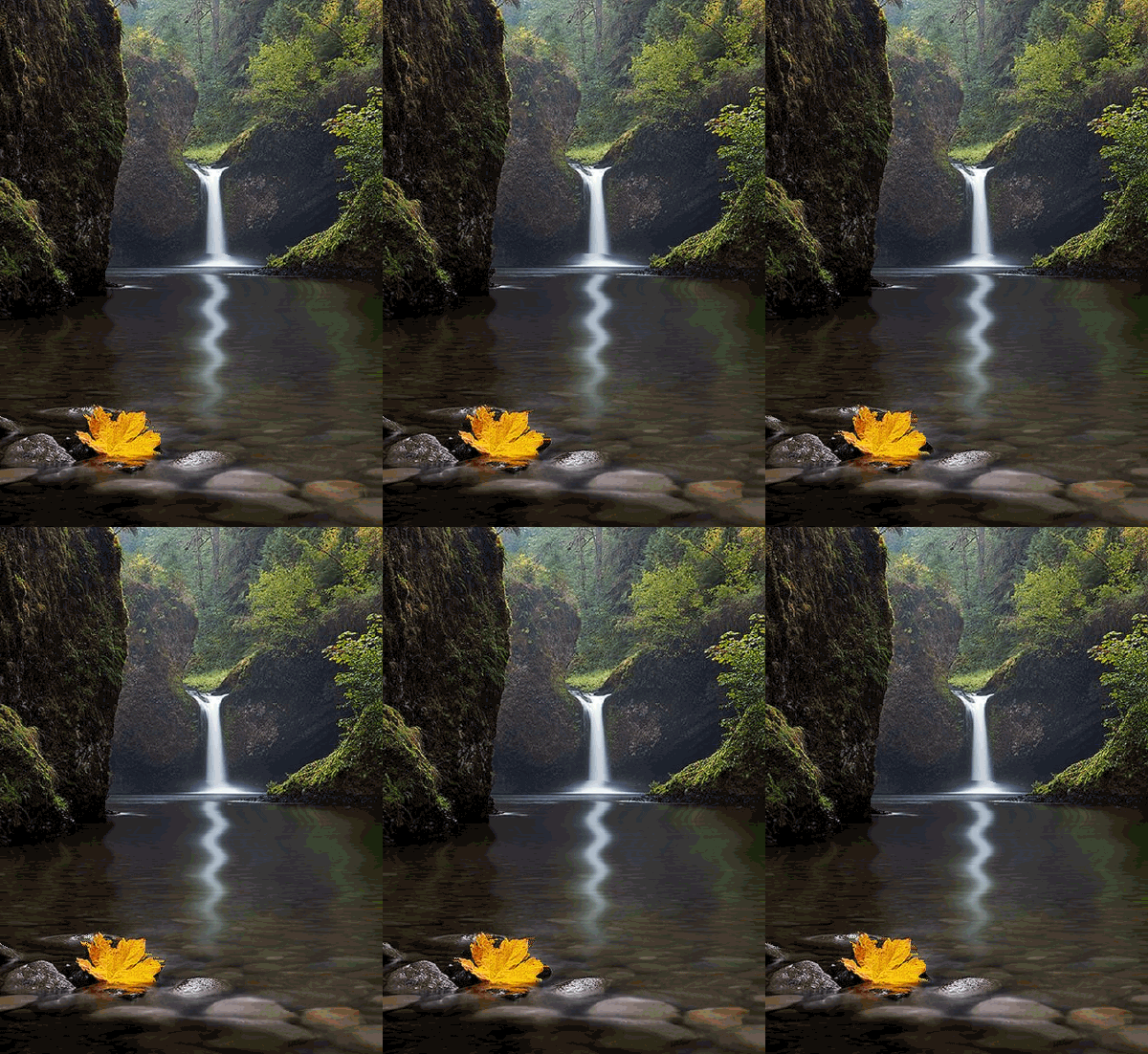
Photo credit: Randy Neufeldt
A Dhammatalk by Ajahn Chah
Now please pay attention, not allowing your mind to wander off after other things. Create the feeling that right now you are sitting on a mountain or in a forest somewhere, all by yourself. What do you have sitting here right now? There are body and mind, that’s all, only these two things. All that is contained within this frame sitting here now is called ”body.” The ”mind” is that which is aware and is thinking at this very moment. These two things are also called ”nāma” and ”rūpa.” ”Nāma” refers to that which has no ”rūpa,” or form. All thoughts and feelings, or the four mental khandhas of feeling, perception, volition and consciousness, are nāma, they are all formless. When the eye sees form, that form is called rūpa, while the awareness is called nāma. Together they are called nāma and rūpa, or simply body and mind.
Understand that sitting here in this present moment are only body and mind. But we get these two things confused with each other. If you want peace you must know the truth of them. The mind in its present state is still untrained; it’s dirty, not clear. It is not yet the pure mind. We must further train this mind through the practice of meditation.
Some people think that meditation means to sit in some special way, but in actual fact standing, sitting, walking and reclining are all vehicles for meditation practice. You can practice at all times. Samādhi literally means ”the firmly established mind.” To develop samādhi you don’t have to go bottling the mind up. Some people try to get peaceful by sitting quietly and having nothing disturb them at all, but that’s just like being dead. The practice of samādhi is for developing wisdom and understanding.
Samādhi is the firm mind, the one-pointed mind. On which point is it fixed? It’s fixed onto the point of balance. That’s its point. But people practice meditation by trying to silence their minds. They say, ”I try to sit in meditation but my mind won’t be still for a minute. One instant it flies off one place, the next instant it flies off somewhere else… How can I make it stop still?” You don’t have to make it stop, that’s not the point. Where there is movement is where understanding can arise. People complain, ”It runs off and I pull it back again; then it goes off again and I pull it back once more…” So they just sit there pulling back and forth like this.
They think their minds are running all over the place, but actually it only seems like the mind is running around. For example, look at this hall here… ”Oh, it’s so big!” you say… actually it’s not big at all. Whether or not it seems big depends on your perception of it. In fact this hall is just the size it is, neither big nor small, but people run around after their feelings all the time.
Meditating to find peace… You must understand what peace is. If you don’t understand it you won’t be able to find it. For example, suppose today you brought a very expensive pen with you to the monastery. Now suppose that, on your way here, you put the pen in your front pocket, but at a later time you took it out and put it somewhere else, such as the back pocket. Now when you search your front pocket… It’s not there! You get a fright. You get a fright because of your misunderstanding, you don’t see the truth of the matter. Suffering is the result. Whether standing, walking, coming and going, you can’t stop worrying about your lost pen. Your wrong understanding causes you to suffer. Understanding wrongly causes suffering… ”Such a shame! I’d only bought that pen a few days ago and now it’s lost.”
But then you remember, ”Oh, of course! When I went to bathe I put the pen in my back pocket.” As soon as you remember this you feel better already, even without seeing your pen. You see that? You’re happy already, you can stop worrying about your pen. You’re sure about it now. As you’re walking along you run your hand over your back pocket and there it is. Your mind was deceiving you all along. The worry comes from your ignorance. Now, seeing the pen, you are beyond doubt, your worries are calmed. This sort of peace comes from seeing the cause of the problem, samudaya, the cause of suffering. As soon as you remember that the pen is in your back pocket there is nirodha, the cessation of suffering.
So you must contemplate in order to find peace. What people usually refer to as peace is simply the calming of the mind, not the calming of the defilements. The defilements are simply being temporarily subdued, just like grass covered by a rock. In three or four days you take the rock off the grass and in no long time it grows up again. The grass hadn’t really died, it was simply being suppressed. It’s the same when sitting in meditation: the mind is calmed but the defilements are not really calmed. Therefore, samādhi is not a sure thing. To find real peace you must develop wisdom. Samādhi is one kind of peace, like the rock covering the grass… in a few days you take the rock away and the grass grows up again. This is only a temporary peace. The peace of wisdom is like putting the rock down and not lifting it up, just leaving it where it is. The grass can’t possibly grow again. This is real peace, the calming of the defilements, the sure peace which results from wisdom.
We speak of wisdom (paññā) and samādhi as separate things, but in essence they are one and the same. Wisdom is the dynamic function of samādhi; samādhi is the passive aspect of wisdom. They arise from the same place but take different directions, different functions, like this mango here. A small green mango eventually grows larger and larger until it is ripe. It is all the same mango, the larger one and the ripe one are all the same mango, but its condition changes. In Dhamma practice, one condition is called samādhi, the later condition is called paññā, but in actuality sīla, samādhi, and paññā are all the same thing, just like the mango. Continue reading →