
Words spoken with good manners
Comment
June 7, 2015
Words spoken with good manners have reached a lot more hearts than words
spoken sternly. ~Saad Tasleem


Words spoken with good manners have reached a lot more hearts than words
spoken sternly. ~Saad Tasleem
When you do things from your soul, you feel a river moving in you, a joy.
Knock, And He’ll open the door
Vanish, And He’ll make you shine like the sun
Fall, And He’ll raise you to the heavens
Become nothing, And He’ll turn you into everything.
~Rumi

Many parents try to keep their married children under their control. They do not give due freedom to them and tend to interfere with a young married couple’s life. When parents try to control their married son or married daughter and want them to follow their way of life strictly, this will create a lot of misunderstanding between the two generations as well as unhappiness between the couple. Parents may be doing it in good faith due to love and attachment towards the children, but in so doing, they are inviting more problems to themselves and to the children.
Parents must allow their children to shoulder the responsibilities of their own lives and families. For example: if some seeds are dropped under a tree, plants might grow after sometime. But if you want those plants to grow healthy and independent you must transplant them to open ground somewhere else to grow separately, so that they are not hampered by the shade of the parent tree.
Parents should not neglect the ancient wisdom based on advice given by religious teachers, wise people and elders who have developed a knowledge of the world through their own trial and errors. ~Ven. Dr. K. Sri Dhammananda


Liberating Prayer
O Blessed One, Shakyamuni Buddha,
Precious treasury of compassion,
Bestower of supreme inner peace,
You, who love all beings without exception,
Are the source of happiness and goodness;
And you guide us to the liberating path.
Your body is a wishfulfilling jewel,
Your speech is supreme, purifying nectar,
And your mind is refuge for all living beings.
With folded hands I turn to you,
Supreme unchanging friend,
I request from the depths of my heart:
Please give me the light of your wisdom
To dispel the darkness of my mind
And to heal my mental continuum.
Please nourish me with your goodness,
That I in turn may nourish all beings
With an unceasing banquet of delight.
Through your compassionate intention,
Your blessings and virtuous deeds,
And my strong wish to rely upon you,
May all suffering quickly cease
And all happiness and joy be fulfilled;
And may holy Dharma flourish for evermore.
Composed by Venerable Geshe Kelsang Gyatso at Manjushri Centre, England, June 2001
© Geshe Kelsang Gyatso and New Kadampa Tradition 2001
Try watching a spider. A spider spins its web in any convenient niche and then sits in the center, staying still and silent. Later, a fly comes along and lands on the web. As soon as it touches and shakes the web, ”boop!” – the spider pounces and winds it up in thread. It stores the insect away and then returns again to collect itself silently in the center of the web.
Watching a spider like this can give rise to wisdom. Our six senses have mind at the center surrounded by eye, ear, nose, tongue and body. When one of the senses is stimulated, for instance, form contacting the eye, it shakes and reaches the mind. The mind is that which knows, that which knows form. Just this much is enough for wisdom to arise. It’s that simple.
Like a spider in its web, we should live keeping to ourselves. As soon as the spider feels an insect contact the web, it quickly grabs it, ties it up and once again returns to the center. This is not at all different from our own minds. ”Coming to the center” means living mindfully with clear comprehension, being always alert and doing everything with exactness and precision – this is our center. There’s really not a lot for us to do; we just carefully live in this way. But that doesn’t mean that we live heedlessly thinking, ”There is no need to do siting or walking meditation!” and so forget all about our practice. We can’t be careless! We must remain alert just as the spider waits to snatch up insects for its food. ~Ajahn Chah

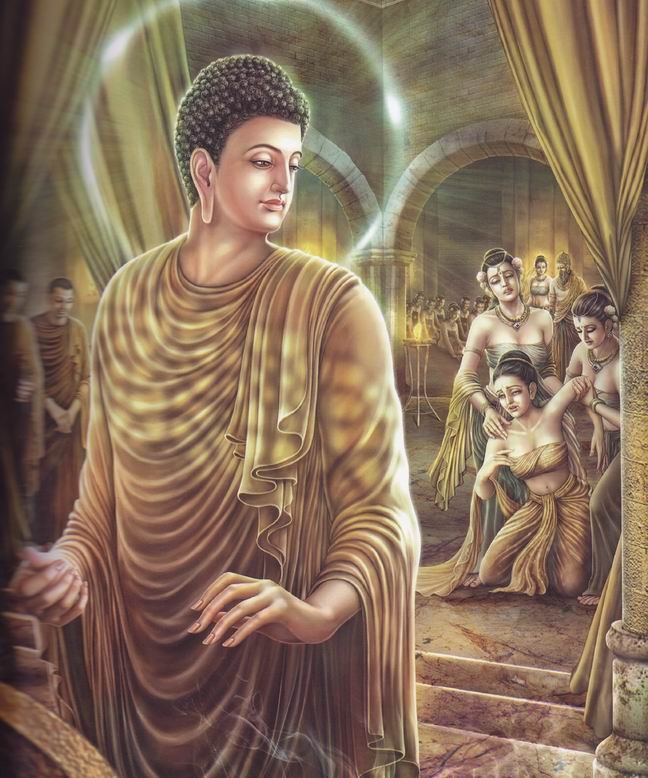
A Dhammatalk by Ajahn Chah
In our lives we have two possibilities: indulging in the world or going beyond the world. The Buddha was someone who was able to free himself from the world and thus realized spiritual liberation.
In the same way, there are two types of knowledge – knowledge of the worldly realm and knowledge of the spiritual, or true wisdom. If we have not yet practiced and trained ourselves, no matter how much knowledge we have, it is still worldly, and thus cannot liberate us.
Think and really look closely! The Buddha said that things of the world spin the world around. Following the world, the mind is entangled in the world, it defiles itself whether coming or going, never remaining content. Worldly people are those who are always looking for something – who can never find enough. Worldly knowledge is really ignorance; it isn’t knowledge with clear understanding, therefore there is never an end to it. It revolves around the worldly goals of accumulating things, gaining status, seeking praise and pleasure; it’s a mass of delusion which has us stuck fast.
Once we get something, there is jealousy, worry and selfishness. And when we feel threatened and can’t ward it off physically, we use our minds to invent all sorts of devices, right up to weapons and even nuclear bombs, only to blow each other up. Why all this trouble and difficulty?
This is the way of the world. The Buddha said that if one follows it around there is no reaching an end.
Come to practice for liberation! It isn’t easy to live in accordance with true wisdom, but whoever earnestly seeks the path and fruit and aspires to Nibbāna will be able to persevere and endure. Endure being contented and satisfied with little; eating little, sleeping little, speaking little and living in moderation. By doing this we can put an end to worldliness.
If the seed of worldliness has not yet been uprooted, then we are continually troubled and confused in a never-ending cycle. Even when you come to ordain, it continues to pull you away. It creates your views, your opinions, it colors and embellishes all your thoughts – that’s the way it is. Continue reading
Today is one of its kind; it won’t come again. Bring joy to someone,
speak good words and use them to heal, encourage others and learn to care.
~Mufti Ismail Menk
Cats, not dogs, are the most common pets in America. Studies have shown that people who own pets live longer, have less stress, and have fewer heart attacks. Over 50% of all pet owners would rather be stranded on a desert island with their pet, not another person. Source: AnimalLeague

All life is either moving forward and evolving or shrinking back and dying. If you want to evolve in your own life, you have to push through the obstacles instead of running from them. Obstacles and challenges are the agents of growth. Nobody gets to be large and in charge without facing challenges and moving through them. Birth is messy, painful, scary, uncertain, and freaky. Birth is also a glorious miracle that leads to new life. If you want the new life you say you want, you have to do the work instead of just studying and discussing and wishing and wanting. ~ Jen Sincero

Like other reptiles, turtles are cold blooded. In some species of turtle the temperature determines if the egg will develop into a male or female, lower temperatures lead to a male while higher temperatures lead to a female. Some turtles lay eggs in the sand and leave them to hatch on their own. The young turtles make their way to the top of the sand and scramble to the water while trying to avoid predators. Sea turtles have special glands which help remove salt from the water they drink.
Source: ScienceKids