

1. The tail

    Comment

    Jendhamunismilingatrainsy052405There is a story about a princess who had a small eye problem that she felt was really bad. Being the king’s daughter, she was rather spoiled and kept crying all the time. When the doctors wanted to apply medicine, she would invariably refuse any medical treatment and kept touching the sore spot on her eye. In this way it became worse and worse, until finally the king proclaimed a large reward for whoever could cure his daughter. After some time, a man arrived who claimed to be a famous physician, but actually was not even a doctor.

    He declared that he could definitely cure the princess and was admitted to her chamber. After he had examined her, he exclaimed, “Oh, I’m so sorry!” “What is it?” the princess inquired. The doctor said, “There is nothing much wrong with your eye, but there is something else that is really serious.” The princess was alarmed and asked, “What on earth is so serious?” He hesitated and said, “It is really bad. I shouldn’t tell you about it.” No matter how much she insisted, he refused to tell her, saying that he could not speak without the king’s permission.

    When the king arrived, the doctor was still reluctant to reveal his findings. Finally the king commanded, “Tell us what is wrong. Whatever it is, you have to tell us!” At last the doctor said, “Well, the eye will get better within a few days – that is no problem. The big problem is that the princess will grow a tail, which will become at least nine fathoms long. It may start growing very soon. If she can detect the first moment it appears, I might be able to prevent it from growing.” At this news everyone was deeply concerned. And the princess, what did she do? She stayed in bed, day and night, directing all her attention to detecting when the tail might appear. Thus, after a few days, her eye got well.

    This shows how we usually react. We focus on our little problem and it becomes the center around which everything else revolves. So far, we have done this repeatedly, life after life. We think, “My wishes, my interests, my likes and dislikes come first!” As long as we function on this basis, we will remain unchanged. Driven by impulses of desire and rejection, we will travel the roads of samsara without finding a way out. As long as attachment and aversion are our sources of living and drive us onward, we cannot rest.

    From Daring Steps toward Fearlessness: The Three Vehicles of Buddhism, by Ringu Tulku Rinpoche
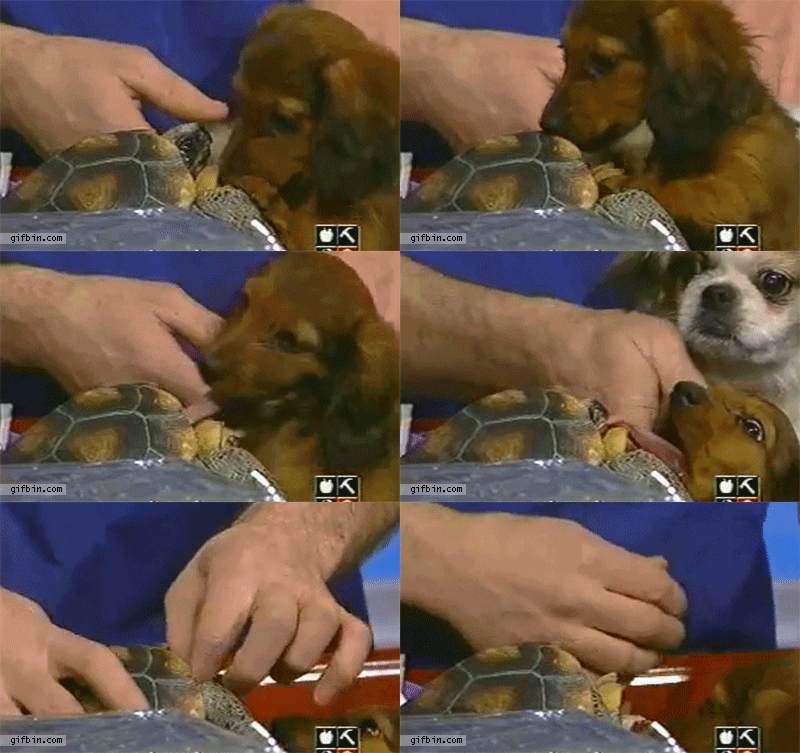
     

  2. Turtle bites puppy’s tongue

    Comment

    Turtles have good eyesight and an excellent sense of smell. Hearing and sense of touch are both good and even the shell contains nerve endings. The shell of a turtle is made up of 60 different bones all connected together. The top domed part of a turtle’s shell is called the carapace and the bottom underlying part is called the plastron. Source: AnimalPlanet

  3. Kitty loves the box

    Comment

    This box-loving aspect of a cat’s personality has long puzzled their human carers, and it’s also caught the attention of scientists. Researchers, who published their findings in Applied Animal Behaviour Science, investigated whether hiding in boxes might reduce stress for cats in animal shelters.

    While most species of dog can adapt to shelter environments relatively quickly, cats often experience high levels of stress. Previous studies have shown that cats prefer areas where they have the ability to hide, but until now scientists have not studied whether so-called “hiding enrichment” might benefit a cat’s sense of well-being and specifically if providing boxes for cats to hide in might help to ease those turbulent first few weeks in a new shelter. By Steve Williams, Care2

  4. To be freed from self-importance

    Comment

    Humility does not mean believing oneself to be inferior, but to be freed from self-importance. It is a state of natural simplicity which is in harmony with our true nature and allows us to taste the freshness of the present moment. – Matthieu Ricard

  5. Value judgments

    Comment

    Mindful and creative, a child who has neither a past,
    nor examples to follow, nor value judgments, simply lives,
    speaks and plays in freedom. ~Arnaud Desjardins

  6. The worm

    Comment

    buddhateaching

    by Ajahn Brahmavamso

    There is a wonderful little story about two monks who lived together in a monastery for many years; they were great friends. Then they died within a few months of one another. One of them got reborn in the heaven realms, the other monk got reborn as a worm in a dung pile. The one up in the heaven realms was having a wonderful time, enjoying all the heavenly pleasures. But he started thinking about his friend, “I wonder where my old mate has gone?” So he scanned all of the heaven realms, but could not find a trace of his friend. Then he scanned the realm of human beings, but he could not see any trace of his friend there, so he looked in the realm of animals and then of insects. Finally he found him, reborn as a worm in a dung pile… Wow! He thought: “I am going to help my friend. I am going to go down there to that dung pile and take him up to the heavenly realm so he too can enjoy the heavenly pleasures and bliss of living in these wonderful realms.”

    So he went down to the dung pile and called his mate. And the little worm wriggled out and said: “Who are you?”, “I am your friend. We used to be monks together in a past life, and I have come up to take you to the heaven realms where life is wonderful and blissful.” But the worm said: “Go away, get lost!” “But I am your friend, and I live in the heaven realms,” and he described the heaven realms to him. But the worm said: “No thank you, I am quite happy here in my dung pile. Please go away.” Then the heavenly being thought: “Well if I could only just grab hold of him and take him up to the heaven realms, he could see for himself.” So he grabbed hold of the worm and started tugging at him; and the harder he tugged, the harder that worm clung to his pile of dung.

    Do you get the moral of the story? How many of us are attached to our pile of dung?

    Link source


  7. Loving-kindness meditation

    Comment
    History Of Buddhism

    History Of Buddhism

    Loving-kindness meditation can be brought in to support the practice of insight meditation to help keep the mind open and sweet. It provides the essential balance to support Insight meditation practice.

    It is a fact of life that many people are troubled by difficult emotional states in the pressured societies we live in, but do little in terms of developing skills to deal with them. Yet even when the mind goes sour it is within most people’s capacity to arouse positive feelings to sweeten it. Loving-kindness is a meditation practice taught by the Buddha to develop the mental habit of selfless or altruistic love. In the Dhammapada can be found the saying: “Hatred cannot coexist with loving-kindness, and dissipates if supplanted with thoughts based on loving-kindness.”

    Loving-kindness is a meditation practice, which brings about positive attitudinal changes as it systematically develops the quality of ‘loving-acceptance’. It acts, as it were, as a form of self-psychotherapy, a way of healing the troubled mind to free it from its pain and confusion. Of all Buddhist meditations, loving-kindness has the immediate benefit of sweetening and changing old habituated negative patterns of mind.

    To put it into its context, Loving-kindness is the first of a series of meditations that produce four qualities of love: Friendliness (metta), Compassion (karuna), Appreciative Joy (mudita) and Equanimity (upekkha). The quality of ‘friendliness’ is expressed as warmth that reaches out and embraces others. When loving-kindness practice matures it naturally overflows into compassion, as one empathises with other people’s difficulties; on the other hand one needs to be wary of pity, as its near enemy, as it merely mimics the quality of concern without empathy. The positive expression of empathy is an appreciation of other people’s good qualities or good fortune, or appreciative joy, rather than feelings of jealousy towards them. This series of meditations comes to maturity as ‘on-looking equanimity’. This ‘engaged equanimity’ must be cultivated within the context of this series of meditations, or there is a risk of it manifesting as its near enemy, indifference or aloofness. So, ultimately you remain kindly disposed and caring toward everybody with an equal spread of loving feelings and acceptance in all situations and relationships.

    ~By Ven. Pannyavaro, BuddhaNet


  8. Simplicity of the present moment

    Comment

    Do not encumber your mind with useless thoughts. What good does it do to brood on the past or anticipate the future? Remain in the simplicity of the present moment. ~Dilgo Khyentse Rinpoche

    We must make good use of this life for the time that we have left. This brief flash of light, like the sun appearing through the clouds. ~Kalu Rinpoche


    Jendhamuni060515


  9. Under certain circumstances

    Comment

    Jealousy in romance is like salt in food. A little can enhance the savor,
    but too much can spoil the pleasure and, under certain circumstances,
    can be life-threatening. ~Maya Angelou

    nature5


  10. Water under the bridge

    Comment

    People who have lost relationships often wonder why they can’t just let it be water under the bridge. It is water under the bridge – the trouble is we do not live on the bridge but in the river of life with its many twists and turns. ~Grant Fairley

    nature-animation-gif-6

Hermit of Tbeng Mountain

Sachjang Phnom Tbeng សច្ចំ​​ ភ្នំត្បែង is a very long and interesting story written by Mr. Chhea Sokoan, read by Jendhamuni Sos. You can click on the links below to listen. Part 1 | Part 2

List of Khmer songs