1. Kitty is very thirsty

    Comment

    Hydration is an extremely important part of your cat’s overall health. Exactly how much water should your cat drink every day? How can you make sure your feline is getting enough? The amount of water consumption depends on a variety of factors, including the size of your cat, the time of year and whether your cat’s diet includes wet food or dry cat food only. If cats are given dry food only, they will require significantly more supplemental water to stay acceptably hydrated. Normally, a cat will require 2-4 ounces of fresh water in addition to its food. Dry food is only 10 percent water, while canned is approximately 80 percent water. So obviously your cat is going to drink a lot more water if you are providing dry food only.

    How Can I Tell If My Cat Is Getting Enough Water?

    There are a few simple signs that will give you a pretty good indication of your cat is staying hydrated:

    • Skin elasticity. Gently pull the skin at the base of your cat’s neck (scruff). The skin should spring back when you release it. If it does not, your cat might not be getting enough water.
    • A shiny coat without dry flakes is a sign of hydration
    • Your cat should exhibit normal physical activity and not be overly lethargic
    • Is your cat urinating 2-3 times per day? You can tell if this is happening by checking your cat’s litter box for medium-sized clumps.

    Source: Catster

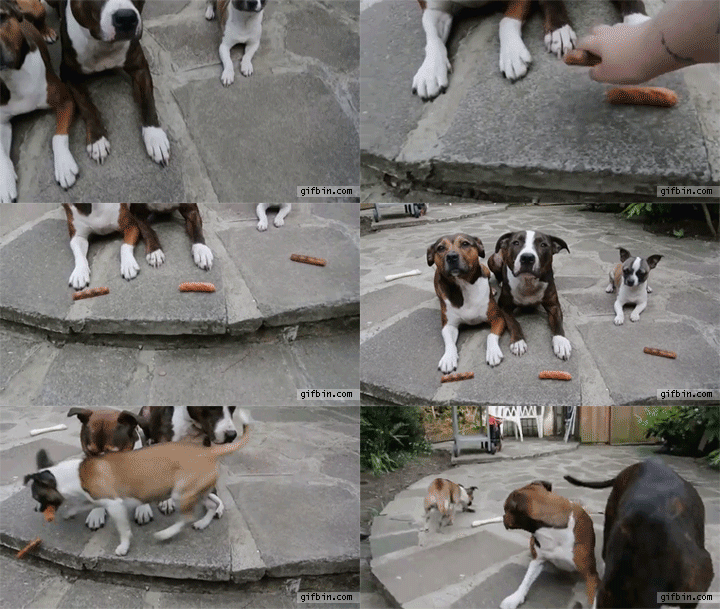
  2. Chihuahua takes all the sausages

    Comment

    The Chihuahua is the Smallest Breed of Dog in the World. The Chihuahua has one of the largest color combinations of any breed. Chihuahuas can come in virtually any color combination. The color varieties are as big as you can imagine. Their hair also comes in long, short or mid-coat. It can be wiry or silky, and can be single coat or double coat. The Chihuahua has one of the longest lifespans. It has an average lifespan of 10 – 18 years. With many Chihuahuas living well over 20 years old. Toy breeds generally live longer than larger breeds. Source: Totally Chihuahuas

  3. Generate more light than heat

    Comment

    I looked at the rising Sun and asked, “What have you to teach me today?” I heard a voice which said, “Always generate more light than heat” All mornings are like Paintings. You need a little inspiration to get going, a little smile to brighten up and SMS from someone like me to color your day. ~Santabanta sms

  4. Kitty is very tired

    Comment

    If your cat’s eyes are closed, it’s not necessarily because it’s tired. A sign of closed eyes means your cat is happy or pleased. A cat’s field of vision does not cover the area right under its nose. Want to call a hairball by its scientific name? Next time, say the word “bezoar.” Source: AnimalPlanet


  5. The loneliest thing in the World

    Comment

    Being surrounded by wrong people is the loneliest thing in the World. Being alone is a state of being that no one wants to be in. It is easy to get caught up feeling sad and detached from the rest of the world, but one must realize that they have to use times of loneliness to build their relationships with God, and also to build upon the foundation that is considered their life.

    Don’t take being alone as a bad thing, for times of loneliness are actually good times, times in which a person can focus on strengthening their own mind to push their selves towards their own dreams and desires. Alone isn’t always lonely, sometimes it may be, but most times alone is just a season in our lives, a season in which we must focus on building, or rebuilding, a season in which we have to work on the fight inside of ourselves so that we may soon take it to the rest of the world. ~By J. Johnson

  6. Many dogs love car rides

    Comment

    Many dogs love car rides. Be sure to keep your dog secured with a seat belt or other safety device. Dogs are creatures of habit. They like familiarity and form expectations and schedules. Dogs can know you as much by scent as by eyesight (if not more!), and you can help them feel secure when you leave by providing a soft object that has your scent on it. (A sweatshirt or blanket you sleep with). Source: The Dog Guide

  7. Do our best to let it go

    Comment

    As we go through life, and we learn more from our experiences, it is impossible to avoid the lessons that pain will bring. The key to overcoming the pain in your life is to realize that though pain is something that is inevitably a part of life, we have the choice of whether we are going to wallow in it and suffer, or move on from it, and do our best to let it go.

    Our lives are much too short to just focus on the hurtful times, and instead we should make great attempts to stay on the path towards greatness and reaching our dreams despite how much pain we may be in. Eventually the pain of your present will diminish, and if you waste time by not continuing to move forward you will be set back much further than you would have if you would of just worked through it. So hold on, be strong; keep pushing through the rough patches in life, because eventually pain ends. ~By J. Johnson

  8. To all the beautiful girls

    Comment

    To all the girls who don’t have a special person
    to send them a ‘good night’ text.
    ‘Good night. Beautiful and sweet dreams.’

    ~Unknown

  9. Samma Samadhi – Detachment Within Activity

    Comment

    Jendhamuni with mom 060315

    A Dhammatalk by Ajahn Chah

    Take a look at the example of the Buddha. Both in his own practice and in his methods for teaching the disciples he was exemplary. The Buddha taught the standards of practice as skillful means for getting rid of conceit, he couldn’t do the practice for us. Having heard that teaching we must further teach ourselves, practice for ourselves. The results will arise here, not at the teaching.

    The Buddha’s teaching can only enable us to get an initial understanding of the Dhamma, but the Dhamma is not yet within our hearts. Why not? Because we haven’t yet practiced, we haven’t yet taught ourselves. The Dhamma arises at the practice. If you know it, you know it through the practice. If you doubt it, you doubt it at the practice. Teachings from the Masters may be true, but simply listening to Dhamma is not yet enough to enable us to realize it. The teaching simply points out the way to realize. To realize the Dhamma we must take that teaching and bring it into our hearts. That part which is for the body we apply to the body, that part which is for the speech we apply to the speech, and that part which is for the mind we apply to the mind. This means that after hearing the teaching we must further teach ourselves to know that Dhamma, to be that Dhamma.

    The Buddha said that those who simply believe others are not truly wise. A wise person practices until he is one with the Dhamma, until he can have confidence in himself, independent of others.

    On one occasion, while Venerable Sāriputta was sitting, listening respectfully at his feet as the Buddha expounded the Dhamma, the Buddha turned to him and asked,

    ”Sāriputta, do you believe this teaching?”

    Venerable Sāriputta replied, ”No, I don’t yet believe it.”

    Now this is a good illustration. Venerable Sāriputta listened, and he took note. When he said he didn’t yet believe he wasn’t being careless, he was speaking the truth. He simply took note of that teaching, because he had not yet developed his own understanding of it, so he told the Buddha that he didn’t yet believe – because he really didn’t believe. These words almost sound as if VenerableSāriputta was being rude, but actually he wasn’t. He spoke the truth, and the Buddha praised him for it.

    ”Good, good, Sāriputta. A wise person doesn’t readily believe, he should consider first before believing.”

    Conviction in a belief can take various forms. One form reasons according to Dhamma, while another form is contrary to the Dhamma. This second way is heedless, it is a foolhardy understanding, micchā-ditthi, wrong view. One doesn’t listen to anybody else.

    Take the example of Dīghanakha the Brahman. This Brahman only believed himself, he wouldn’t believe others. At one time when the Buddha was resting at Rājagaha, Dīghanakha went to listen to his teaching. Or you might say that Dīghanakha went to teach the Buddha because he was intent on expounding his own views…

    ”I am of the view that nothing suits me.”

    This was his view. The Buddha listened to Dīghanakha’s view and then answered,

    ”Brahman, this view of yours doesn’t suit you either.”

    When the Buddha had answered in this way, Dīghanakha was stumped. He didn’t know what to say. The Buddha explained in many ways, till the Brahman understood. He stopped to reflect and saw….

    ”Hmm, this view of mine isn’t right.” Continue reading

  10. The Training of the Heart

    Comment

    White buddha

    A Dhamma talk by Ajahn Chah

    In the time of Ajahn Mu and Ajahn Sao life was a lot simpler, a lot less complicated than it is today. In those days monks had few duties and ceremonies to perform. They lived in the forests without permanent resting places. There they could devote themselves entirely to the practice of meditation.

    In those times one rarely encountered the luxuries that are so commonplace today, there simply weren’t any. One had to make drinking cups and spittoons out of bamboo and lay people seldom came to visit. One didn’t want or expect much and was content with what one had. One could live and breathe meditation!

    The monks suffered many privations living like this. If someone caught malaria and went to ask for medicine, the teacher would say, ”You don’t need medicine! Keep practicing”. Besides, there simply weren’t all the drugs that are available now. All one had were the herbs and roots that grew in the forest. The environment was such that monks had to have a great deal of patience and endurance; they didn’t bother over minor ailments. Nowadays you get a bit of an ache and you’re off to the hospital!

    Sometimes one had to walk ten to twelve kilometers on alms round. You would leave as soon as it was light and maybe return around ten or eleven o’clock. One didn’t get very much either, perhaps some glutinous rice, salt or a few chilis. Whether you got anything to eat with the rice or not didn’t matter. That’s the way it was. No one dared complain of hunger or fatigue; they were just not inclined to complain but learned to take care of themselves. They practiced in the forest with patience and endurance alongside the many dangers that lurked in the surroundings. There were many wild and fierce animals living in the jungles and there were many hardships for body and mind in the ascetic practice of the dhutanga or forest-dwelling monk. Indeed, the patience and endurance of the monks in those days was excellent because the circumstances compelled them to be so.

    In the present day, circumstances compel us in the opposite direction. In ancient times, one had to travel by foot; then came the oxcart and then the automobile. Aspiration and ambition increased, so that now, if the car is not air-conditioned, one will not even sit in it; impossible to go if there is no air-conditioning! The virtues of patience and endurance are becoming weaker and weaker. The standards for meditation and practice are lax and getting laxer, until we find that meditators these days like to follow their own opinions and desires. When the old folks talk about the old days, it’s like listening to a myth or a legend. You just listen indifferently, but you don’t understand. It just doesn’t reach you!

    As far as we should be concerned about the ancient monks’ tradition, a monk should spend at least five years with his teacher. Some days you should avoid speaking to anyone. Don’t allow yourself to speak or talk very much. Don’t read books! Read your own heart instead. Take Wat Pah Pong for example. These days many university graduates are coming to ordain. I try to stop them from spending their time reading books about Dhamma, because these people are always reading books. They have so many opportunities for reading books, but opportunities for reading their own hearts are rare. So, when they come to ordain for three months following the Thai custom, we try to get them to close their books and manuals. While they are ordained they have this splendid opportunity to read their own hearts.

    Listening to your own heart is really very interesting. This untrained heart races around following its own untrained habits. It jumps about excitedly, randomly, because it has never been trained. Therefore train your heart! Buddhist meditation is about the heart; to develop the heart or mind, to develop your own heart. This is very, very important. This training of the heart is the main emphasis. Buddhism is the religion of the heart. Only this! One who practices to develop the heart is one who practices Buddhism. Continue reading

Hermit of Tbeng Mountain

Sachjang Phnom Tbeng សច្ចំ​​ ភ្នំត្បែង is a very long and interesting story written by Mr. Chhea Sokoan, read by Jendhamuni Sos. You can click on the links below to listen. Part 1 | Part 2

List of Khmer songs