

1. Yard long beans nutrition facts
    Comment

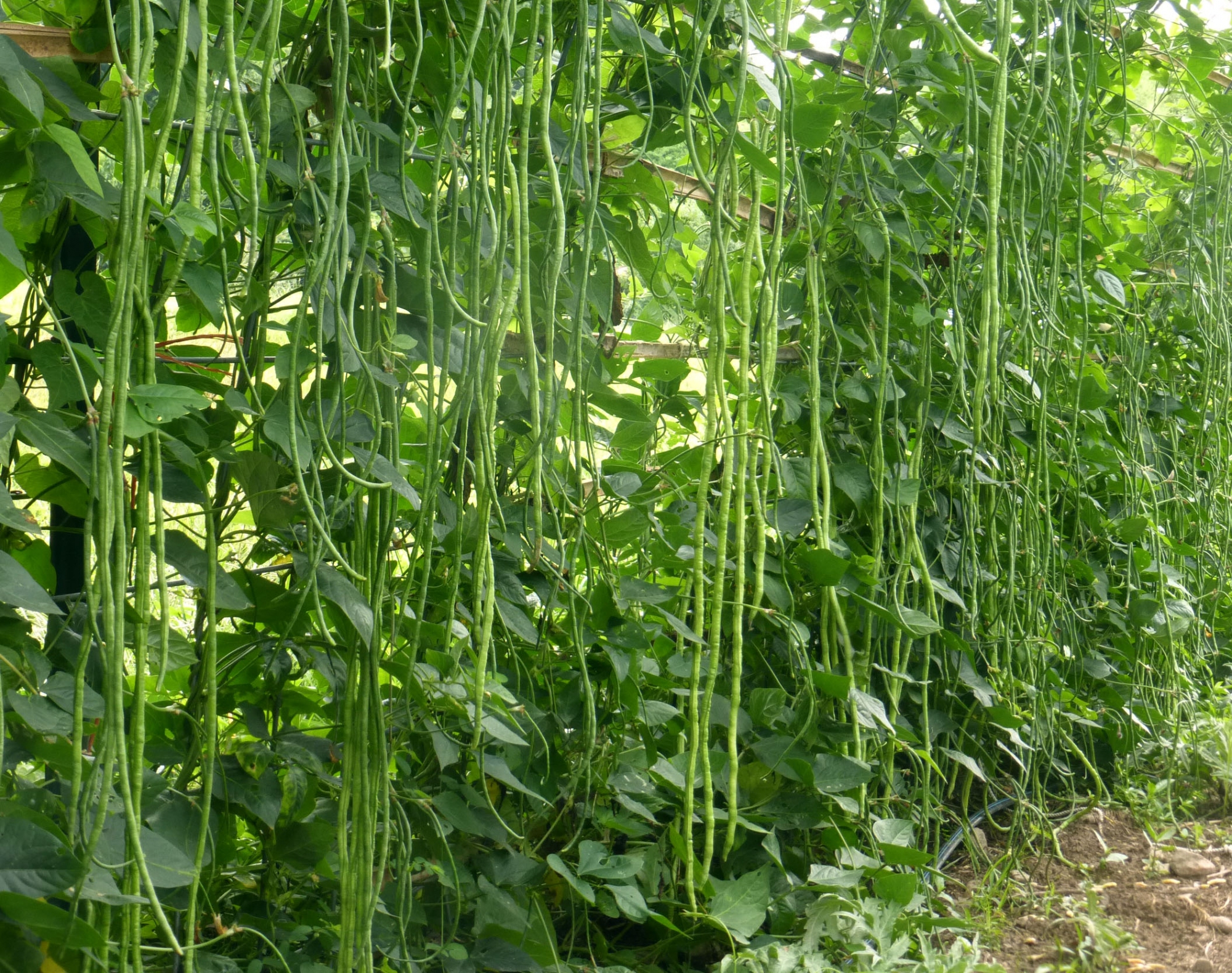
    Chewy and flavorful yard long beans, also known as Chinese snake beans, are closely related to black-eyed peas. Its immature, tender, edible pods are one of the most popular pod-vegetables used in the Philippines and other East Asian cuisines. The beans are also grown in small scales in the home gardens in Southern United states, West-Indies as well as in the Mediterranean regions.

    The yard long pods are actually legumes belonging to the Fabaceae family. The beans were thought to have originated in southern Chinese Yunnan province. Scientific name: Vigna unguiculata, sub. sesquipedalis. Some of the common names include asparagus-bean, string-bean or Chinese snake beans. The beans in general recognized by local names as bora (West Indies), dau gok (China), pole sitao (Philippines), etc.

    Yard-long bean is a fast growing annual plant; require trellis to support its growth. Dwarf and tall climbing varieties exist. Depending upon the cultivar type, it bears blue to violet flowers after about 6-10 weeks of seedling. Numerous pencil thin, tender, light-green, flexible-textured pods appear after about another two to four weeks following flowering. These fleshy, pendulous pods are usually harvested while they are immature and eaten as green vegetables. The pods vary in length that ranges from 30 to 80 cm.

    As in other bean varieties, harvesting may not be a time-guided event. The pods usually harvested early for young, immature beans, or they may left on the shrub to dry-out in order to obtain dried beans. Continue reading

  2. Kitty yawning

    Comment

    Have you ever watched a cat yawn? His mouth opens so wide, you can count every tooth. It has been estimated that a cat yawns on the average of 109,500 times in his life. Lots of animals yawn. Humans yawn; the earliest yawn often occurs 11 weeks after conception – that’s before the baby is born. The yawn becomes contagious somewhere in the first five years of life. Chimpanzees and apes yawn, and they yawn infectiously just like us. Fish and birds also yawn. ~Virginia Wells, PetPlace

  3. Happiness — the key to life

    Comment

    When I was 5 years old, my mother always told me that happiness was the key to life. When I went to school, they asked me what I wanted to be when I grew up. I wrote down ‘happy’. They told me I didn’t understand the assignment, and I told them they didn’t understand life. ~John Lennon

  4. Love without trust is not yet love

    Comment

    When you love someone, you have to have trust and confidence. Love without trust is not yet love. Of course, first you have to have trust, respect, and confidence in yourself. Trust that you have a good and compassionate nature. You are part of the universe; you are made of stars. When you look at your loved one, you see that he is also made of stars and carries eternity inside. Looking in this way, we naturally feel reverence. True love cannot be without trust and respect for oneself and for the other person. ~Thich Nhat Hanh

    Jendhamuni outside class 080915


  5. Love without knowing

    Comment

    To love without knowing how to love wounds the person we love. To know how to love someone, we have to understand them. To understand, we need to listen. When you love someone, you should have the capacity to bring relief and help him to suffer less. This is an art. If you don’t understand the roots of his suffering, you can’t help, just as a doctor can’t help heal your illness if she doesn’t know the cause. You need to understand the cause of your loved one’s suffering in order to help bring relief. ~Thich Nhat Hanh

    red rose animation

  6. Nourishing our ability to love

    Comment

    When we feed and support our own happiness, we are nourishing our ability to love. That’s why to love means to learn the art of nourishing our happiness. Understanding someone’s suffering is the best gift you can give another person. Understanding is love’s other name. If you don’t understand, you can’t love. ~Thich Nhat Hanh

    water reflection

  7. The story of Kisa Gautami

    Comment
    Mother of dead child072715

    Kisa Gautami carried the dead child to the Buddha and told Him her sad story.

    Kisa Gautami was a young woman from a wealthy family who was happily married to an important merchant. When her only son was one-year-old, he fell ill and died suddenly. Kisa Gautami was struck with grief, she could not bare the death of her only child. Weeping and groaning, she took her dead baby in her arms and went from house to house begging all the people in the town for news of a way to bring her son back to life.

    Of course, nobody could help her but Kisa Gautami would not give up. Finally she came across a Buddhist who advised her to go and see the Buddha himself.

    When she carried the dead child to the Buddha and told Him her sad story, He listened with patience and compassion, and then said to her, “Kisa Gautami, there is only one way to solve your problem. Go and find me four or five mustard seeds from any family in which there has never been a death.”

    Kisa Gautami was filled with hope, and set off straight away to find such a household. But very soon she discovered that every family she visited had experienced the death of one person or another. At last, she understood what the Buddha had wanted her to find out for herself — that suffering is a part of life, and death comes to us all. Once Kisa Guatami accepted the fact that death is inevitable, she could stop her grieving. She took the child’s body away and later returned to the Buddha to become one of His followers.

    Source: Buddhanet  |  Link source


  8. Grief isn’t the answer

    Comment

    Through all those times I lived in sorrows, I learned that grief isn’t the answer, but staying happy is what keeps life going.  ~Simphiwe Scientist Dumi

Hermit of Tbeng Mountain

Sachjang Phnom Tbeng សច្ចំ​​ ភ្នំត្បែង is a very long and interesting story written by Mr. Chhea Sokoan, read by Jendhamuni Sos. You can click on the links below to listen. Part 1 | Part 2

List of Khmer songs