

Redemption and Forgiveness
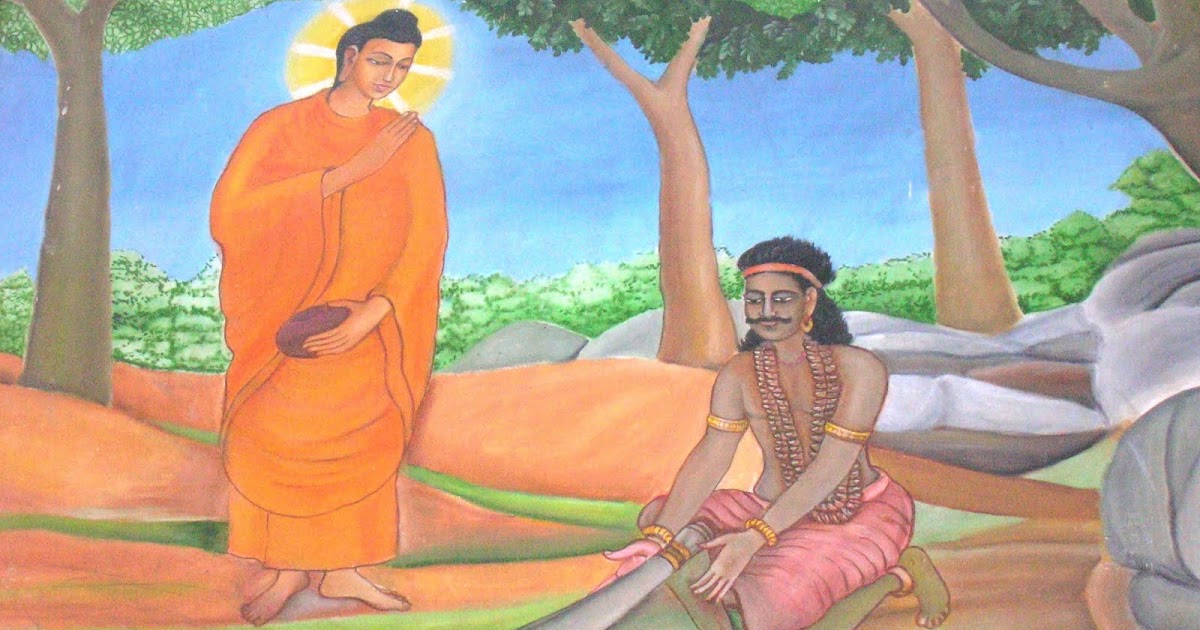
Buddha and Angulimala
by Jack Kornfield
Milarepa, the most famous saint in the Himalayas, was a Tibetan youth whose family was terribly abused by relatives after his father died. As a result, Milarepa was urged by his mother to study black magic and take revenge on those who had mistreated them. With yogic powers he killed many of them. But afterward, Milarepa was filled with fear and remorse and sought out a Buddhist teacher to help him release his bad karma. Through years of extreme penance and a series of harrowing trials, Milarepa atoned for his terrible past. Then Milarepa dedicated his life to awakening and spent years teaching and caring for others. The story of his redemption is the most celebrated myth in all of Tibetan Buddhism.
In the same way, redemption transformed the worst killer of the Buddha’s era, Angulimala. Indian astrologers said Angulimala was born under a robber star. Through the jealousy and lies of those around him, Angulimala was convinced that his religious duty required him to kill a thousand innocent people. Living in the thick Jalini forest, he became the most feared figure of his day, a swordsman who could run as fast as a swift horse.
The Buddha deliberately went wandering there, even though others warned him not to go. When Angulimala chased the Buddha, magic powers thwarted him. “Stop! Stop!” shouted Angulimala. The Buddha responded, “I have stopped, I have stopped all harm to living beings.” Somehow the Buddha’s fearlessness was enough to break the spell of misguided destruction. Then the Buddha demanded that Angulimala cut off the limb of a tree. When the limb was cut, the Buddha said, “Now put it back.” When Angulimala acknowledged that he was helpless to do so, the Buddha explained, “Your power is so limited, it can only destroy life. What about the power to preserve life?” Angulimala then threw away his sword to become a monk and eventually a respected disciple of the Buddha. Like Milarepa, Angulimala is now widely venerated as a saint. The great popularity of these stories speaks to the universal need for redemption, to reclaim our nobility. Continue reading