1. You cannot entertain ten hours a day

    Comment

    You can not entertain weak, harmful, negative thoughts ten hours a day and expect to bring about beautiful, strong and harmonious conditions by ten minutes of strong, positive, creative thought. ― Charles F. Haanel

  2. Each morning when I open my eyes

    Comment

    Each morning when I open my eyes I say to myself: I, not events, have the power to make me happy or unhappy today. I can choose which it shall be. Yesterday is dead, tomorrow hasn’t arrived yet. I have just one day, today, and I’m going to be happy in it. ~ Groucho Marx

    yellow leaves floating in a creek

  3. If I keep on saying to myself

    Comment

    Man often becomes what he believes himself to be. If I keep on saying to myself that I cannot do a certain thing, it is possible that I may end by really becoming incapable of doing it. On the contrary, if I have the belief that I can do it, I shall surely acquire the capacity to do it even if I may not have it at the beginning.” ~ Mahatma Gandhi

    blue flower animation

  4. Create a life worth living, a noble life

    Comment

    We can’t escape pain; we can’t escape the essential nature of our lives. But we do have a choice. We can give in and relent, or we can fight, persevere, and create a life worth living, a noble life. Pain is a fact; our evaluation of it is a choice. ~ Jacob Held

    Leaf in Stream

  5. Cinca-Manavika making a false accusation against the Buddha

    Comment

    Cinca-Manavika, a female ascetic, making a false accusation against the Buddha

    40. Cinca-Manavika, a female ascetic, making a false accusation against the Buddha

    There dwelt in Savatthi city, a female ascetic called Cinca-manavika, who was as pretty as a goddess. The heretical teachers, who did not get enough alms and were envious of the Buddha attempted to destroy His reputation by setting her to make a false accusation against Him. She wrapped a scarlet shawl round her and pretended to pay visits to the Buddha at Jetavana Monastery at nightfall, though, as a matter of fact, she slept at the monastery of the heretical teachers, and at day break she entered the city as if she was coming back from the Buddha at Jetavana Monastery. In this way she caused doubts to arise in the minds of devotees returning in the evening from the monastery after hearing a sermon from the Buddha, and those who were going there early in the morning to pay their respects to the Buddha. After a period of about nine months she placed a wooden knob against her stomach and tied it with an apron round her body to make it appear that she was big with child. Then she approached the Buddha who was preaching and made a false and wicked accusation thus: “Why have you not prepared my confinement room?” The gods appeared as mice and bit loose the apron round her body, when the knob of wood fell before the audience, and she was given a sound beating and driven away.

    THE ILLUSTRATED HISTORY OF BUDDHISM
    by ASHIN JANAKA BHIVAMSA (Aggamahapandita)
    Artist: U Ba Kyi | Link to this post

  6. It’s a habit…

    Comment

    Being miserable is a habit; being happy is a habit; and the choice is yours. ~ Tom Hopkins

    meadow-flowers-swaying-win-wind-animated

  7. Human Energy

    51

    When I give light
    I also receive,
    When I smile
    I give light to others,
    they give light to me.

    It is with the light
    all of us give, all,
    that we are free.

    ~Hugh Brown, gr 4, Red Wing, M

  8. Like a Moon

    61

    If you light a lamp for somebody, it will also brighten your path. ~Gautama Buddha

  9. Control your mind

    Comment

    waterfall

    Man’s mind influences his body profoundly. The mind has just as much potential to be a medication as it has to be a poison. When the mind is vicious, it can kill a being but when it is steady and diligent it can benefit others. When the mind is concentrated on right thoughts, and supported by right effort and understanding, the effect it produces is immense. A mind with pure and wholesome thoughts leads to healthy relaxed living.

    The Buddha says: “No enemy can harm one so much as one’s own thoughts of craving, thoughts of hate, thoughts of jalousy and so on”.

    A man who does not know how to adjust his mind according to circumstances is as if dead. Turn your mind inwards, and try to find pleasure within yourself.

    It is only when the mind is controlled and properly directed that it becomes useful to its owner and society. An unruly mind is a liability both to its

    owner and to others. All the havoc wrought in this world is the creation of men who have not learned the way of mind control, balance and poise.

    Calmness is not weakness. A calm attitude at all times shows a man of culture. It is not too hard for one to be calm when things are favourable, but to be composed when things are wrong is hard indeed. It is this difficult quality that is worth achieving, for by exercing such calm and control, a man builds strength of character.

    ~by Venerable K. Sri Dhammananda

  10. Angulimala reciting a Paritta blessing

    Comment

    Angulimala reciting a Paritta blessing for a woman in the throes of childbirth

    39. Angulimala reciting a Paritta blessing for a woman in the throes of childbirth

    Angulimala led a peaceful life after he had become a monk. But most of the people were still scared of him and dared not approach him on his alms-round. He therefore found it difficult to get enough food for his meals. One day as he went on his alms-round, he saw a woman in the throes of childbirth. Moved by compassion, he reported this pathetic case to the Buddha who then taught him the Angulimala Paritta in Pali which means:—” Sister, from the day I was born of the Noble Birth, (i.e., since my Ordination), I have not consciously deprived any living being of life. By this truth may health be to thee and thy unborn child”. He studied this Paritta, and going to the presence of the suffering sister sat on a seat separated from her by a screen and made this asseveration by reciting the Paritta in Pali. Instantly she was delivered of the child with great ease. After that he had enough food on his alms-rounds and was contented and happy.

    THE ILLUSTRATED HISTORY OF BUDDHISM
    by ASHIN JANAKA BHIVAMSA (Aggamahapandita)
    Artist: U Ba Kyi | Link to this post


Live & Die for Buddhism

candle

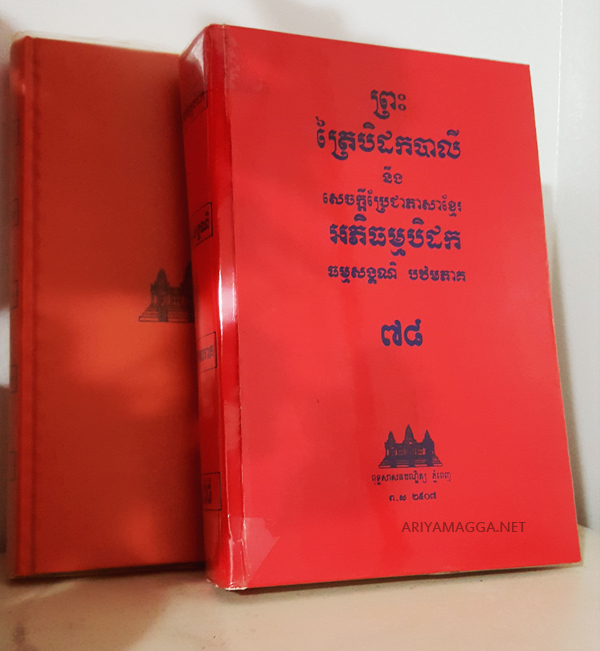
Khmer Tipitaka 1 – 110

 ព្រះត្រៃបិដក

ព្រះត្រៃបិដក ប្រែថា កញ្រ្ចែង ឬ ល្អី​ ៣ សម្រាប់ដាក់ផ្ទុកពាក្យពេចន៍នៃព្រះសម្មាសម្ពុទ្ធ

The Tipitaka or Pali canon, is the collection of primary Pali language texts which form the doctrinal foundation of Theravada Buddhism. The three divisions of the Tipitaka are: Vinaya Pitaka, Sutta Pitaka, Abhidhamma Pitaka.

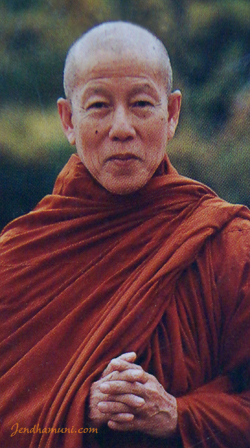
Maha Ghosananda

Maha Ghosananda

Supreme Patriarch of Cambodian Buddhism (5/23/1913 - 3/12/07). Forever in my heart...

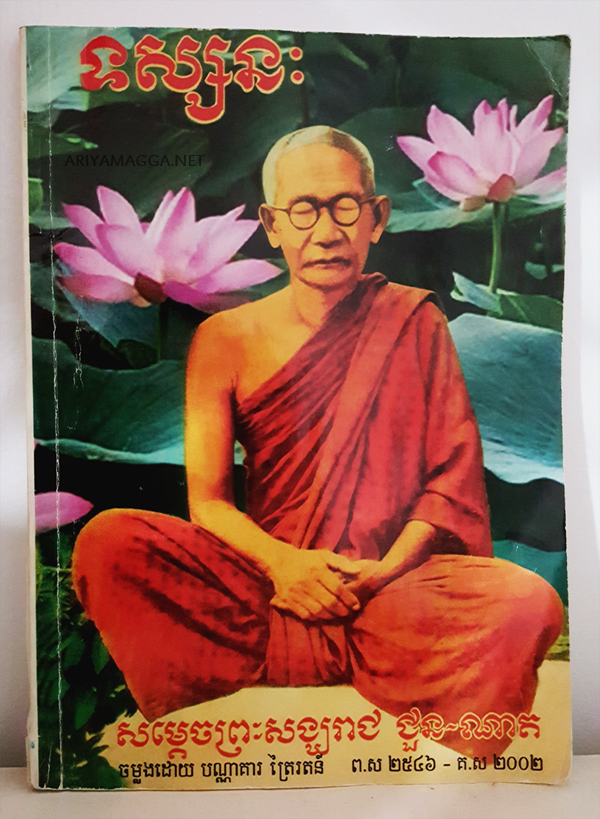
Samdech Chuon Nath

My reflection

វចនានុក្រមសម្តេចសង្ឃ ជួន ណាត
Desktop version

Listen to Khmer literature and Dhamma talk by His Holiness Jotannano Chuon Nath, Supreme Patriarch of Cambodia Buddhism.

Shantidevas’ Bodhisattva vows

My reflection

Should anyone wish to ridicule me and make me an object of jest and scorn why should I possibly care if I have dedicated myself to others?

Let them do as they wish with me so long as it does not harm them. May no one who encounters me ever have an insignificant contact.

Regardless whether those whom I meet respond towards me with anger or faith, may the mere fact of our meeting contribute to the fulfilment of their wishes.

May the slander, harm and all forms of abuse that anyone should direct towards me act as a cause of their enlightenment.

As a solid rock is not shaken by the wind, so the wise are not shaken by blame and praise. As a deep lake is clear and calm, so the wise become tranquil after they listened to the truth…

Good people walk on regardless of what happens to them. Good people do not babble on about their desires. Whether touched by happiness or by sorrow, the wise never appear elated or depressed. ~The Dhammapada

Hermit of Tbeng Mountain

Sachjang Phnom Tbeng សច្ចំ​​ ភ្នំត្បែង is a very long and interesting story written by Mr. Chhea Sokoan, read by Jendhamuni Sos. You can click on the links below to listen. Part 1 | Part 2

Beauty in nature

A beautiful object has no intrinsic quality that is good for the mind, nor an ugly object any intrinsic power to harm it. Beautiful and ugly are just projections of the mind. The ability to cause happiness or suffering is not a property of the outer object itself. For example, the sight of a particular individual can cause happiness to one person and suffering to another. It is the mind that attributes such qualities to the perceived object. — Dilgo Khyentse Rinpoche

Nature is loved by what is best in us. The sky, the mountain, the tree, the animal, give us a delight in and for themselves. — Ralph Waldo Emerson


Our journey for peace
begins today and every day.
Each step is a prayer,
Each step is a meditation,
Each step will build a bridge.

—​​​ Maha Ghosananda