1. Let yourself relax and breathe

    Comment

    You cannot judge the value of a life by its quantity. It is by the joy that you are feeling. The more joyful you are, the longer you live. Let yourself relax and breathe and be free and be joyous, and romp. ~Abraham-Hicks

    Kali and Buddhas relic 041716

    Vipassana master Dejapanno placing the Sacred Relics of Buddha Sakyamuni on Kali’s head.

  2. The amount of joy that you feel

    Comment

    The standard of success in life isn’t the things.
    It isn’t the money or the stuff.
    It is absolutely the amount of joy that you feel. ~Abraham-Hicks

    RFA photo

    RFA photo

  3. Every time you choose

    Comment

    Every time you choose whether or not to fulfill your function, you are really choosing whether or not to be happy. ~A Course In Miracles

    12

    RFA photo

  4. Heaven is a Wonderland

    51

    Heaven is a wonderland
    Where angels dance and play
    And laughter and happiness
    Are the music of the day

    Joy fills the clouds
    Upon which angels roam
    Everyone loves everyone
    No one ever feels alone

    Heaven is mystical, magical
    And beautiful too
    Where angels old and new
    Are watching over me and you.

    Poem title: Heaven Is
    ~The Poetry Pad

  5. Your Look

    69

    Anybody can love your looks, but it’s your personality that makes someone stay with you… ~E.C.I

  6. Your Day

    54

    Life is too short to start your day with broken pieces of yesterday, it will definitely destroy your wonderful today and ruin your great tomorrow. ~Unknown

  7. Sunset and Sunrise

    44

    I love equally
    The rising sun-duty
    And the setting sun-peace

    ~Sri Chinmoy

  8. Don’t Give Up

    63

    Don’t let today’s troubles
    Bring you down,
    Or allow you to question
    Your ability

    Don’t let life’s little obstacles
    Keep you from trying,
    Or become the reason
    For defeat

    Don’t let your fears
    Keep you from dreaming,
    Or from chasing
    your dream

    Don’t give up for any reason
    Believe in yourself,
    And in yourself
    You’ll find strength

    ~The Poetry Pad

  9. The Story of Garahadinna

    Comment

    lotus flower

    Verses 58 – 59: As a sweet-smelling and beautiful lotus flower may grow upon a heap of rubbish thrown on the highway, so also, out of the rubbish heap of beings may appear a disciple of the Buddha, who with his wisdom shines forth far above the blind (ignorant) worldlings.

    1. sankarabhutesu: rubbish heap of beings.

    2. andhabhute puthujjane: blind worldlings. The worldlings are like the blind because they are lacking in knowledge.

    The Story of Garahadinna

    While residing at the Jetavana monastery, the Buddha uttered Verses (58) and (59) of this book, with reference to a rich man named Garahadinna and the miracle of the lotus flowers.

    There were two friends named Sirigutta and Garahadinna in Savatthi. Sirigutta was a follower of the Buddha and Garahadinna was a follower of the Niganthas, the ascetics who were hostile to the Buddhists. At the instance of the Niganthas, Garahadinna often said to Sirigutta, “What benefit do you get by following the Buddha? Come, be a follower of my teachers.” Having been told thus many times, Sirigutta said to Garahadinna, “Tell me, what do your teachers know?” To this, Garahadinna replied that his teachers knew everything; with their great power they knew the past, the present and the future and also the thoughts of others. So, Sirigutta invited the Niganthas to his house for alms-food.

    Sirigutta wanted to find out the truth about the Niganthas, whether they really possessed the power of knowing other people’s thoughts, etc. So he made a long, deep trench and filled it up with excreta and filth. Seats were then placed precariously over the trench; and big empty pots were brought in and covered up with cloth and banana leaves to make them appear as if they were full of rice and curries. When the Niganthas arrived, they were requested to enter one by one, to stand near their respective seats, and to sit down simultaneously. As all of them sat down, the flimsy strings broke and the Niganthas fell into the filthy trench. Then Sirigutta taunted them, “Why don’t you know the past, the present and the future? Why don’t you know the thoughts of others?” All the Niganthas then fled in terror.

    Garahadinna naturally was furious with Sirigutta and refused to talk to him for two weeks. Then, he decided that he would have his revenge on Sirigutta. He pretended that he was no longer angry, and one day asked Sirigutta to invite, on his behalf, the Buddha and his five hundred disciples to partake of alms-food. So Sirigutta went to the Buddha and invited him to the house of Garahadinna. At the same time, he told the Buddha about what he had done to the Niganthas, the teachers of Garahadinna. He also expressed his fear that this invitation might be a reprisal and so the invitation should be accepted only after due consideration.

    The Buddha, with his supernormal power, knew that this would be the occasion for the two friends to attain Sotapatti Fruition, and therefore accepted the invitation. Garahadinna made a trench, filled it with live coals and covered it with mats. He also kept some empty pots covered with cloth and banana leaves to make them appear as if filled with rice and curries. The next day, the Buddha came followed by five hundred bhikkhus in single file. When the Buddha stepped on the mat over the trench, the mat and live coals miraculously disappeared, and five hundred lotus flowers, each as large as a cart wheel, sprang up for the Buddha and his disciples to sit upon.

    Seeing this miracle, Garahadinna was very much alarmed and he said rather incoherently to Sirigutta, “Help me, dear friend. Out of my desire for revenge, I have truly done a great wrong. My bad designs have had no effect at all on your Teacher. The pots in my kitchen are all empty. Please help me.” Sirigutta then told Garahadinna to go and look at the pots. When Garahadinna found all the pots filled with food he was astounded and at the same time very much relieved and very happy. So the food was offered to the Buddha and his disciples. After the meal, the Buddha expressed his appreciation (anumodana) of the meritorious act and then said, “Ignorant worldlings, lacking in knowledge, do not know the unique qualities of the Buddha, the Dhamma and the Samgha and so they are like the blind; but the wise, having knowledge, are like people with sight.”

    Then the Buddha spoke in verse as follows:

    Verses 58 – 59: As a sweet-smelling and beautiful lotus flower may grow upon a heap of rubbish thrown on the highway, so also, out of the rubbish heap of beings may appear a disciple of the Buddha, who with his wisdom shines forth far above the blind (ignorant) worldlings.
    At the end of the discourse, both Garahadinna and Sirigutta attained Sotapatti Fruition.

    End of Chapter Four: Flowers (Pupphavagga)

    Dhammapada Verses 58 and 59
    Garahadinna Vatthu

    Yatha sankaradhanasmim
    ujjhitasmim mahapathe
    padumam tattha jayetha
    sucigandham manoramam.

    Evam sankarabhutesu1
    andhabhute puthujjane2
    atirocati pannaya
    sammasambuddhasavako.

    Source: Tipitaka


Live & Die for Buddhism

candle

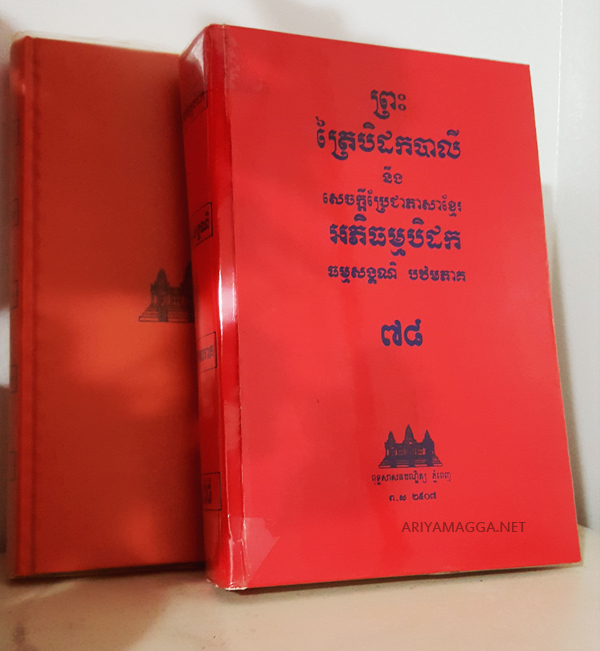
Khmer Tipitaka 1 – 110

 ព្រះត្រៃបិដក

ព្រះត្រៃបិដក ប្រែថា កញ្រ្ចែង ឬ ល្អី​ ៣ សម្រាប់ដាក់ផ្ទុកពាក្យពេចន៍នៃព្រះសម្មាសម្ពុទ្ធ

The Tipitaka or Pali canon, is the collection of primary Pali language texts which form the doctrinal foundation of Theravada Buddhism. The three divisions of the Tipitaka are: Vinaya Pitaka, Sutta Pitaka, Abhidhamma Pitaka.

Maha Ghosananda

Maha Ghosananda

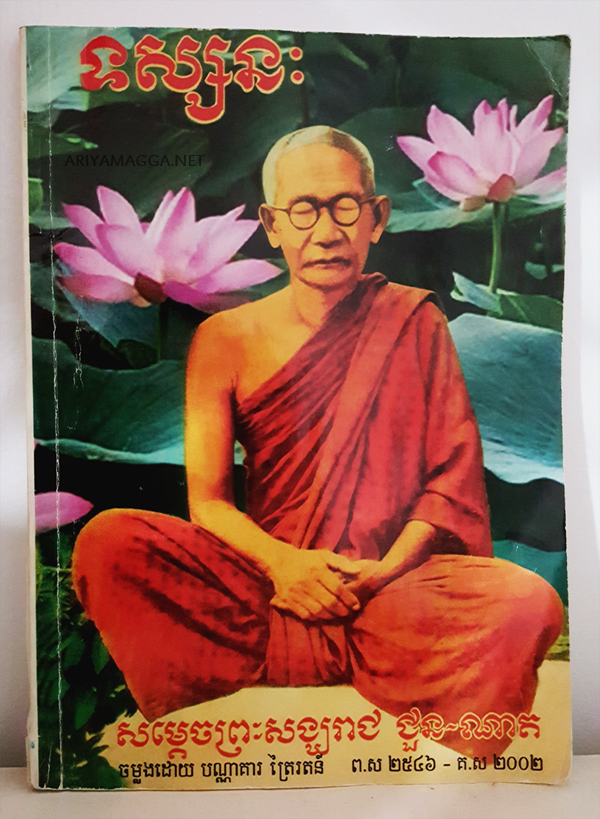
Supreme Patriarch of Cambodian Buddhism (5/23/1913 - 3/12/07). Forever in my heart...

Samdech Chuon Nath

My reflection

វចនានុក្រមសម្តេចសង្ឃ ជួន ណាត
Desktop version

Listen to Khmer literature and Dhamma talk by His Holiness Jotannano Chuon Nath, Supreme Patriarch of Cambodia Buddhism.

Shantidevas’ Bodhisattva vows

My reflection

Should anyone wish to ridicule me and make me an object of jest and scorn why should I possibly care if I have dedicated myself to others?

Let them do as they wish with me so long as it does not harm them. May no one who encounters me ever have an insignificant contact.

Regardless whether those whom I meet respond towards me with anger or faith, may the mere fact of our meeting contribute to the fulfilment of their wishes.

May the slander, harm and all forms of abuse that anyone should direct towards me act as a cause of their enlightenment.

As a solid rock is not shaken by the wind, so the wise are not shaken by blame and praise. As a deep lake is clear and calm, so the wise become tranquil after they listened to the truth…

Good people walk on regardless of what happens to them. Good people do not babble on about their desires. Whether touched by happiness or by sorrow, the wise never appear elated or depressed. ~The Dhammapada

Hermit of Tbeng Mountain

Sachjang Phnom Tbeng សច្ចំ​​ ភ្នំត្បែង is a very long and interesting story written by Mr. Chhea Sokoan, read by Jendhamuni Sos. You can click on the links below to listen. Part 1 | Part 2

Beauty in nature

A beautiful object has no intrinsic quality that is good for the mind, nor an ugly object any intrinsic power to harm it. Beautiful and ugly are just projections of the mind. The ability to cause happiness or suffering is not a property of the outer object itself. For example, the sight of a particular individual can cause happiness to one person and suffering to another. It is the mind that attributes such qualities to the perceived object. — Dilgo Khyentse Rinpoche

Nature is loved by what is best in us. The sky, the mountain, the tree, the animal, give us a delight in and for themselves. — Ralph Waldo Emerson


Our journey for peace
begins today and every day.
Each step is a prayer,
Each step is a meditation,
Each step will build a bridge.

—​​​ Maha Ghosananda