1. A Gift of Dhamma

    Comment

    What is Dhamma? Dhamma is that which can cut through the problems and difficulties of mankind, gradually reducing them to nothing. That’s what is called Dhamma and that’s what should be studied throughout our daily lives so that when some mental impression arises in us, we’ll be able to deal with it and go beyond it.

    Problems are common to us all whether living here in Thailand or in other countries. If we don’t know how to solve them, we’ll always be subject to suffering and distress. That which solves problems is wisdom and to have wisdom we must develop and train the mind.

    The subject of practice isn’t far away at all, it’s right here in our body and mind. Westerners and Thais are the same, they both have a body and mind. A confused body and mind means a confused person and a peaceful body and mind, a peaceful person.

    Photo credit: Randy Neufeldt

    Actually, the mind, like rain water, is pure in its natural state. If we were to drop green coloring into clear rain water, however, it would turn green. If yellow coloring it would turn yellow.

    The mind reacts similarly. When a comfortable mental impression “drops” into the mind, the mind is comfortable. When the mental impression is uncomfortable, the mind is uncomfortable. The mind becomes “cloudy” just like the colored water.

    When clear water contacts yellow, it turns yellow. When it contacts green, it turns green. It will change color every time. Actually, that water which is green or yellow is naturally clean and clear. This is also the natural state of the mind, clean and pure and unconfused. It becomes confused only because it pursues mental impressions; it gets lost in its moods! ~Ajahn Chah

  2. Garden of Happiness

    50

    Cheerfulness removes the rust from the mind, lubricates our inward machinery, and enables us to do our work with fewer creaks and groans.  If people were universally cheerful, there wouldn’t be half the quarreling or a tenth part of the wickedness there is.  Cheerfulness, too, promotes health and morality.  Cheerful people live longest here on earth, afterward in our hearts. ~ Author Unknown

  3. The Story of Thera Cittahattha

    Comment

    Verse 38: If a man’s mind is unsteady, if he is ignorant of the true Dhamma, and if his faith is wavering, then his knowledge will never be perfect.

    Verse 39: If a man’s mind is free from passion, if he is free from ill will, if he has abandoned both good and evil, and if he is vigilant, for such a man there is no danger.

    The Story of Thera Cittahattha

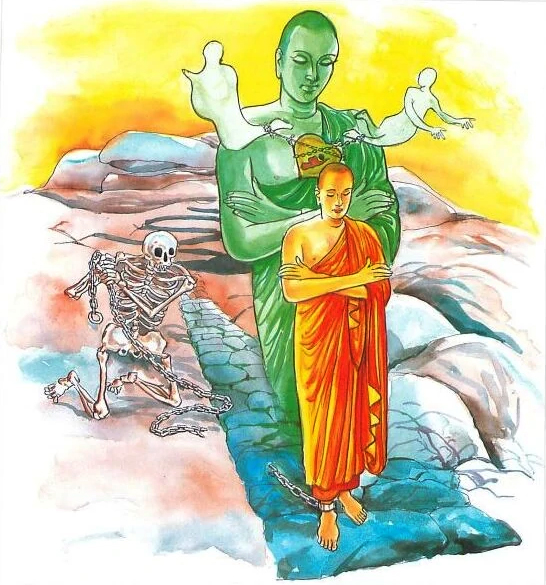
    While residing at the Jetavana monastery, the Buddha uttered Verses (38) and (39) of this book, with reference to Thera Cittahattha.

    A man from Savatthi, after looking for his lost ox in the forest, felt very hungry and went to a village monastery, where he was given the remains of the morning meal. While taking his food, it occurred to him that even though he worked hard every day he could not get such good food and that it might be a good idea to become a bhikkhu. So he asked the bhikkhus to admit him into the Order. At the monastery, he performed the duties of a bhikkhu and as there was plenty of food he soon gained weight. After some time, he got weary of going round for alms-food and returned to the life of a lay man. A few days later, he felt that life at home was too strenuous and he went back to the monastery to be admitted as a bhikkhu for a second time. For a second time, he left the Order and returned to home-life. Again, he went back to the monastery for a third time and left it. This shuttling process went on for six times, and because he acted only according to his whims he was known as Thera Cittahattha.

    While he was going back and forth between his home and the monastery, his wife became pregnant. One day, during his last stay at home, he happened to enter the bedroom while his wife was asleep. She was almost naked as the clothes she was wearing had partially fallen off. She was also snoring loudly through her nose and mouth and saliva was trickling down her mouth. Thus, with her mouth open and her bloated stomach, she looked just like a corpse. Seeing her thus, he instantly came to perceive the impermanent and unpleasant nature of the body, and he reflected, “I have been a bhikkhu for several times and it is only because of this woman that I have not been able to remain as a bhikkhu.” Hence, taking the yellow robe with him he left his home for the monastery for the seventh time. As he went along he repeated the words “impermanence” and “unpleasantness” (anicca and dukkha) and thus attained Sotapatti Fruition on the way to the monastery. Continue reading

  4. Be the kind of person you Admire and Respect

    38

    You cannot change the world,
    But you can present the world with
    one improved person – Yourself.
    You can go to work on yourself to make yourself
    Into the kind of person you admire and respect.
    You can become a role model and set a standard for others.
    You can control and discipline yourself to resist acting
    Or speaking in a negative way
    Toward anyone for any reason.
    You can insist upon always doing things the loving way,
    Rather than the hurtful way.
    By doing these things each day,
    You can continue on your journey
    Toward becoming an exceptional human being.

    Poem title: Change Your World
    Written by Brian Tracy

  5. If it is truthful and helpful

    Comment

    If it is not truthful and not helpful, don’t say it.
    If it is truthful and not helpful, don’t say it.
    If it is not truthful yet helpful, don’t say it.
    If it is truthful and helpful, wait for the right time.

    ~ Buddha

  6. Strengthening the mind

    Comment

    Strengthening the mind is not done by making it move around as is done to strengthen the body, but by bringing the mind to a halt, bringing it to rest. ~Ajahn Chah

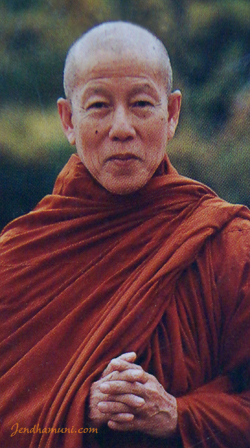
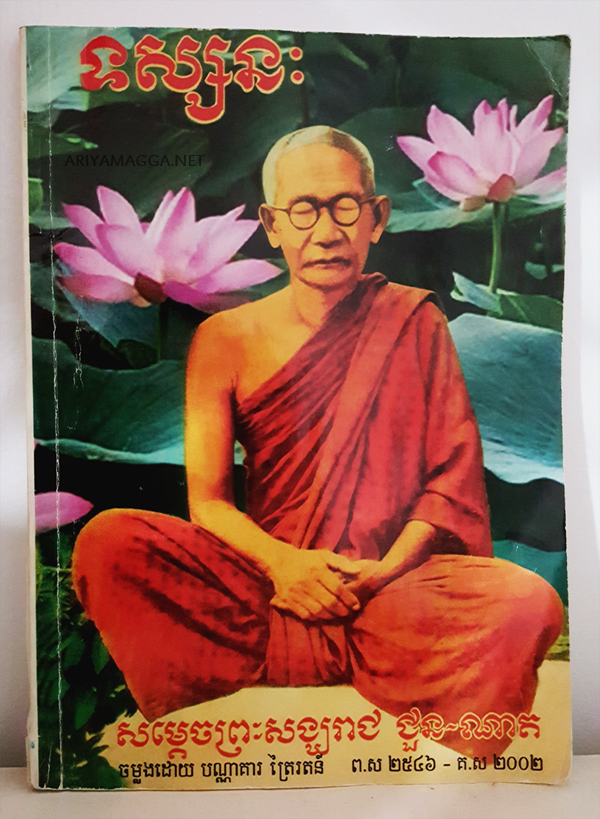
    His Holiness Jotannano Chuon Nath, Supreme Patriarch of Cambodia Buddhism [March 11, 1883 – September 25, 1969].

  7. Yourself

    Comment

    Love yourself and watch –
    Today, tomorrow, always.

    First establish yourself in the way,
    Then teach,
    And so defeat sorrow.

    To straighten the crooked
    You must first be a harder thing –
    Straighten yourself.

    You are the only master.
    Who else?
    Subdue yourself,
    And discover your master.

    Willfully you have fed
    Your own mischief.
    Soon it will crush you.

    By your own folly
    You will be brought as low
    As your worst enemy wishes.
    So the creeper chokes the tree.

    How hard it is to serve yourself,
    How easy to lose yourself
    In mischief and folly.

    The kashta reed dies when it bears fruit.
    So the fool,
    Scorning the teachings of the awakened,
    Spurning those who follow the law,
    Perishes when his folly flowers.

    Mischief is yours.
    Sorrow is yours.
    But virtue is also yours,
    And purity.

    You are the source
    Of all purity and impurity.

    No one purifies another.

    Never neglect your work
    For another’s,
    However great his need.

    Your work is to discover your work
    And then with all your heart
    To give yourself to it.

    ~The Dhamapada


  8. Where does rain come from?

    Comment

    It comes from all the dirty water that evaporates from the earth, like urine and the water you throw out after washing your feet. Isn’t it wonderful how the sky can take that dirty water and change it into pure, clean water? Your mind can do the same with your defilements if you let it. ~Ajahn Chah

    Buddha statues

  9. The Story of Thera Samgharakkhita

    Comment

    Verse 37: The mind wanders far and moves about alone: it is non-material; it lies in the cave (chamber) of the heart. Those who control their mind will be free from the bonds of Mara.

    1. ekacaram: walking alone, moves about alone, it means conceiving one thought at a time, i.e., one thought arises only when another ceases.
    2. guhasayam: lit., lying, or sleeping in a cave; mind lies and arises continually in the cave (chamber) of the heart (hadayavatthu), the seat of consciousness.

    The Story of Thera Samgharakkhita

    While residing at the Jetavana monastery, the Buddha uttered Verse (37) of this book, with reference to the nephew of Thera Samgharakkhita.

    Once, there lived in Savatthi, a senior bhikkhu by the name of Samgharakkhita. When his sister gave birth to a son, she named the child after the thera and he came to be known as Samgharakkhita Bhagineyya. The nephew Samgharakkhita, in due course, was admitted into the Order. While the young bhikkhu was staying in a village monastery he was offered two sets of robes, and he intended to offer one to his uncle, the thera.

    At the end of the vassa he went to his uncle to pay respect to him and offered the robe to the thera. But, the uncle declined to accept the robe, saying that he had enough. Although he repeated his request, the thera would not accept. The young bhikkhu felt disheartened and thought that since his uncle was so unwilling to share the requisites with him, it would be better for him to leave the Order and live the life of a layman. Continue reading

  10. Monastery of Confusion

    Comment

    Buddha

    A Dhammatalk by Ajahn Chah

    Staying or going is not important, but our thinking is. So all of you, please work together, cooperate and live in harmony. This should be the legacy you create here at Wat Pah Nanachat Bung Wai, the International Forest Monastery of Bung Wai District. Don’t let it become Wat Pah Nanachat Woon Wai, the International Forest Monastery of Confusion and Trouble. Whoever comes to stay here should be helping create this legacy.

    The way I see it, the lay people are providing robes material, almsfood, the dwelling place, and medicines in appropriate measure. It’s true that they are simple country folk, but they support you out of their faith as best they can. Don’t get carried away with your ideas of how you think they should be, such as, “Oh, I try to teach these lay people, but they do make me upset. Today is the observance day, and they came to take precepts. Then tomorrow they’ll go casting their fishing nets. They’ll drink their whiskey. They do these things right out there where anyone can see. Then the next observance day, they’ll come again. They’ll take the precepts and listen to the Dharma talk again, and then they’ll go to put out their nets again, kill animals again, and drink again.”

    You can get pretty upset thinking like this. You’ll think that your activities with the lay people don’t bring any benefit at all. Today they take the precepts, and tomorrow they go cast the fishing nets. A monk without much wisdom might get discouraged and feel he’s failed, thinking his work bears no fruit. But it’s not that his efforts have no result; it’s those lay people who get no result. Of course there is some good result from making efforts at virtue. So when there is such a situation and we start to suffer over it, what should we do?

    We contemplate within ourselves to recognize that our good intentions have brought some benefit and do have meaning. It’s just that the spiritual faculties of those people aren’t developed. They aren’t strong yet. That’s how it is for now, so we patiently continue to advise them. If we just give up on such people, they are likely to become worse than they are now. If we keep at it, they may come to maturity one day and recognize their unskillful actions. Then they will feel some remorse and start to be ashamed of doing such things.

    Right now, they have the faith to support us with material offerings, giving us our requisites for living. I’ve considered this: it’s quite a big deal. It’s no small thing. Donating our food, our dwellings, the medicines to treat our illnesses, is not a small thing. We are practicing for the attainment of Nibbāna. If we don’t have any food to eat, that will be pretty difficult. How would we sit in meditation? How would we be able to build this monastery? Continue reading


Live & Die for Buddhism

candle

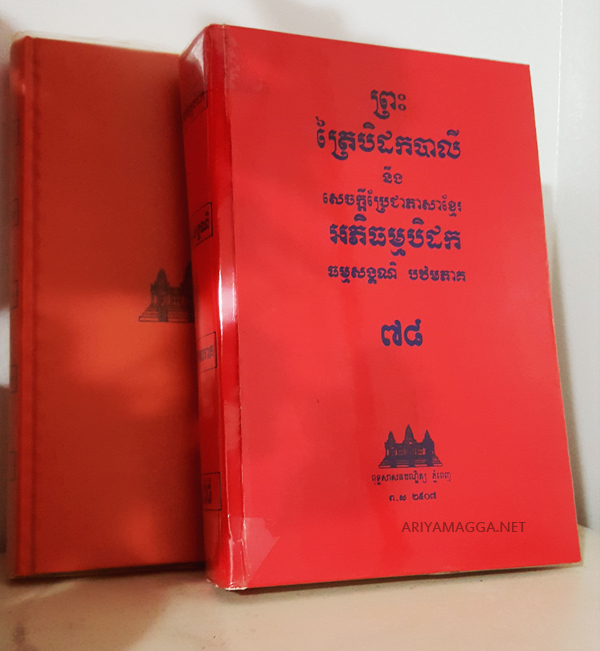
Khmer Tipitaka 1 – 110

 ព្រះត្រៃបិដក

ព្រះត្រៃបិដក ប្រែថា កញ្រ្ចែង ឬ ល្អី​ ៣ សម្រាប់ដាក់ផ្ទុកពាក្យពេចន៍នៃព្រះសម្មាសម្ពុទ្ធ

The Tipitaka or Pali canon, is the collection of primary Pali language texts which form the doctrinal foundation of Theravada Buddhism. The three divisions of the Tipitaka are: Vinaya Pitaka, Sutta Pitaka, Abhidhamma Pitaka.

Maha Ghosananda

Maha Ghosananda

Supreme Patriarch of Cambodian Buddhism (5/23/1913 - 3/12/07). Forever in my heart...

Samdech Chuon Nath

My reflection

វចនានុក្រមសម្តេចសង្ឃ ជួន ណាត
Desktop version

Listen to Khmer literature and Dhamma talk by His Holiness Jotannano Chuon Nath, Supreme Patriarch of Cambodia Buddhism.

Shantidevas’ Bodhisattva vows

My reflection

Should anyone wish to ridicule me and make me an object of jest and scorn why should I possibly care if I have dedicated myself to others?

Let them do as they wish with me so long as it does not harm them. May no one who encounters me ever have an insignificant contact.

Regardless whether those whom I meet respond towards me with anger or faith, may the mere fact of our meeting contribute to the fulfilment of their wishes.

May the slander, harm and all forms of abuse that anyone should direct towards me act as a cause of their enlightenment.

As a solid rock is not shaken by the wind, so the wise are not shaken by blame and praise. As a deep lake is clear and calm, so the wise become tranquil after they listened to the truth…

Good people walk on regardless of what happens to them. Good people do not babble on about their desires. Whether touched by happiness or by sorrow, the wise never appear elated or depressed. ~The Dhammapada

Hermit of Tbeng Mountain

Sachjang Phnom Tbeng សច្ចំ​​ ភ្នំត្បែង is a very long and interesting story written by Mr. Chhea Sokoan, read by Jendhamuni Sos. You can click on the links below to listen. Part 1 | Part 2

Beauty in nature

A beautiful object has no intrinsic quality that is good for the mind, nor an ugly object any intrinsic power to harm it. Beautiful and ugly are just projections of the mind. The ability to cause happiness or suffering is not a property of the outer object itself. For example, the sight of a particular individual can cause happiness to one person and suffering to another. It is the mind that attributes such qualities to the perceived object. — Dilgo Khyentse Rinpoche

Nature is loved by what is best in us. The sky, the mountain, the tree, the animal, give us a delight in and for themselves. — Ralph Waldo Emerson


Our journey for peace
begins today and every day.
Each step is a prayer,
Each step is a meditation,
Each step will build a bridge.

—​​​ Maha Ghosananda