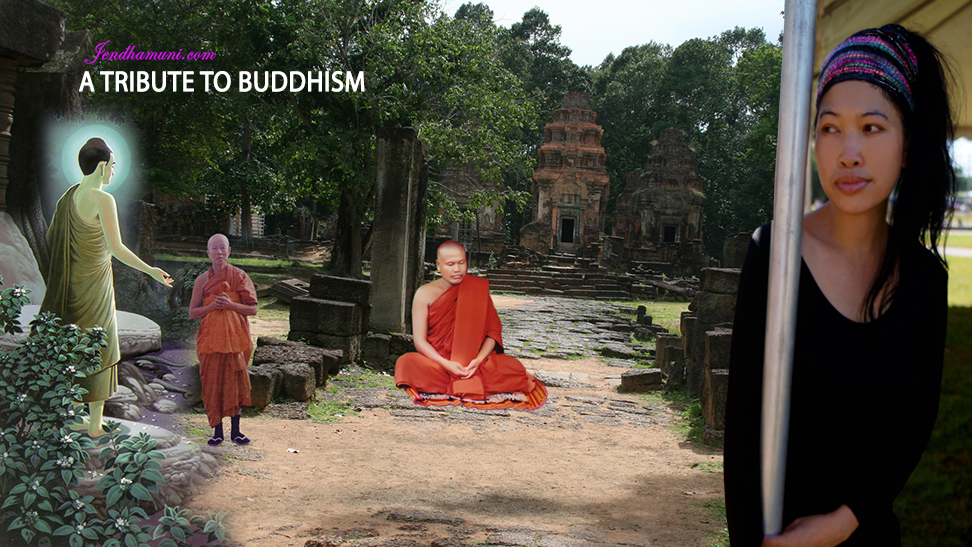
Bring your own sunshine
Comment
January 24, 2016
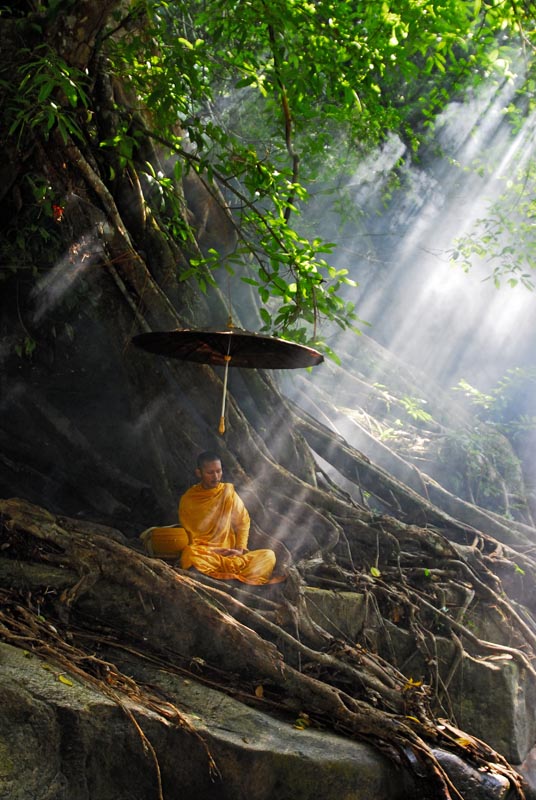
Wherever you go, no matter what the weather, always bring your own sunshine. ~Anthony J. D’Angelo


Wherever you go, no matter what the weather, always bring your own sunshine. ~Anthony J. D’Angelo
In our daily life, we encounter people who are angry, deceitful, intent only on satisfying their own needs. There is so much anger, distrust, greed, and pettiness that we are losing our capacity to work well together. Margaret J. Wheatley

He who lives in harmony with himself lives in harmony with the world. ~Marcus Aurelius

Letting go gives us freedom, and freedom is the only condition for happiness. If, in our heart, we still cling to anything – anger, anxiety, or possessions – we cannot be free. ~ Thich Nhat Hanh
A thing of beauty is a joy for ever:
Its loveliness increases;
it will never pass into nothingness.
~ John Keats, Endymion
Because of greed, fear and ignorance
As soon as people understand the Buddha’s teachings, they realize that a pure heart can protect them much better than bits of paper, bits of metal and a few chanted words and they no longer rely on such things. In the teachings of the Buddha, it is honesty, kindness, understanding, patience, forgiveness, generosity, loyalty and other good qualities that truly protect you and give you true prosperity.
I know a person who makes a living selling lucky charms. He claims that his charms can give good luck, prosperity and he guarantees that you will be able to pick three numbers. But if what he says is true then why isn’t he himself a multi-millionaire? If his lucky charms really work, then why doesn’t he win the lottery week after week? The only luck he has is that there are people silly enough to buy his magic charms. ~ by Venerable S. Dhammika
Adapt, Adjust and Accommodate
It is easy to sit and meditate. The most difficult part is to practice bearing injury, learning to adapt, adjust and accommodate. These are teachings of the great saint and sage of the Himalayas, Sri Swami Sivanandaji Maharaj. You can do your prayer, meditation, spiritual practice by yourself. But what about your attitude when you deal with people, when you work with them day in and day out? That is where you have to prove that you have achieved something in your spiritual practices.
If a person practices adapting, adjusting and accommodating, he would never point a finger at others and blame them. Even if another person is at fault, if you know how to adapt, adjust and accommodate you are rise above those situations. Still, the most difficult thing is to bear insult and injury. That needs a tremendous capacity to keep the mind under your thumb.
Do your daily work, deal with everyone, move with everybody. Be in ocean, but learn to surf well. ~ Sri Swami Satchidananda
Source: Spiritual Now
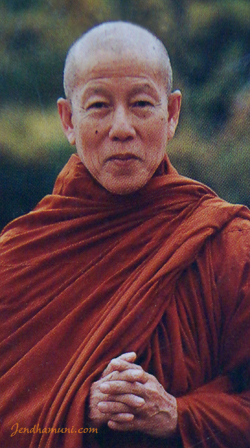
If you want to stay young, beautiful, charming and healthy: Smile a lot, don’t think too much, eat more fruits and veggies, stay humble, calm and cool. Do not be shaken by blame and praise… ~Jendhamuni

All of us have moments in our lives that test our courage. Taking children into a house with a white carpet is one of them. ~Erma Bombeck

RFA photo

Photo credit: KT/ Mai Vireak
Metta meditation is a practice of cultivating understanding, love, and compassion by looking deeply, first for ourselves and then for others. Once we love and take care of ourselves, we can be much more helpful to others. Metta meditation can be practiced in part or in full. Just saying one line of the metta meditation will already bring more compassion and healing into the world.
To love is, first of all, to accept ourselves as we actually are. That is why in this love meditation, “Know thyself” is the first practice of love. When we practice this, we see the conditions that have caused us to be the way we are. This makes it easy for us to accept ourselves, including our suffering and our happiness at the same time.
Metta means “lovingkindness” in Pali. We begin this with an aspiration: “May I be . . . ” Then we transcend the level of aspiration and look deeply at all the positive and negative characteristics of the object of our meditation, in this case ourselves. The willingness to love is not yet love. We look deeply, with all our being, in order to understand. We don’t just repeat the words, or imitate others, or strive after some ideal. The practice of love meditation is not autosuggestion. We don’t just say, “I love myself. I love all beings.” We look deeply at our body, our feelings, our perceptions, our mental formations, and our consciousness, and in just a few weeks, our aspiration to love will become a deep intention. Love will enter our thoughts, our words, and our actions, and we will notice that we have become “peaceful, happy, and light in body and spirit; safe and free from injury; and free from anger, afflictions, fear, and anxiety.”
When we practice, we observe how much peace, happiness, and lightness we already have. We notice whether we are anxious about accidents or misfortunes, and how much anger, irritation, fear, anxiety, or worry are already in us. As we become aware of the feelings in us, our self-understanding will deepen. We will see how our fears and lack of peace contribute to our unhappiness, and we will see the value of loving ourselves and cultivating a heart of compassion.
In this love meditation, “anger, afflictions, fear, and anxiety” refer to all the unwholesome, negative states of mind that dwell in us and rob us of our peace and happiness. Anger, fear, anxiety, craving, greed, and ignorance are the great afflictions of our time. By practicing mindful living, we are able to deal with them, and our love is translated into effective action.
This is a love meditation adapted from the Visuddhimagga (The Path of Purification) by Buddhaghosa, a 5th-century systematization of the Buddha’s teachings. Continue reading
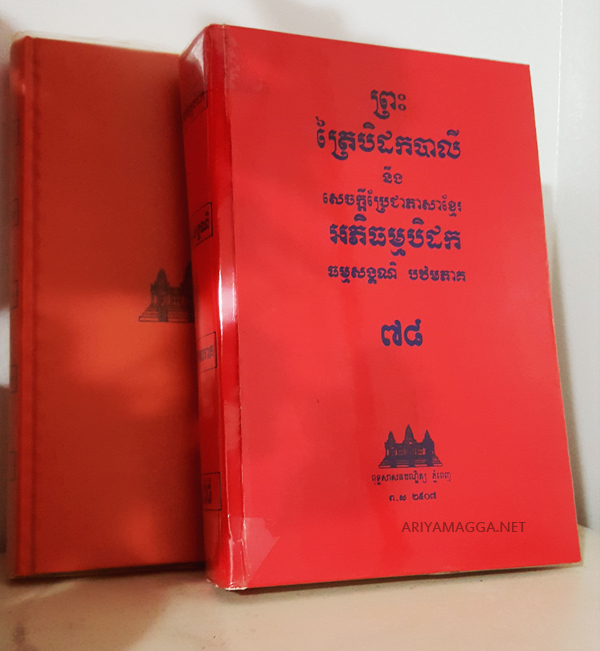
ព្រះត្រៃបិដក ប្រែថា កញ្រ្ចែង ឬ ល្អី ៣ សម្រាប់ដាក់ផ្ទុកពាក្យពេចន៍នៃព្រះសម្មាសម្ពុទ្ធ
The Tipitaka or Pali canon, is the collection of primary Pali language texts which form the doctrinal foundation of Theravada Buddhism. The three divisions of the Tipitaka are: Vinaya Pitaka, Sutta Pitaka, Abhidhamma Pitaka.
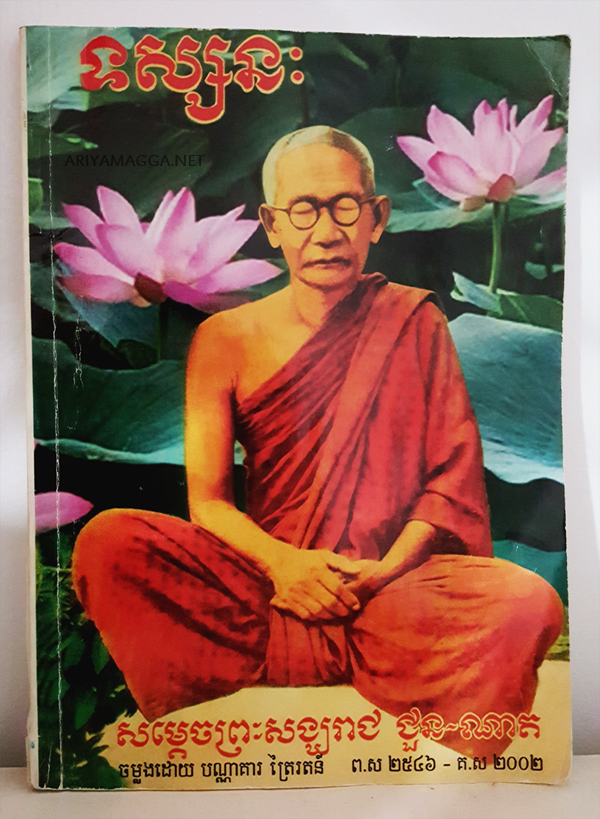
វចនានុក្រមសម្តេចសង្ឃ ជួន ណាត
Desktop version
Listen to Khmer literature and Dhamma talk by His Holiness Jotannano Chuon Nath, Supreme Patriarch of Cambodia Buddhism.
Should anyone wish to ridicule me and make me an object of jest and scorn why should I possibly care if I have dedicated myself to others?
Let them do as they wish with me so long as it does not harm them. May no one who encounters me ever have an insignificant contact.
Regardless whether those whom I meet respond towards me with anger or faith, may the mere fact of our meeting contribute to the fulfilment of their wishes.
May the slander, harm and all forms of abuse that anyone should direct towards me act as a cause of their enlightenment.

As a solid rock is not shaken by the wind, so the wise are not shaken by blame and praise. As a deep lake is clear and calm, so the wise become tranquil after they listened to the truth…
Good people walk on regardless of what happens to them. Good people do not babble on about their desires. Whether touched by happiness or by sorrow, the wise never appear elated or depressed. ~The Dhammapada