1. Until we have peace deep within us

    27

    Unless and until we have peace deep within us, we can never hope to have peace in the outer world. You and I create the world by the vibrations that we offer to it. If we can invoke peace and then offer it to somebody else, we will see how peace expands from one to two persons, and gradually to the world at large. Peace will come about in the world from the perfection of individuals. If you have peace, I have peace, he has peace, and she has peace, then automatically universal peace will dawn. ~Sri Chinmoy

  2. Like the light of the sun, moon and stars

    Comment

    Like the light of the sun, moon and stars, may the love, compassion and
    wisdom shine forth. May they strike every single living being and dispel
    the darkness of ignorance, attachment and hatred that has lurked for ages in
    their being. When any living being meets with another may it be like the
    reunion of a mother and child who have long been separated. In a harmonious
    world such as this may I see everyone sleep peacefully to the music of
    non-violence. This is my dream. ~17th Gyalwa Karmapa Orgyen Trinley
    Dorje

  3. Start a New Life Every Morning

    Comment

    by 17th Karmapa

    We sometimes wake up fresh in the morning yet still go through the day half asleep. Our busy 21st century lives overwhelm us with a relentless stream of immediate tasks. We lose sight of how precious it is just to have a human life.

    This is an awareness that we need to feel in our hearts. I would like to share with you a practice that I call ‘living your whole life in a single day.’ You can do this by starting with this thought in the morning: ‘I am starting a whole new life. It begins right now’. Initially, leave yourself a note at your bedside to remind you, and then slowly cultivate the habit of waking up with this thought.

    Your body is fresh from the night’s rest; when you wake up with this awareness, so does your mind. Ask yourself what kind of person you want to be in the life that you will live today. Throughout the day, remind yourself that your life is happening right now. In the afternoon, check to see how your life is going and readjust as needed. A whole lifetime of possibilities stretches out before you every moment.

    This is the basic truth of interdependence. Conditions are constantly shifting, and what seemed impossible earlier can suddenly become possible. Every moment counts. Every action counts. A single kind act can have a positive impact on the future of many others you share the earth with. You can change the course of the future in any moment. Do so consciously, and the whole world will benefit.

  4. Difference Without Division

    Comment

    Diversity within a society does not have to be problematic; it can be a source of richness and enjoyment. We can recognize and enjoy differences, but we must be careful not to exaggerate their importance or solidify our differences. When we do, we easily lose sight of our shared humanity, and divide ourselves up into categories of us and them, higher and lower, better and worse. ~ 17th Karmapa

  5. Not for Sure

    Comment

    Two Dhamma Talks by Ajahn Chah

    Still, Flowing Water

    Okay, everyone, pay attention. Don’t let your mind focus on this person or that. Create the feeling that right now you’re sitting alone on a mountain or in a forest somewhere, all by yourself. What do you have sitting here right now? Just body and mind, that’s all, only these two things. Everything sitting in this physical lump here is “body.” “Mind” is what’s aware of sense impressions and is thinking in the present. These two things are also called nama and rupa. Nama refers to what has no rupa, or form. All thoughts and sensations, such as feelings, perceptions, thought-fabrications, and consciousness, are nama. They’re all formless. When the eye sees forms, those forms are called rupa. The awareness of forms is called nama. Together they’re called nama and rupa, or simply body and mind.

    Understand that what’s sitting here in the present moment is just body and mind. Everything comes out of these two things. If you want peace, these are the only things you have to know. But the mind at present is still untrained. It’s dirty. Unclean. It’s not the primal mind. We have to train it by making it peaceful from time to time.

    Some people think that concentration means sitting, but the truth of the matter is that standing, sitting, walking, and lying down are part of the practice, too. You can practice concentration at any time. Concentration literally means “firm intent.” To practice concentration you don’t have to imprison the mind. Some people think, “I have to go look for some peace, to sit without any issues arising at all. I want to sit in total silence,” but that’s a dead person, not a live one. To practice concentration is to give rise to knowledge, to give rise to discernment.

    Concentration is a firm intent, focused on a single object. What kind of object is a single object? The proper object. Ordinarily we want to sit in total silence. People come and say, “I try to sit in concentration, but my mind won’t stay put. First it runs off one place, then it runs off somewhere else. I don’t know how to make it stop still.” It’s not the sort of thing you can stop. You’re not trying to stop it from running, for the running is where it’s aware of itself. People complain, “It runs off and I pull it back again; then it walks off again and I pull it back once more…” So they just sit there pulling back and forth like this.

    They think their mind’s running around, but actually the only things that run are our impressions. For example, look at this hall here: “Wow,” you say, “it’s so big!” But the hall isn’t what’s big, just our impression of it. Actually, this hall is just the size it is, not big, not small, but we run around after our impressions of things. Continue reading

  6. Sunsets are viewed with wonder

    Comment

    Sunsets, like childhood, are viewed with wonder not just because they are beautiful but because they are fleeting. ~Richard Paul Evans

    golden sea


  7. In the Shape of a Circle

    Comment

    Buddha meditating

    by Venerable Ajahn Chah

    When it comes to the Dhamma, we have to understand that our opinions are one thing; the Dhamma is something else.

    As for the practice, start out by establishing your powers of endurance and then contemplate. Contemplate your activities, your comings and goings. Contemplate what you’re up to. Whatever arises, the Buddha has us know all around. Whatever direction things come in from, he has us know all around. If we know all around, whatever comes at us from this way, we see it. Whatever comes at us from that way, we see it. Right we know. Wrong we know. Happy we know. Glad we know. We know all around.

    But our minds, when they contemplate, aren’t yet all around. We know just this side but leave that side wide open. It’s like putting a fence around a field or a house but it doesn’t go all around. If we put it up just on this side, thieves will come in that side, the side that the fence hasn’t gone around. Why is that? We haven’t closed the gate. Our fence isn’t yet good. It’s normal that they’ll have to come through that opening. So we contemplate again, adding more fence, closing things off, continually.

    Putting up a fence means establishing mindfulness and always being alert. If we do this, the Dhamma won’t go anywhere else. It’ll come right here. Good and bad, the Dhamma we should see and should know, will arise right here.

    As for whatever we don’t need to know, we let it go for the time being. We don’t waste our time with the logs we aren’t yet strong enough to lift. Wait until we have a tractor or a ten-wheel truck before trying to move them. Focus for the time being just on the things you can lift. Keep at it, using your powers of endurance, bit by bit.

    If you stick with this steadily, your happy moods and sad moods, your desirable moods and undesirable moods, will all come in right there. That’s when you get to watch them.

    Your moods and preoccupations are one thing; the mind is something else. They’re two different kinds of things. Usually when a mood hits, one that we like, we go running after it. If it’s one we don’t like, we turn our backs on it. When this is the case, we don’t see our own mind. We just keep running after our moods. The mood is the mood; the mind is the mind. You have to separate them out to see what the mind is like, what the mood is like. Continue reading

  8. The Story of Thera Mahakassapa

    Comment

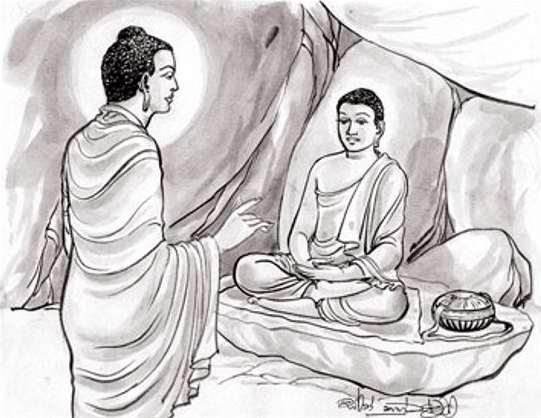
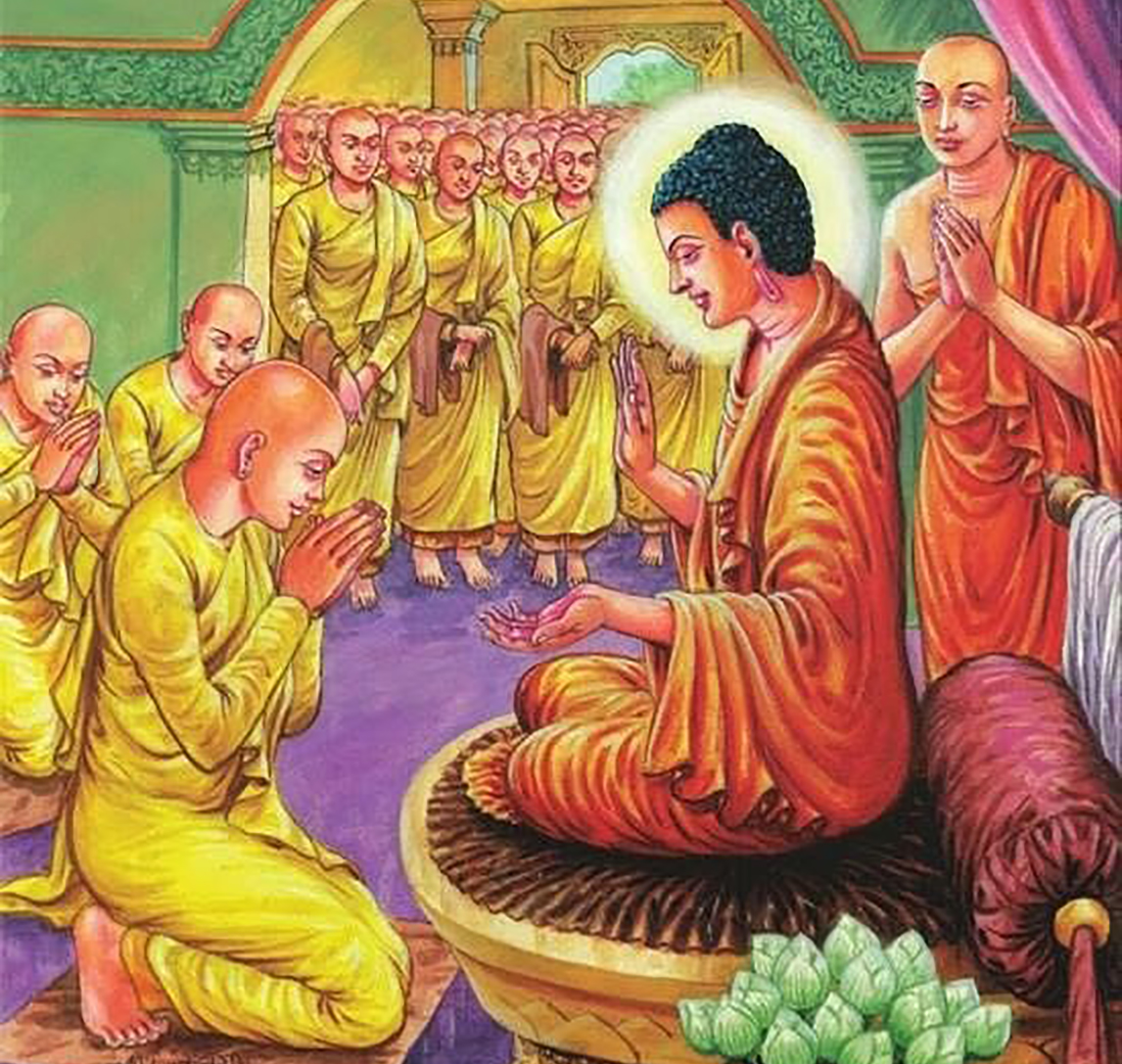
    Buddha and Maha Kassapa

    Verse 28: The wise one dispels negligence by means of mindfulness; he ascends the tower of wisdom and being free from sorrow looks at the sorrowing beings. Just as one on the mountain top looks at those on the plain below, so also, the wise one (the arahat) looks at the foolish and the ignorant (worldlings).

    1. dhiro: the wise one; in this context, the arahat.

    2. bile: the foolish; in this context, the worldings.

    The Story of Thera Mahakassapa

    While residing at the Jetavana monastery, the Buddha uttered Verse (28) of this book, with reference to Thera Mahakassapa.

    On one occasion, while Thera Mahakassapa was staying at Pipphali cave, he spent his time developing the mental image of light (aloka kasina) and trying to find out through Divine Vision, beings who were mindful and beings who were negligent, also those who were about to die and those who were about to be born.

    From his monastery, the Buddha saw through his Divine Vision what Thera Mahakassapa was doing and wanted to warn him that he was wasting his time. So he sent forth his radiance and appeared seated before the thera and exhorted him thus: “My son Kassapa, the number of births and deaths of beings is innumerable and cannot be counted. It is not your concern to count them; it is the concern only of the Buddhas.”

    Then the Buddha spoke in verse as follows:
    Verse 28. The wise one dispels negligence by means of mindfulness; he ascends the pinnacle of wisdom and being free from sorrow looks at the sorrowing beings. Just as one on the mountain top looks at those on the plain below, so also, the wise one (the arahat) looks at the foolish and the ignorant (worldlings).

    Dhammapada Verse 28
    Mahakassapatthera Vatthu

    Pamadam appamadena
    yada nudati pandito
    pannapasadamaruyha
    asoko sokinim pajam
    pabbatatthova bhumatthe
    dhiro1 bale2 avekkhati.

    Source: Tipitaka


  9. True happiness

    Comment

    True happiness is…to enjoy the present, without anxious dependence upon the future. ~Seneca

    purple flower on rain


Live & Die for Buddhism

candle

Khmer Tipitaka 1 – 110

 ព្រះត្រៃបិដក

ព្រះត្រៃបិដក ប្រែថា កញ្រ្ចែង ឬ ល្អី​ ៣ សម្រាប់ដាក់ផ្ទុកពាក្យពេចន៍នៃព្រះសម្មាសម្ពុទ្ធ

The Tipitaka or Pali canon, is the collection of primary Pali language texts which form the doctrinal foundation of Theravada Buddhism. The three divisions of the Tipitaka are: Vinaya Pitaka, Sutta Pitaka, Abhidhamma Pitaka.

Maha Ghosananda

Maha Ghosananda

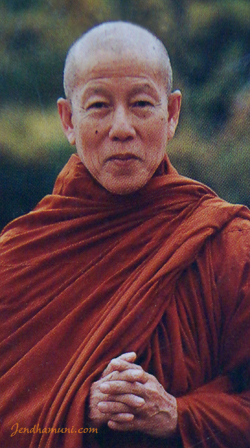
Supreme Patriarch of Cambodian Buddhism (5/23/1913 - 3/12/07). Forever in my heart...

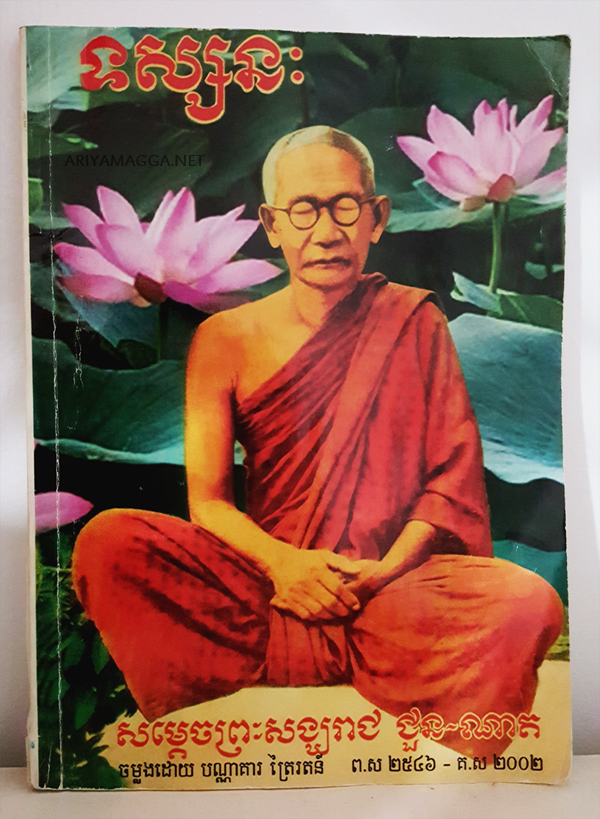
Samdech Chuon Nath

My reflection

វចនានុក្រមសម្តេចសង្ឃ ជួន ណាត
Desktop version

Listen to Khmer literature and Dhamma talk by His Holiness Jotannano Chuon Nath, Supreme Patriarch of Cambodia Buddhism.

Shantidevas’ Bodhisattva vows

My reflection

Should anyone wish to ridicule me and make me an object of jest and scorn why should I possibly care if I have dedicated myself to others?

Let them do as they wish with me so long as it does not harm them. May no one who encounters me ever have an insignificant contact.

Regardless whether those whom I meet respond towards me with anger or faith, may the mere fact of our meeting contribute to the fulfilment of their wishes.

May the slander, harm and all forms of abuse that anyone should direct towards me act as a cause of their enlightenment.

As a solid rock is not shaken by the wind, so the wise are not shaken by blame and praise. As a deep lake is clear and calm, so the wise become tranquil after they listened to the truth…

Good people walk on regardless of what happens to them. Good people do not babble on about their desires. Whether touched by happiness or by sorrow, the wise never appear elated or depressed. ~The Dhammapada

Hermit of Tbeng Mountain

Sachjang Phnom Tbeng សច្ចំ​​ ភ្នំត្បែង is a very long and interesting story written by Mr. Chhea Sokoan, read by Jendhamuni Sos. You can click on the links below to listen. Part 1 | Part 2

Beauty in nature

A beautiful object has no intrinsic quality that is good for the mind, nor an ugly object any intrinsic power to harm it. Beautiful and ugly are just projections of the mind. The ability to cause happiness or suffering is not a property of the outer object itself. For example, the sight of a particular individual can cause happiness to one person and suffering to another. It is the mind that attributes such qualities to the perceived object. — Dilgo Khyentse Rinpoche

Nature is loved by what is best in us. The sky, the mountain, the tree, the animal, give us a delight in and for themselves. — Ralph Waldo Emerson


Our journey for peace
begins today and every day.
Each step is a prayer,
Each step is a meditation,
Each step will build a bridge.

—​​​ Maha Ghosananda