1. Desire, anger and stupidity

    Comment

    Desire, anger and stupidity–
    Engaging in those creates karma that is non-virtuous.
    The fruit of non-virtue is experienced as suffering.
    Free of attachment, free of aversion, and without stupidity–
    Acting within those states creates karma that is virtuous.
    The fruit of virtue is experienced as happiness.

    — Shantideva

    tree11-2915-Ariyamagga


  2. Complete awakening

    Comment

    The cultivation of bodhicitta is to wish for true, complete awakening for the welfare of others.
    — The Ornament for Clear Realization

    rose-bee

  3. All beings have been our mothers

    Comment

    When we have acquired an awareness of the fact that all beings have been our mothers, and when this awareness is constant, the result will be that when we see meat, we will be conscious of the fact that it is the flesh of our own mothers. And, far from putting it in our mouths and eating it, we will be unable to even take it into our hands or smell its odor. ~ Shabkar Tsogdruk Rangdrol

    “When we bring mindfulness to the dinner table, it suffuses the rest of our life as well. We become more sensitive to the well-being of animals, of the environment, and of ourselves and our families. We are more aware of the choices we make in all areas of our life. We enjoy food more, know that, while the obtaining of even plant foods necessitates some suffering, the amount and kind of suffering is dramatically reduced when we leave meat off our shopping lists and out of our kitchens. We become more aware of how meat consumption feeds violence and anger.”  ~Kate Lawrence

    jforest


  4. Three ways of killing

    Comment

    There are three ways of killing that we, as Buddhists, have to restrain: either by directly killing, indirectly killing, or rejoicing to see others be killed. Not only does this apply to human life, it should be also extended to all living beings. ~ Zen Master Thich Thanh Tu

    Buddha dhamma talk112515

  5. I once met…

    Comment

    I once met the richest man on Earth. He was a beggar who slept under a bridge, but he’s rich because he had God. ~Unknown


  6. Compassion without attachment

    Comment

    Compassion without attachment is possible. Therefore, we need to clarify the distinctions between compassion and attachment. True compassion is not just an emotional response but a firm commitment founded on reason. Because of this firm foundation, a truly compassionate attitude toward others does not change even if they behave negatively. Genuine compassion is based not on our own projections and expectations, but rather on the needs of the other: irrespective of whether another person is a close friend or an enemy, as long as that person wishes for peace and happiness and wishes to overcome suffering, then on that basis we develop genuine concern for their problem. This is genuine compassion. For a Buddhist practitioner, the goal is to develop this genuine compassion, this genuine wish for the well-being of another, in fact for every living being throughout the universe. — Tenzin Gyatso, the Fourteenth Dalai Lama

    colorful-lotus


  7. All Dreamers Understand

    Comment

    Note: This poem has nothing to do with Jendhamuni’s life

    Our love was a romantic book
    from the sacred day we met,
    your gentle charm enthralled me
    from then-on the scene was set:
    A sunny day, a rainy day,
    it mattered not to me,
    if I could see your happy face
    and walk and talk with thee.

    When snow was falling from the sky
    and chilly breezes blew,
    were it not for your embrace
    I’d pine the whole day through.
    So now we are alone my love
    I offer you my hand,
    to join with yours in wedlock
    as all “dreamers” understand.

    Author: Joyce Hemsley
    Link source


  8. Our planet and our home…

    Comment

    We gently caress you, the Earth, our planet and our home.
    Our vision has brought us closer to you,
    making us aware of the harm we have done
    to the life-network upon which we ourselves depend.
    We are reminded that we have poisoned your waters, your lands, your air.
    We have filled you with the bones of our dead from war and greed.
    Your pain is our pain.
    Touching you gently, we pray that we may become
    peace-bringers and life-bringers so that our home
    in its journey around the Sun not become a sterile and lonely place.
    May this prayer and its power last forever.

    ~Sensei Ulrich, Manitoba Buddhist Temple

  9. Transforming greed into gratitude

    38

    Happiness can only be achieved by looking inward & learning to enjoy whatever life has and this requires transforming greed into gratitude. ~John Chrysostom

  10. The Buddha showed much compassion…

    Comment

    If there is any religion that would cope with modern scientific needs it would be Buddhism. — Albert Einstein

    Buddha

    When the Buddha was diligently walking the path of Bodhisattva, he did not only aspire to achieve Buddhahood for himself. He also had a very deep concern for all the distressed sentient beings in this world. The Buddha showed much compassion in his constant actions of helping sentient beings. The world is like a dirty, stinking sewage tank and we are almost drowning in it. No one but the Buddha was willing to come to this suffering world to rescue us. Therefore, when Buddha was born in this world more than two thousand years ago, he denounced the worldly life, practiced diligently, attained enlightenment and then preached his teachings. If there was no distressed sentient beings like us, he wouldn’t have needed to come into this suffering world, as he had already freed himself from the cycle of birth and death and awakened to the truth of all phenomena.

    The contributions of Buddha to us are profound and incomparable. As Buddhists we should reinforce the concept of appreciating the Buddha. Otherwise, if we do not understand the Buddha’s sincerity, do not learn his compassion, and do not pursue the vast merits of the great teaching in Buddhism, we do not qualify as the Buddha’s faithful disciples.

    Source: BuddhaNet
    Link source


Live & Die for Buddhism

candle

Khmer Tipitaka 1 – 110

 ព្រះត្រៃបិដក

ព្រះត្រៃបិដក ប្រែថា កញ្រ្ចែង ឬ ល្អី​ ៣ សម្រាប់ដាក់ផ្ទុកពាក្យពេចន៍នៃព្រះសម្មាសម្ពុទ្ធ

The Tipitaka or Pali canon, is the collection of primary Pali language texts which form the doctrinal foundation of Theravada Buddhism. The three divisions of the Tipitaka are: Vinaya Pitaka, Sutta Pitaka, Abhidhamma Pitaka.

Maha Ghosananda

Maha Ghosananda

Supreme Patriarch of Cambodian Buddhism (5/23/1913 - 3/12/07). Forever in my heart...

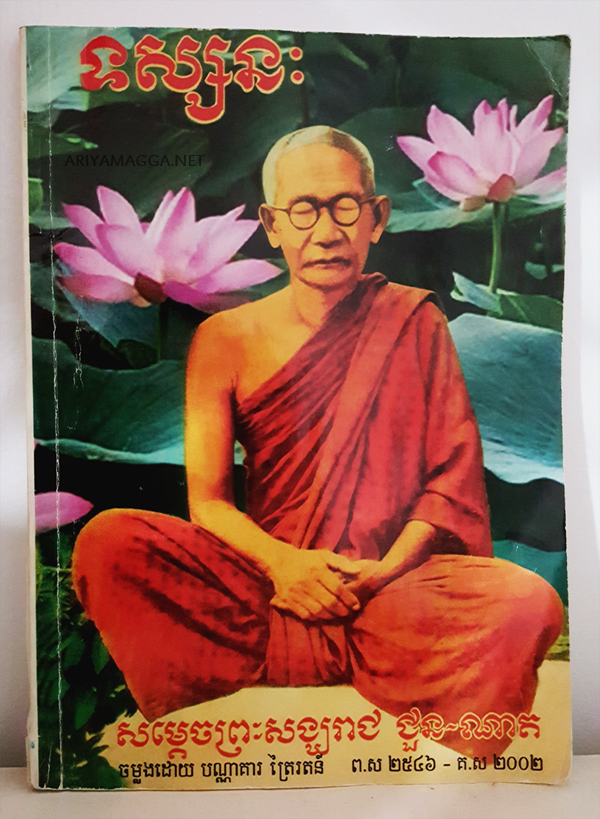
Samdech Chuon Nath

My reflection

វចនានុក្រមសម្តេចសង្ឃ ជួន ណាត
Desktop version

Listen to Khmer literature and Dhamma talk by His Holiness Jotannano Chuon Nath, Supreme Patriarch of Cambodia Buddhism.

Shantidevas’ Bodhisattva vows

My reflection

Should anyone wish to ridicule me and make me an object of jest and scorn why should I possibly care if I have dedicated myself to others?

Let them do as they wish with me so long as it does not harm them. May no one who encounters me ever have an insignificant contact.

Regardless whether those whom I meet respond towards me with anger or faith, may the mere fact of our meeting contribute to the fulfilment of their wishes.

May the slander, harm and all forms of abuse that anyone should direct towards me act as a cause of their enlightenment.

As a solid rock is not shaken by the wind, so the wise are not shaken by blame and praise. As a deep lake is clear and calm, so the wise become tranquil after they listened to the truth…

Good people walk on regardless of what happens to them. Good people do not babble on about their desires. Whether touched by happiness or by sorrow, the wise never appear elated or depressed. ~The Dhammapada

Hermit of Tbeng Mountain

Sachjang Phnom Tbeng សច្ចំ​​ ភ្នំត្បែង is a very long and interesting story written by Mr. Chhea Sokoan, read by Jendhamuni Sos. You can click on the links below to listen. Part 1 | Part 2

Beauty in nature

A beautiful object has no intrinsic quality that is good for the mind, nor an ugly object any intrinsic power to harm it. Beautiful and ugly are just projections of the mind. The ability to cause happiness or suffering is not a property of the outer object itself. For example, the sight of a particular individual can cause happiness to one person and suffering to another. It is the mind that attributes such qualities to the perceived object. — Dilgo Khyentse Rinpoche

Nature is loved by what is best in us. The sky, the mountain, the tree, the animal, give us a delight in and for themselves. — Ralph Waldo Emerson


Our journey for peace
begins today and every day.
Each step is a prayer,
Each step is a meditation,
Each step will build a bridge.

—​​​ Maha Ghosananda