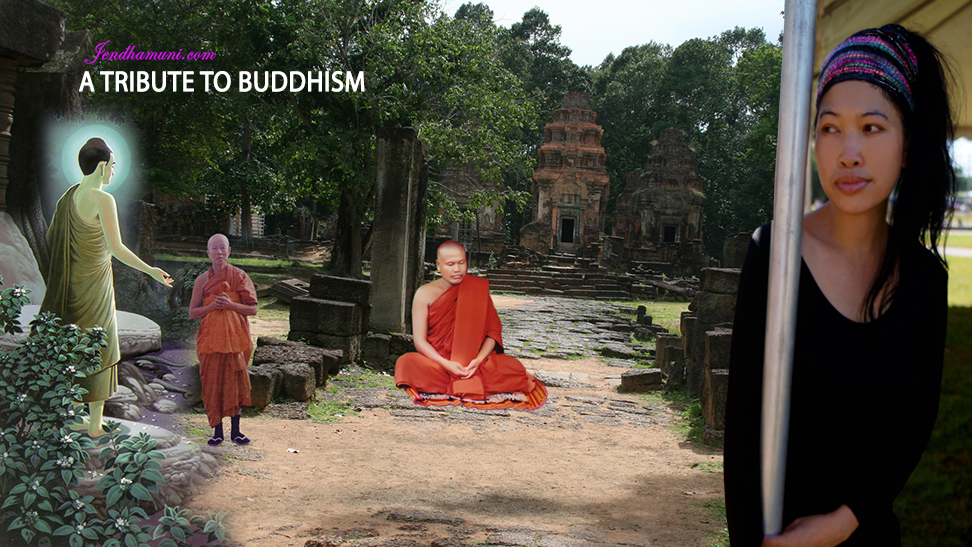
Having a kind heart
Comment
November 18, 2015
No matter what you think you look like, having a kind heart will always make you beautiful. ~Terry Mark


No matter what you think you look like, having a kind heart will always make you beautiful. ~Terry Mark

Lessons in how to treat one’s parents,
Support for one’s parents,
assistance to one’s wife and children,
consistency in one’s work:
This is the highest protection.
[Sn II.4]
Mother & father,
compassionate to their family,
are called
Brahma,
first teachers,
those worthy of gifts
from their children.
So the wise should pay them
homage,
honor
with food & drink
clothing & bedding
anointing & bathing
& washing their feet.
Performing these services to their parents, the wise
are praised right here
and after death
rejoice in heaven.

They go to many a refuge,
to mountains and forests,
to park and tree shrines:
people threatened with danger.
That’s not the secure refuge,
not the supreme refuge,
that’s not the refuge,
having gone to which,
you gain release
from all suffering & stress.
But when, having gone
to the Buddha, Dhamma,
& Sangha for refuge,
you see with right discernment
the four noble truths —
stress,
the cause of stress,
the transcending of stress,
& the noble eightfold path,
the way to the stilling of stress:
that’s the secure refuge,
that, the supreme refuge,
that is the refuge,
having gone to which,
you gain release
from all suffering & stress.
~Dhammapada
I want to thank all my wonderful friends, brothers, and sisters so much for your kind and caring messages. My health have been back to normal –100 percent recovered. Because I got sick for nearly one week, I have so many projects to complete before returning to a normal schedule on gplus. I miss all of you. Love and respect all my dear friends just like my brothers and sisters. Due to my very hectic schedule, I hardly have time to respond to any friend on gplus. Only come by to post several items each day. ~Jendhamuni

Practicing generosity in a Buddhist context means to consider everyone equal, not to discriminate against anyone. There are cruel persons and kind persons among the poor and destitute, just as there are among the wealthy, and we must not exclude the cruel ones from our practice.
As the sutra states, ‘Bodhisattvas consider everyone, friends and enemies alike, as equal. They do not condemn anyone’s past wrongdoings, nor do they hate those who are presently doing harm.’ This expresses the spirit of Mahayana Buddhism. Poverty creates anger, hatred, and wrongdoing. If we teach Buddhist philosophy through lectures, but do not practice generosity to ease the suffering of others, we have not yet attained the essence of Buddhism. We should practice generosity with compassion and not disdain, without discriminating against people who, because of their poverty, have caused anger and hatred. ~Thich Nhat Hanh

Mindfulness can help people to reconnect by slowing down and appreciating all the gifts that the earth can offer.
Many people suffer deeply and they do not know they suffer. They try to cover up the suffering by being busy. Many people get sick today because they get alienated from Mother Earth.
The practice of mindfulness helps us to touch Mother Earth inside of the body and this practice can help heal people. So the healing of the people should go together with the healing of the Earth and this is the insight and it is possible for anyone to practice.
This kind of enlightenment is very crucial to a collective awakening. In Buddhism we talk of meditation as an act of awakening, to be awake to the fact that the earth is in danger and living species are in danger.
~Thich Nhat Hanh

When someone has done us, our loved ones, or our people, a great wrong, this is the very last thing in the world we want to do. We hate and loathe our enemies, and may well have very good reason for this antipathy.
It takes tremendous courage and insight to break this self-perpetuating cycle, but it is possible. And Buddhism offers unique insights into how we can break down the barriers that separate us and find a path to peace. And one skillful way to do this is through meditation in which we empathetically become one with our enemy and his suffering. Again, this is not easy to do, but in understanding another’s suffering, however much we may think they deserve it or have brought it upon themselves, we find common ground. We all suffer. Being human, we all know what suffering is. We know what it is to lose a love one, to be abused, to be victimized. In our common suffering, and our compassionate response to suffering, we have a basis for finding and seeing our common humanity. ~Thich Nhat Hanh

Not by hating hatred ceases
In this world of tooth and claw;
Love alone from hate releases —
This is the Eternal Law.
~Dhammapada


by Ven. K. Piyatissa Thera
Naturally, any bad person may possess some good quality. Some men are evil in mind but speak in deceptive language or slyly perform their deeds in an unsuspecting manner. Some men are coarse only in their language but not in their mind or deeds. Some men are coarse and cruel in their deeds but neither in their speech nor in their mind. Some are soft and kind in mind, speech and deed as well.
When we feel angry with any person, we should try to find out some good in him, either in his way of thinking, or in his way of speaking or in his way of acting. If we find some redeeming quality in him, we should ponder its value and ignore his bad qualities as natural weaknesses that are to be found in everyone. Whilst we think thus, our mind will soften and we may even feel kindly towards that person. If we develop this way of thinking we will be able to curb or eliminate our anger towards him.
At times, this method may not be successful and we shall then have to try the third method. Basically, this entails reflecting thus:
“He has done some wrong to me and in so doing has spoiled his mind. Then why should I spoil or impair my own mind because of his foolishness? Sometimes I ignore support or help offered by my relatives; sometimes their tears even shed because of my activities. Being a person of such type myself, why should I not therefore ignore that foolish man’s deed?
“He has done that wrong, being subject to anger, should I too follow him, making my mind subject to anger? Is it not foolish to imitate him? He harboring his hatred destroys himself internally. Why should I, on his account, destroy my reputation?
“All things are momentary. Both his mind and body are momentary too. The thoughts and the body with which the wrong was done to me are not now existing. What I call the same man now are the thoughts and physical parts which are different from the earlier ones that harmed me although belonging to the same psycho-physical process. Thus, one thought together with one mass of physical parts did me some wrong, and vanished there and then, giving place to succeeding thoughts and material parts to appear. So with which am I getting angry? WIth the vanished and disappeared thoughts and physical parts or with the thoughts and material parts which do not do any wrong now? Should I get angry with one thing which is innocent whereas another thing has done me wrong and vanished?
“The so-called ‘I’ is not the same for two consecutive moments. At the moment the wrong was done there was another thought and another mass of molecules which were regarded as ‘I,’ whereas what are regarded as ‘I’ at the present moment are a different thought and collection of molecules, though belonging to the same process. Thus some other being did wrong to someone else and another gets angry with another. Is this not a ridiculous situation?”
If we scrutinize the exact nature of our life and its happenings in this manner, our anger might subside or vanish there and then.
There is another way, too, to eliminate upsurging anger. Suppose we think of someone who has done wrong to us. On such occasions we should remember that we suffer harm or loss as a result of our previous kamma. Even if others were angry with us, they could not harm us if there were no latent force of past unwholesome kamma committed by us which took advantage of this opportunity to arouse our adversary. So it is I who am responsible for this harm or loss and not anybody else. And at the same time, now while I am suffering the result of past kamma, if I, on account of this, should get angry and do any harm to him, by that do I accumulate much more unwholesome kamma which would bring me correspondingly unwholesome results.

If we recall to mind this law of kamma, our anger may subside immediately. We can consider such a situation in another way too. We as the followers of Buddha believe that our Bodhisatta passed through incalculable numbers of lives practicing virtues before he attained Buddhahood. The Buddha related the history of some of his past lives as illustrations to teach us how he practiced these virtues. The lives of the prince Dhammapala and the ascetic Khantivadi are most illustrative and draw our attention.
At one time the Bodhisatta had been born as the son of a certain king named Mahapatapa. The child was named Culla Dhammapala. One day the Queen sat on a chair fondling her child and did not notice the King passing by. The King thought the Queen was so proud of her child as not to get up from her chair even when she saw that her lord the King passed that way. So he grew angry and immediately sent for the executioner. When he came the King ordered him to snatch the child from the Queen’s arms and cut his hands, feet and head off, which he did instantly. The child, our Bodhisatta, suffered all that with extreme patience and did not grow ill-tempered or relinquish his impartial love for his cruel father, lamenting mother and the executioner. So far had he matured in the practice of forbearance and loving-kindness at that time.
At another time, our Bodhisatta was an ascetic well-known for his developed virtue of forbearance and consequently people named him Khantivadi, the preacher of forbearance. One day he visited Benares and took his lodgings at the royal pleasure grove. Meanwhile, the King passed that way with his harem and, seeing the ascetic seated under a tree, asked what virtue he was practicing, to which the ascetic replied that of forbearance. The King was a materialist who regarded the practice of virtue to be humbug. So, hearing the words of the ascetic, he sent for the executioner and ordered him to cut off his hands and feet and questioned the ascetic as to whether he could hold to forbearance at the severing of his limbs. The ascetic did not feel ill-tempered but even at that time he lay down extending his loving-kindness and holding his forbearance undiminished. He spoke to the King in reply to the effect that his forbearance and other virtues were not in his limbs but in his mind. The King, being unsuccessful in his attempts to disturb the ascetic’s feelings, grew angrier and kicked the stomach of the ascetic with his heel and went away. Meanwhile, the King’s minister came over and, seeing what had happened, bowed before the dying ascetic and begged him saying: “Venerable one, none of us agreed to this cruel act of the King and we are all sorrowing over what has been done to you by that devilish man. We ask you to curse the King but not us.” At this the ascetic said: “May that king who has caused my hands and feet to be cut off, as well as you, live long in happiness. Persons who practice virtues like me never get angry.” Saying this, he breathed his last. Continue reading

From Sadness to Hope – the Power of Compassion
May the supreme and precious awakening mind
Arise where it has not yet arisen.
And where it has declined or does not exist,
May it flourish and keep growing.
“It is clear that the greater your sense of altruism, the more you work
for the welfare of others, the greater will be your own satisfaction.
And when you come to die you’ll be able to go with confidence. As you
dedicate yourself to working for others, your own interests will
incidentally be fulfilled. Selfishness and self-centredness, on the
other hand, lead to anxiety and suspicion, poor health and a decline in
well-being.” ~His Holiness the Dalai Lama
Although the Buddha had spoken about suffering when he taught the Four
Noble Truths, that is no grounds for feeling depressed. Rather we should
examine what gives rise to suffering and take on the challenge of
overcoming it. He said that helping others who suffer to cope and
overcome their grief described is a great gift of kindness.
His Holiness clarified that we experience two levels of pain, physical and mental, and that while physical pain tends to have a physical cause, mental suffering usually derives from our own way of thinking. For this the 8th century Indian master, Shantideva, offers practical advice:
Why be unhappy about something
If it can be remedied?
And what is the use of being unhappy about something
If it cannot be remedied?
Source: dalailama.com
Link to this article


ព្រះត្រៃបិដក ប្រែថា កញ្រ្ចែង ឬ ល្អី ៣ សម្រាប់ដាក់ផ្ទុកពាក្យពេចន៍នៃព្រះសម្មាសម្ពុទ្ធ
The Tipitaka or Pali canon, is the collection of primary Pali language texts which form the doctrinal foundation of Theravada Buddhism. The three divisions of the Tipitaka are: Vinaya Pitaka, Sutta Pitaka, Abhidhamma Pitaka.
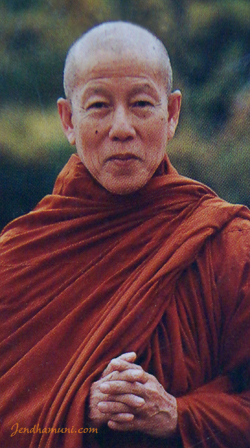
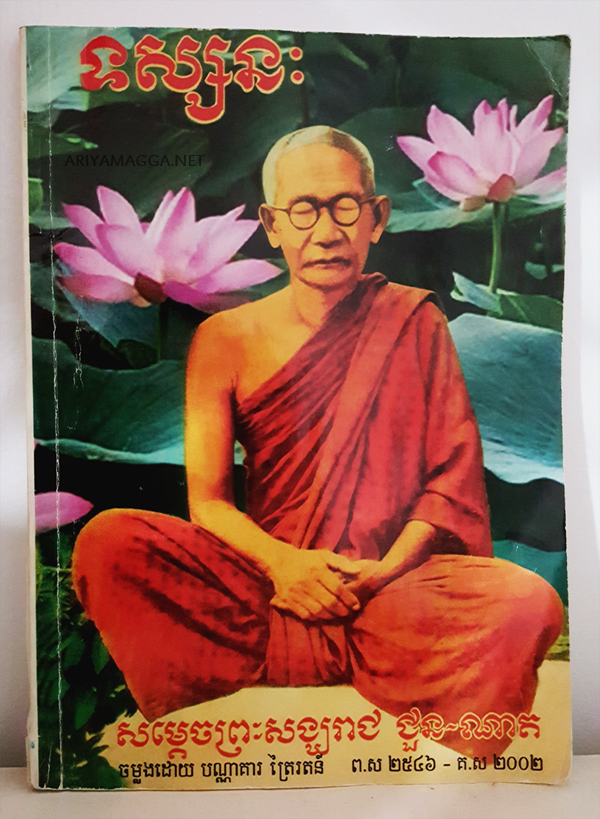
វចនានុក្រមសម្តេចសង្ឃ ជួន ណាត
Desktop version
Listen to Khmer literature and Dhamma talk by His Holiness Jotannano Chuon Nath, Supreme Patriarch of Cambodia Buddhism.

Should anyone wish to ridicule me and make me an object of jest and scorn why should I possibly care if I have dedicated myself to others?
Let them do as they wish with me so long as it does not harm them. May no one who encounters me ever have an insignificant contact.
Regardless whether those whom I meet respond towards me with anger or faith, may the mere fact of our meeting contribute to the fulfilment of their wishes.
May the slander, harm and all forms of abuse that anyone should direct towards me act as a cause of their enlightenment.

As a solid rock is not shaken by the wind, so the wise are not shaken by blame and praise. As a deep lake is clear and calm, so the wise become tranquil after they listened to the truth…
Good people walk on regardless of what happens to them. Good people do not babble on about their desires. Whether touched by happiness or by sorrow, the wise never appear elated or depressed. ~The Dhammapada