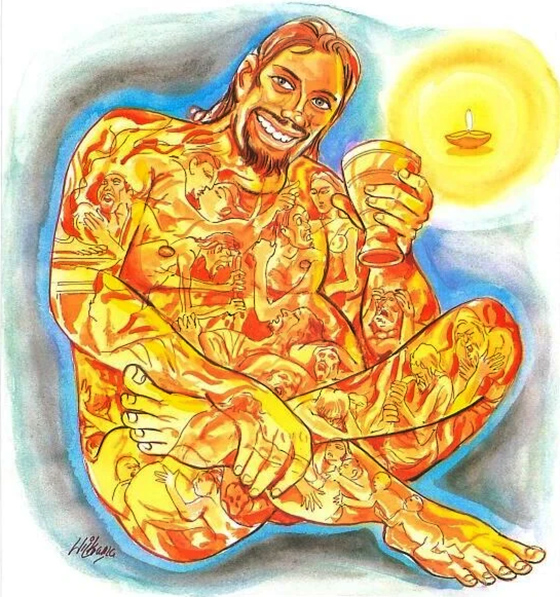
Verse 147: Look at this dressed up body, a mass of sores, supported (by bones), sickly, a subject of many thoughts (of sensual desire). Indeed, that body is neither permanent nor enduring.
The Story of Sirima
While residing at the Jetavana monastery, the Buddha uttered Verse (147) of this book, with reference to Sirima the courtesan.
Once, there lived in Rajagaha, a very beautiful courtesan by the name of Sirima. Every day Sirima offered alms-food to eight bhikkhus. One of these bhikkhus happened to mention to other bhikkhus how beautiful Sirima was and also that she offered very delicious food to the bhikkhus every day. On hearing this, a young bhikkhu fell in love with Sirima even without seeing her. The next day, the young bhikkhu went with the other bhikkhus to the house of Sirima. Sirima was not well on that day, but since she wanted to pay obeisance to the bhikkhus, she was carried to their presence. The young bhikkhu, seeing Sirima, thought to himself, “Even though she is sick, she is very beautiful !” And he felt a strong desire for her.
That very night, Sirima died. King Bimbisara went to the Buddha and reported to him that Sirima, the sister of Jivaka, had died. The Buddha told King Bimbisara to take the dead body to the cemetery and keep it there for three days without burying it, but to have it protected from crows and vultures. The king did as he was told. On the fourth day, the dead body of the beautiful Sirima was no longer beautiful or desirable; it got bloated and maggots came out from the nine orifices. On that day, the Buddha took his bhikkhus to the cemetery to observe the body of Sirima. The king also came with his men. The young bhikkhu, who was so desperately in love with Sirima, did not know that Sirima had died. When he learnt that the Buddha and the bhikkhus were going to see Sirima, he joined them. At the cemetery, the corpse of Sirima was surrounded by the bhikkhus headed by the Buddha, and also by the king and his men.
The Buddha then asked the king to get a town crier announce that Sirima would be available on payment of one thousand in cash per night. But no body would take her for one thousand, or for five hundred, or for two hundred and fifty, or even if she were to be given free of charge. Then the Buddha said to the audience, “Bhikkhus! Look at Sirima. When she was living, there were many who were willing to give one thousand to spend one night with her; but now none would take her even if given without any payment. The body of a person is subject to deterioration and decay.” Continue reading
Behold this body — a painted image, a mass of heaped up sores, infirm, full of hankering — of which nothing is lasting or stable!
Fully worn out is this body, a nest of disease, and fragile. This foul mass breaks up, for death is the end of life.
These dove-colored bones are like gourds that lie scattered about in autumn. Having seen them, how can one seek delight?
This city (body) is built of bones, plastered with flesh and blood; within are decay and death, pride and jealousy.
Even gorgeous royal chariots wear out, and indeed this body too wears out. But the Dhamma of the Good does not age; thus the Good make it known to the good.
The man of little learning grows old like a bull. He grows only in bulk, but, his wisdom does not grow.
Through many a birth in samsara have I wandered in vain, seeking the builder of this house (of life). Repeated birth is indeed suffering! Continue reading
This heart of ours is very difficult to soften. But we’d all most probably like our heart to be more soft and compassionate. The way it can ever soften is to be able to put ourselves in others shoes, in the shoes of the person we see suffering, for example.
Then go through what they go through, feel what they feel and experience. Naturally our heart softens and more compassion flows. So don’t resist the suffering you encounter, but take it as a way to train your heart in compassion. ~ Dzigar Kongtrul Rinpoche
That’s right. Snow is actually clear. Snowflakes are made out of ice crystals, so when light passes through, it bends and bounces off each individual crystal. The entire spectrum of light is reflected back to our eyes, and we see white snow. So there’s actually no such thing as a White Christmas, but that sounds a lot catchier than Translucent Christmas.
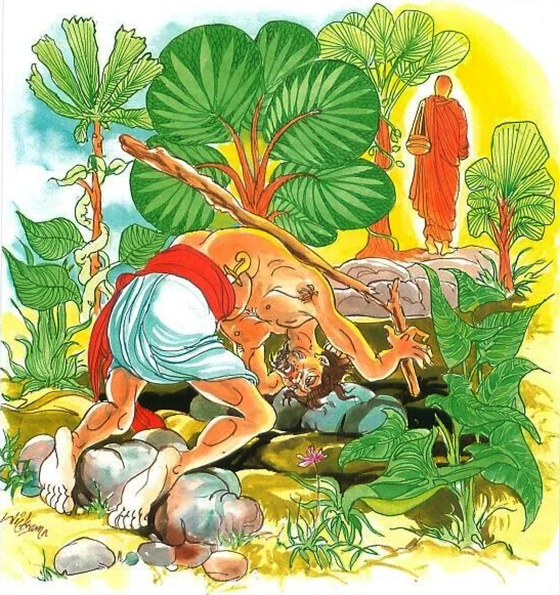
Verse 146: Why is there laughter? Why is there joy although (the world) is always burning? Shrouded in darkness why not seek the light?
The Story of the Companions of Visakha
While residing at the Jetavana monastery, the Buddha uttered Verse (146) of this book, with reference to companions of Visakha.
Five hundred men from Savatthi, wishing to make their wives to be generous, kind-hearted and virtuous like Visakha, sent them to Visakha to be her constant companions. During a bacchanalian festival which lasted for seven days, the wives of those men took all the drinks left by their husbands and got drunk in the absence of Visakha. For this misbehaviour they were beaten by their husbands. On another occasion, saying that they wished to listen to the Buddha’s discourse, they asked Visakha to take them to the Buddha and secretly took small bottles of liquor hidden in their clothes. Continue reading
138-140 Sharp pain, or disaster, bodily injury, serious illness, or derangement of mind, trouble from the government, or grave charges, loss of relatives, or loss of wealth, or houses destroyed by ravaging fire; upon dissolution of the body that ignorant man is born in hell. Continue reading
— Shutterfly