1. Nothing will change

    Comment

    You can complain as much as you like about your life and the problems nothing will change unless you stop complaining and start making things right yourself. ~Anurag Prakash Ray

  2. Jealousy

    Comment

    From among all… adverse conditions, the foremost is jealousy. Jealousy can rob us of our freedom and interrupt loving relationships between people. Jealousy occurs when we cannot tolerate others encountering situations that seem to involve more happiness than what we have. When we continually feel the need to have others beneath us and none equal to us, that is jealousy. When we are controlled by jealousy, we only feel comfortable when others come to us for assistance; we only feel at ease when others are looking to us with hope. We cannot stand being in situations where others have something that we need.

    When we become jealous, we are not willing to see the positive qualities of others. Whether we are alone or in a group, when we are overcome by jealousy our eyes are not willing to see the good things in others; they are constantly looking for other’s faults. We build up intolerance toward the faults of others. In particular, when we see others enjoying good fortune that exceeds our own, we cannot stand it. In this way, we create extra and superfluous difficulties for our minds to deal with.

    A better approach would be to pay more attention to our own conduct than to the conduct of others. ~17th Karmapa


  3. Avoiding criticism

    Comment

    boy with ducks

    We should not say bad things about anyone, whether or not they are bodhisattvas. It is not the same thing, however, if we know that pointing out someone’s mistakes will help them to change. Generally speaking, since it is not easy to change another person, we should avoid criticism. Other people do not like to hear it and, further, laying out their faults will create problems and troubles for us. We who are supposed to be practicing the dharma should be trying to do whatever brings happiness to ourselves and others. Since faultfinding does not bring any benefit, we should carefully avoid it.

    If we really want to help someone, perhaps we can say something once in a pleasant way so that the person can readily understand, “Oh yes, this is something I need to change.” However, it is better not to repeat our comments, because if we keep mentioning faults, not only will it not truly help, it will disturb others to no good effect. Therefore not mentioning the faults of others is the practice of bodhisattvas. ~17th Karmapa


  4. Expanding our compassion

    1

    If we allow our compassion to remain only inside of ourselves, our compassion will become powerless, without a function. It would become like a vase that despite having the ability to carry water had been placed high upon a shelf and never used.

    To expand our compassion we can apply our imagination to everyday’s situations. Sometimes when the wind blows I imagine that my compassion mixes with the wind and is carried in every direction to touch all sentient beings. Sometimes when I see beautiful clouds in the sky I imagine that they carry my compassion and that all beings over whom the clouds hover also experience the feeling of compassion. We can also do contemplation involving our five sense faculties. For example, we continually have objects in our visual field. Having first giving rise to compassion mentally we can then spread that compassion to any sentient being who appears before our eyes and imagine that they experience all of our compassion, love and joy. – Karmapa 17th Karmapa

  5. Lamp in the darkness

    Comment

    However much fighting there is in the world, however much darkness there is, we must be able to serve as small lamps in that darkness. ~17th Karmapa

    Buddha and hungry ghosts  - Ariyamagga

  6. Practicing love and compassion in an impartial way

    Comment

    The practices of loving kindness and compassion are incredibly relevant for everyone. Moreover, training in these qualities provides a common bridge between all different religions and areas of our world society. No matter whether we are people who teach a spiritual path or someone else, everybody can practice love and compassion, but it is important that we do so in an impartial way. ~ 17th Karmapa

    RFA photo/Sireymuny

    RFA photo/Sireymuny

  7. Inner peace is the key

    168

    Inner peace is the key: if you have inner peace, the external problems do not affect your deep sense of peace and tranquility. Without this inner peace, no matter how comfortable your life is materially, you may still be worried, disturbed, or unhappy because of circumstances. ~Dalai Lama

  8. Puppy playing with kitty

    Comment

    Female cats are typically right-pawed while male cats are typically left-pawed. A cat’s cerebral cortex (the part of the brain in charge of cognitive information processing) has 300 million neurons, compared with a dog’s 160 million. Source: Buzzfeed

  9. Miss no single opportunity

    Comment

    Miss no single opportunity of making some small sacrifice, here by a smiling look, there by a kindly word; always doing the smallest right and doing it all for love. ~Unknown

    RFA/Uon Chhin

  10. What metta isn’t

    Comment

    History Of Buddhism

    There are many myths and misunderstandings about metta, or lovingkindness.

    Simply because the word metta is not found in English — and because there isn’t an exact equivalent — it’s possible to think that the emotion itself is something strange and unusual.

    It’s possible for us to confuse metta with other emotions.

    It’s also possible for us to think that since metta is part of a spiritual path it must be something very exalted and distant, and not something that we’ve ever experienced.

    Here are some explanations of what metta is not:

    Metta isn’t the same thing as feeling good, although when we feel metta we do feel more complete, and usually feel more joyful and happy. But it’s possible to feel good and for that not to be metta. We can feel good, but be rather selfish and inconsiderate, for example. Metta has a quality of caring about others.

    Metta isn’t self-sacrifice. A metta-full individual is not someone who always puts others before themselves. Metta has a quality of appreciation, and we need to learn to appreciate ourselves as well as others.

    Metta isn’t something unknown. We all experience Metta. Every time you feel pleasure in seeing someone do well, or are patient with someone who’s a bit difficult, or are considerate and ask someone what they think, you’re experiencing Metta.

    Metta isn’t denying your experience. To practice Metta doesn’t mean “being nice” in a false way. It means that even if you don’t like someone, you can still have their welfare at heart.

    Metta isn’t all or nothing. Metta exists in degrees, and can be expressed in such simple ways as simple as politeness and courtesy.

    Source: http://www.wildmind.org



Live & Die for Buddhism

candle

Khmer Tipitaka 1 – 110

 ព្រះត្រៃបិដក

ព្រះត្រៃបិដក ប្រែថា កញ្រ្ចែង ឬ ល្អី​ ៣ សម្រាប់ដាក់ផ្ទុកពាក្យពេចន៍នៃព្រះសម្មាសម្ពុទ្ធ

The Tipitaka or Pali canon, is the collection of primary Pali language texts which form the doctrinal foundation of Theravada Buddhism. The three divisions of the Tipitaka are: Vinaya Pitaka, Sutta Pitaka, Abhidhamma Pitaka.

Maha Ghosananda

Maha Ghosananda

Supreme Patriarch of Cambodian Buddhism (5/23/1913 - 3/12/07). Forever in my heart...

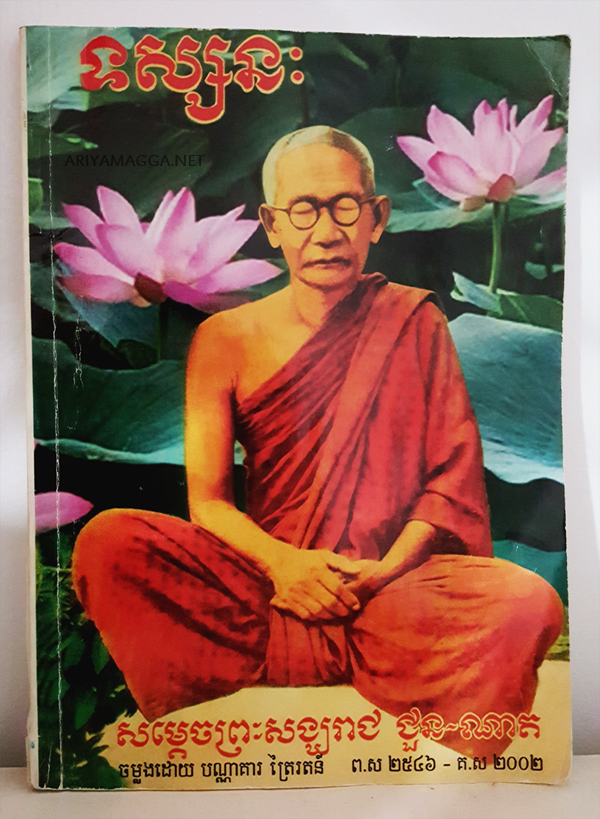
Samdech Chuon Nath

My reflection

វចនានុក្រមសម្តេចសង្ឃ ជួន ណាត
Desktop version

Listen to Khmer literature and Dhamma talk by His Holiness Jotannano Chuon Nath, Supreme Patriarch of Cambodia Buddhism.

Shantidevas’ Bodhisattva vows

My reflection

Should anyone wish to ridicule me and make me an object of jest and scorn why should I possibly care if I have dedicated myself to others?

Let them do as they wish with me so long as it does not harm them. May no one who encounters me ever have an insignificant contact.

Regardless whether those whom I meet respond towards me with anger or faith, may the mere fact of our meeting contribute to the fulfilment of their wishes.

May the slander, harm and all forms of abuse that anyone should direct towards me act as a cause of their enlightenment.

As a solid rock is not shaken by the wind, so the wise are not shaken by blame and praise. As a deep lake is clear and calm, so the wise become tranquil after they listened to the truth…

Good people walk on regardless of what happens to them. Good people do not babble on about their desires. Whether touched by happiness or by sorrow, the wise never appear elated or depressed. ~The Dhammapada

Hermit of Tbeng Mountain

Sachjang Phnom Tbeng សច្ចំ​​ ភ្នំត្បែង is a very long and interesting story written by Mr. Chhea Sokoan, read by Jendhamuni Sos. You can click on the links below to listen. Part 1 | Part 2

Beauty in nature

A beautiful object has no intrinsic quality that is good for the mind, nor an ugly object any intrinsic power to harm it. Beautiful and ugly are just projections of the mind. The ability to cause happiness or suffering is not a property of the outer object itself. For example, the sight of a particular individual can cause happiness to one person and suffering to another. It is the mind that attributes such qualities to the perceived object. — Dilgo Khyentse Rinpoche

Nature is loved by what is best in us. The sky, the mountain, the tree, the animal, give us a delight in and for themselves. — Ralph Waldo Emerson


Our journey for peace
begins today and every day.
Each step is a prayer,
Each step is a meditation,
Each step will build a bridge.

—​​​ Maha Ghosananda