1. The weapon for self-protection is loving-kindness

    Comment

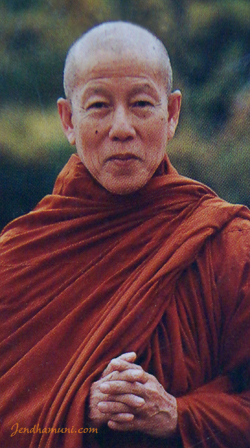
    Jendhamuni and children 072515


    Killing for Self Protection

    The Buddha has advised everyone to abstain from killing. If everybody accepts this advice, human beings would not kill each other. In the case where a person’s life is threatened, the Buddha says even then it is not advisable to kill out of self-protection. The weapon for self-protection is loving-kindness. One who practises this kindness very seldom comes across such misfortune. However, man loves his life so much that he is not prepared to surrender himself to others; in actual practice, most people would struggle for self-protection. It is natural and every living being struggles and kills others for self-protection but kammic effect depends on their mental attitude. During the struggle to protect himself, if he happens to kill his opponent although he has no intention to kill, then he is not responsible for that action. On the other hand, if he kills another person under any circumstances with the intention to kill, then he is not free from the kammic reaction; he has to face the consequences. We must remember that killing is killing; when we disapprove of it, we call it ‘murder’. When we punish man for murdering, we call it ‘capital punishment’. If our own soldiers are killed by an ‘enemy’ we call it ‘slaughter’. However, if we approve a killing, we call it ‘war’. But if we remove the emotional content from these words, we can understand that killing is killing.

    In recent years many scientists and some religionists have used the expressions like ‘humane killing’, ‘mercy killing’, ‘gentle killing’ and ‘painless killing’ to justify the ending of a life. They argue that if the victim feels no pain, if the knife is sharp, killing is justified. Buddhism can never accept these arguments because it is not how the killing occurs that is important, but the fact that a life of one being is terminated by another. No one has any right to do that for whatever reason. ~Ven. Dr. Sri Dhammananda

    Link source


  2. We gain knowledge from our mistakes

    Comment

    Education is not all the lessons we learn from, in our life. We all are witness
    to our own life, and we gain knowledge from our mistakes and that gives
    us wisdom, we can all speak about our own lessons we learn from living
    our own life, & that they don’t teach in school. ~Glen Rambharack

    dancingflowers072715

  3. The path of immortality

    Comment

    Watchfulness is the path of immortality:
    Unwatchfulness is the path of death.
    Those who are watchful never die:
    Those who do not watch are already as dead.

    Those who with a clear mind have seen this truth,
    Those who are wise and ever watchful,
    They feel the joy of watchfulness,
    The joy of the path of the great.

    And those who in high thought and in deep contemplation
    With ever living power advance on the path,
    They in the end reach NIRVANA,
    The peace supreme and infinite joy.

    ~ Buddha, The Dhammapada

    runningwaterB072715


  4. If you need to change

    Comment

    If you need to change, it either means something is missing or something
    is wrong, or it simply means you’ve lost interest. Or that something lost
    its value that needs changing. But change is good, if it’s necessary don’t resist it.

    ~London Mond

    pinkflowerssparkling2


  5. The Saw

    Comment

    by Ajahn Chah

    …But when the mind sees and knows everything, it doesn’t carry the Dhamma along with it. Like this saw: They’re going to use it to cut wood. When all the wood is cut and everything is done, they put the saw away. They don’t need to use it anymore. The saw is the Dhamma. We have to use the Dhamma to practice the paths leading to the fruitions. When the job is done, we put the Dhamma that’s there away. Like a saw used to cut wood: They cut this piece, cut that piece. When they’re finished cutting, they put the saw away here. When that’s the case, the saw has to be the saw; the wood has to be the wood.

    This is called reaching the point of stopping, the point that’s really important. That’s the end of cutting wood. We don’t have to cut wood, for we’ve cut enough. We take the saw and put it away.

    “In Simple Terms: 108 Dhamma Similes”, by Ajahn Chah
    translated from the Thai by Thanissaro Bhikkhu.
    Access to Insight (Legacy Edition), 2 November 2013
    Link source

    Young Buddha072715

  6. The Tail of the Snake

    Comment

    by Ajahn Chah

    We human beings don’t want suffering. We want nothing but pleasure. But actually, pleasure is nothing but subtle suffering. Pain is blatant suffering. To put it in simple terms, suffering and pleasure are like a snake. Its head is suffering; its tail is pleasure. Its head contains poison. Its mouth contains poison. If you get near its head, it’ll bite you. If you catch hold of its tail it seems safe, but if you hold onto its tail without letting go, it can turn around and bite you just the same. That’s because both the head of the snake and the tail of the snake are on the same snake.

    Both happiness and sadness come from the same parents: craving and delusion. That’s why there are times when you’re happy but still restless and ill at ease — even when you’ve gotten things you like, such as material gain, status, and praise. When you get these things you’re happy, but your mind isn’t really at peace because there’s still the sneaking suspicion that you’ll lose them. You’re afraid they’ll disappear. This fear is the cause that keeps you from being at peace. Sometimes you actually do lose these things and then you really suffer. This means that even though these things are pleasant, suffering lies fermenting in the pleasure. We’re simply not aware of it. Just as when we catch hold of a snake: Even though we catch hold of its tail, if we keep holding on without letting go, it can turn around and bite us. Continue reading

  7. Ten Meritorious Deeds

    Comment

    Beautifulredroses072715

    by Ven. Dr. K Sri Dhammananda

    The Buddha taught ten meritorious deeds for us to perform in order to gain a happy and peaceful life as well as to develop knowledge and understanding.

    The ten meritorious deeds are:

    1. Charity
    2. Morality
    3. Mental culture
    4. Reverence or respect
    5. Service in helping others
    6. Sharing merits with others
    7. Rejoicing in the merits of others
    8. Preaching and teaching the Dhamma
    9. Listening to the Dhamma
    10. Straightening one’s views

    The performance of these ten meritorious deeds will not only benefit oneself, but others as well, besides giving benefits to the recipients. Moral conduct benefits all beings with whom one comes into contact. Mental culture brings peace to others and inspires them to practise the Dhamma. Reverence gives rise to harmony in society, while service improves the lives of others. Sharing merits with others shows that one is concerned about others’ welfare, while rejoicing in others’ merits encourages others to perform more merits. Teaching and listening to the Dhamma are important factors for happiness for both the teacher and listener, while encouraging both to live in line with Dhamma. Straightening one’s views enables a person to show to others the beauty of Dhamma. In the Dhammapada, the Buddha taught:

    ‘Should a person perform good,
    He should do it again and again;
    He should find pleasure therein;
    For blissful is the accumulation of good.’
    ‘Think not lightly of good, saying,
    ‘It will not come near to me’?
    Even by the falling of drops a water-jar is filled.
    Likewise the wise man, gathering little by little,
    Fills himself with good.’


  8. Those standing beside

    Comment

    Appreciate those standing beside you for better or worst.
    Life is short. You’ll never know what comes next.
    Someone you take for granted today may turn out
    to be the only one you need tomorrow.  ~Unknown

  9. Dancing birds

    Comment

    When it comes to birds, the males tend to have the more glamorous
    feather shape, coloration, songs, and dances.  Female birds choose
    their mate based on how attractive they find them. It is estimated
    that one third of all bird owners turn on a radio for their pet when
    they leave the house. Source: mspca

  10. Parrot’s walking style

    Comment

    Though there is great diversity among these birds, there are similarities
    as well. All parrots have curved beaks and all are zygodactyls, meaning
    they have four toes on each foot, two pointing forward and two projecting
    backward. Most parrots eat fruit, flowers, buds, nuts, seeds, and some
    small creatures such as insects. Source: NationalGeographic


Live & Die for Buddhism

candle

Khmer Tipitaka 1 – 110

 ព្រះត្រៃបិដក

ព្រះត្រៃបិដក ប្រែថា កញ្រ្ចែង ឬ ល្អី​ ៣ សម្រាប់ដាក់ផ្ទុកពាក្យពេចន៍នៃព្រះសម្មាសម្ពុទ្ធ

The Tipitaka or Pali canon, is the collection of primary Pali language texts which form the doctrinal foundation of Theravada Buddhism. The three divisions of the Tipitaka are: Vinaya Pitaka, Sutta Pitaka, Abhidhamma Pitaka.

Maha Ghosananda

Maha Ghosananda

Supreme Patriarch of Cambodian Buddhism (5/23/1913 - 3/12/07). Forever in my heart...

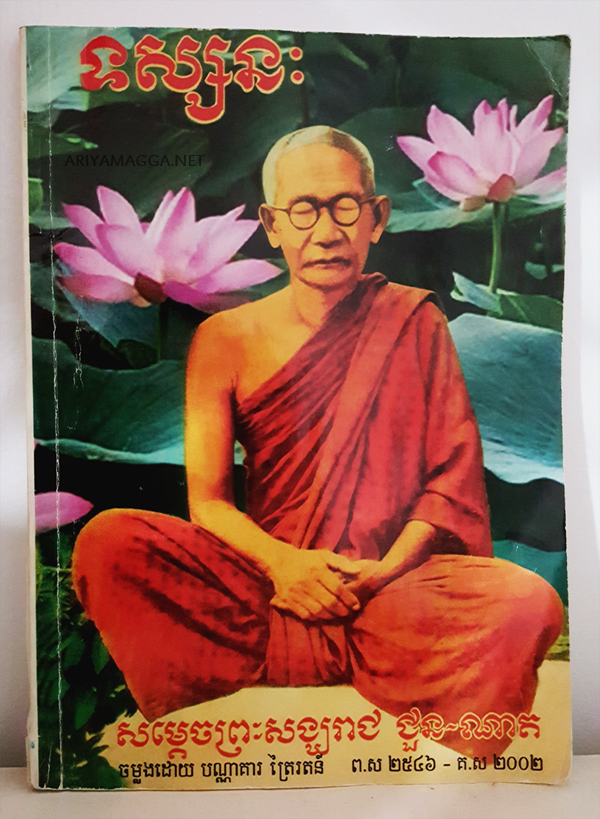
Samdech Chuon Nath

My reflection

វចនានុក្រមសម្តេចសង្ឃ ជួន ណាត
Desktop version

Listen to Khmer literature and Dhamma talk by His Holiness Jotannano Chuon Nath, Supreme Patriarch of Cambodia Buddhism.

Shantidevas’ Bodhisattva vows

My reflection

Should anyone wish to ridicule me and make me an object of jest and scorn why should I possibly care if I have dedicated myself to others?

Let them do as they wish with me so long as it does not harm them. May no one who encounters me ever have an insignificant contact.

Regardless whether those whom I meet respond towards me with anger or faith, may the mere fact of our meeting contribute to the fulfilment of their wishes.

May the slander, harm and all forms of abuse that anyone should direct towards me act as a cause of their enlightenment.

As a solid rock is not shaken by the wind, so the wise are not shaken by blame and praise. As a deep lake is clear and calm, so the wise become tranquil after they listened to the truth…

Good people walk on regardless of what happens to them. Good people do not babble on about their desires. Whether touched by happiness or by sorrow, the wise never appear elated or depressed. ~The Dhammapada

Hermit of Tbeng Mountain

Sachjang Phnom Tbeng សច្ចំ​​ ភ្នំត្បែង is a very long and interesting story written by Mr. Chhea Sokoan, read by Jendhamuni Sos. You can click on the links below to listen. Part 1 | Part 2

Beauty in nature

A beautiful object has no intrinsic quality that is good for the mind, nor an ugly object any intrinsic power to harm it. Beautiful and ugly are just projections of the mind. The ability to cause happiness or suffering is not a property of the outer object itself. For example, the sight of a particular individual can cause happiness to one person and suffering to another. It is the mind that attributes such qualities to the perceived object. — Dilgo Khyentse Rinpoche

Nature is loved by what is best in us. The sky, the mountain, the tree, the animal, give us a delight in and for themselves. — Ralph Waldo Emerson


Our journey for peace
begins today and every day.
Each step is a prayer,
Each step is a meditation,
Each step will build a bridge.

—​​​ Maha Ghosananda