1. Radiate peace, harmony, and love

    Comment

    Radiate peace, harmony, love and laughter from your heart.

    We have stopped for a moment to encounter each other, to meet, to love, to share. This is a precious moment, but it is transient. It is a little parenthesis in eternity. If we share with caring, lightheartedness and love, we will create abundance and joy for each other. And then this moment will have been worthwhile. ~Deepak Chopra


    Jendhamuni at homeblueshirt

  2. Fragments of a Teaching

    Comment

    buddhadhammatalk071115

    A Dhamma talk by Ajahn Chah

    All of you have believed in Buddhism for many years now through hearing about the Buddhist teachings from many sources – especially from various monks and teachers. In some cases Dhamma is taught in very broad and vague terms to the point where it is difficult to know how to put it into practice in daily life. In other instances Dhamma is taught in high language or special jargon to the point where most people find it difficult to understand, especially if the teaching is done too literally from scripture. Lastly there is Dhamma taught in a balanced way, neither too vague nor too profound, neither too broad nor too esoteric – just right for the listener to understand and practice to personally benefit from the teachings. Today I would like share with you teachings of the sort I have often used to instruct my disciples in the past; teachings which I hope may possibly be of personal benefit to those of you here listening today.

    One Who Wishes to Reach the Buddha-Dhamma

    One who wishes to reach the Buddha-Dhamma must firstly be one who has faith or confidence as a foundation. He must understand the meaning of Buddha-Dhamma as follows:

    Buddha: the ‘one-who-knows’, the one who has purity, radiance and peace in his heart.

    Dhamma: the characteristics of purity, radiance and peace which arise from morality, concentration and wisdom.

    Therefore, one who is to reach the Buddha-Dhamma is one who cultivates and develops morality, concentration and wisdom within himself.

    Walking the Path of Buddha-Dhamma

    Naturally people who wish to reach their home are not those who merely sit and think of traveling. They must actually undertake the process of traveling step by step, and in the right direction as well, in order to finally reach home. If they take the wrong path they may eventually run into difficulties such as swamps or other obstacles which are hard to get around. Or they may run into dangerous situations in this wrong direction, thereby possibly never reaching home.

    Those who reach home can relax and sleep comfortably – home is a place of comfort for body and mind. Now they have really reached home. But if the traveler only passed by the front of his home or only walked around it, he would not receive any benefit from having traveled all the way home.

    In the same way, walking the path to reach the Buddha-Dhamma is something each one of us must do individually ourselves, for no one can do it for us. And we must travel along the proper path of morality, concentration and wisdom until we find the blessings of purity, radiance and peacefulness of mind that are the fruits of traveling the path.

    However, if one only has knowledge of books and scriptures, sermons and suttas, that is, only knowledge of the map or plans for the journey, even in hundreds of lives one will never know purity, radiance and peacefulness of mind. Instead one will just waste time and never get to the real benefits of practice. Teachers are those who only point out the direction of the path. After listening to the teachers, whether or not we walk the path by practicing ourselves, and thereby reap the fruits of practice, is strictly up to each one of us.

    Another way to look at it is to compare practice to a bottle of medicine a doctor leaves for his patient. On the bottle is written detailed instructions on how to take the medicine, but no matter how many hundred times the patient reads the directions, he is bound to die if that is all he does. He will gain no benefit from the medicine. And before he dies he may complain bitterly that the doctor wasn’t any good, that the medicine didn’t cure him! He will think that the doctor was a fake or that the medicine was worthless, yet he has only spent his time examining the bottle and reading the instructions. He hasn’t followed the advice of the doctor and taken the medicine. Continue reading

  3. What to do

    Comment

    When you can’t figure out what to do, it’s time for a nap. ~Mason Cooley

  4. Sometimes…

    Comment

    Sometimes life is too hard to be alone, and sometimes life is too good
    to be alone. ~Elizabeth Gilbert

  5. Dog, the driver

    Comment

    Does your dog love to hang out with kids? Most dogs love to play with kids. Come to think of it, dogs are just like kids. They love to run and they sure love to play. And some of us even talk to our dogs like we talk to our babies, right? Source: Iheartdogs

  6. Poor turtle, kitty must be too heavy

    Comment

    Consider before you buy…turtles carry Salmonella

    Salmonella isn’t just a food-borne illness. Turtles and other reptiles carry Salmonella bacteria, which can be easily transmitted to people. A small turtle may seem harmless, giving parents a false sense that they’re a safe pet for children. But they’re not. The disease risk is so great that selling small turtles is illegal in the United States.

    Salmonella is especially dangerous for children and senior citizens
    In 2007, a baby girl in Florida died from Salmonella that was traced back to a pet turtle. The turtle was sold illegally at a flea market and given to the family.

    Salmonella usually gives people a few miserable days of fever and diarrhea, but some end up in the hospital with life-threatening complications. Children and people with weak immune systems are most at risk. Additionally, a small number of people with Salmonella infections later develop Reiter’s syndrome, which causes pain in their joints and can lead to chronic arthritis.

    The U.S. Centers for Disease Control and Prevention (CDC) says: Do not have a turtle in any household that includes children under five, the elderly, or people who have lowered natural resistance to disease due to pregnancy, cancer, chemotherapy, organ transplants, diabetes, liver problems or other diseases.

    Source: The Humane Society of the United States

  7. Blessing and cursing

    Comment

    From the same mouth come blessing and cursing.
    My brothers, these things ought not to be so.

    ~James 3:10 ESV 

  8. The heart of the righteous

    Comment

    The heart of the righteous ponders how to answer,
    but the mouth of the wicked pours out evil things.

    ~Proverbs 15:28 ESV

  9. Devadatta Sutta: About Devadatta

    Comment


    Devadatta071215On one occasion the Blessed One was staying near Rajagaha on Vulture Peak Mountain, not long after Devadatta’s departure. There, referring to Devadatta, he addressed the monks: “Monks, it’s good for a monk periodically to have reflected on his own failings. It’s good for a monk periodically to have reflected on the failings of others. It’s good for a monk periodically to have reflected on his own attainments. It’s good for a monk periodically to have reflected on the attainments of others.

    “Conquered by eight untrue dhammas, his mind overcome, Devadatta is headed for a state of deprivation, headed for hell, there to stay for an eon, incurable. Which eight?

    “Conquered by material gain, his mind overcome, Devadatta is headed for a state of deprivation, headed for hell, there to stay for an eon, incurable.

    “Conquered by lack of material gain…

    “Conquered by status…

    “Conquered by lack of status…

    “Conquered by offerings…

    “Conquered by lack of offerings…

    “Conquered by evil ambition…

    “Conquered by evil friendship, his mind overcome, Devadatta is headed for a state of deprivation, headed for hell, there to stay for an eon, incurable.

    “Monks, it’s good for a monk to keep conquering again & again any arisen material gain. It’s good for a monk to keep conquering again & again any arisen lack of material gain… any arisen status… any arisen lack of status… any arisen offerings… any arisen lack of offerings… any arisen evil ambition… any arisen evil friendship.

    “And for what compelling reason should a monk keep conquering again & again any arisen material gain… any arisen evil friendship? Because when one dwells not having conquered any arisen material gain, effluents arise, along with vexations & fevers. But when one dwells having conquered any arisen material gain, those effluents, vexations, & fevers are not.

    [Similarly with any arisen lack of material gain, any arisen status, any arisen lack of status, any arisen offerings, any arisen lack of offerings, any arisen evil ambition, & any arisen evil friendship.]

    “It’s for this compelling reason that a monk should keep conquering again & again any arisen material gain… any arisen evil friendship. Continue reading


Live & Die for Buddhism

candle

Khmer Tipitaka 1 – 110

 ព្រះត្រៃបិដក

ព្រះត្រៃបិដក ប្រែថា កញ្រ្ចែង ឬ ល្អី​ ៣ សម្រាប់ដាក់ផ្ទុកពាក្យពេចន៍នៃព្រះសម្មាសម្ពុទ្ធ

The Tipitaka or Pali canon, is the collection of primary Pali language texts which form the doctrinal foundation of Theravada Buddhism. The three divisions of the Tipitaka are: Vinaya Pitaka, Sutta Pitaka, Abhidhamma Pitaka.

Maha Ghosananda

Maha Ghosananda

Supreme Patriarch of Cambodian Buddhism (5/23/1913 - 3/12/07). Forever in my heart...

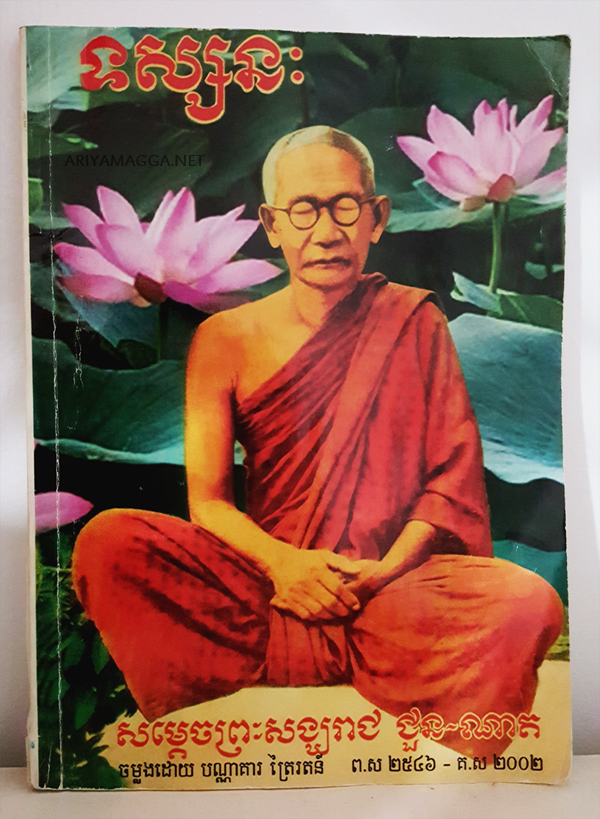
Samdech Chuon Nath

My reflection

វចនានុក្រមសម្តេចសង្ឃ ជួន ណាត
Desktop version

Listen to Khmer literature and Dhamma talk by His Holiness Jotannano Chuon Nath, Supreme Patriarch of Cambodia Buddhism.

Shantidevas’ Bodhisattva vows

My reflection

Should anyone wish to ridicule me and make me an object of jest and scorn why should I possibly care if I have dedicated myself to others?

Let them do as they wish with me so long as it does not harm them. May no one who encounters me ever have an insignificant contact.

Regardless whether those whom I meet respond towards me with anger or faith, may the mere fact of our meeting contribute to the fulfilment of their wishes.

May the slander, harm and all forms of abuse that anyone should direct towards me act as a cause of their enlightenment.

As a solid rock is not shaken by the wind, so the wise are not shaken by blame and praise. As a deep lake is clear and calm, so the wise become tranquil after they listened to the truth…

Good people walk on regardless of what happens to them. Good people do not babble on about their desires. Whether touched by happiness or by sorrow, the wise never appear elated or depressed. ~The Dhammapada

Hermit of Tbeng Mountain

Sachjang Phnom Tbeng សច្ចំ​​ ភ្នំត្បែង is a very long and interesting story written by Mr. Chhea Sokoan, read by Jendhamuni Sos. You can click on the links below to listen. Part 1 | Part 2

Beauty in nature

A beautiful object has no intrinsic quality that is good for the mind, nor an ugly object any intrinsic power to harm it. Beautiful and ugly are just projections of the mind. The ability to cause happiness or suffering is not a property of the outer object itself. For example, the sight of a particular individual can cause happiness to one person and suffering to another. It is the mind that attributes such qualities to the perceived object. — Dilgo Khyentse Rinpoche

Nature is loved by what is best in us. The sky, the mountain, the tree, the animal, give us a delight in and for themselves. — Ralph Waldo Emerson


Our journey for peace
begins today and every day.
Each step is a prayer,
Each step is a meditation,
Each step will build a bridge.

—​​​ Maha Ghosananda