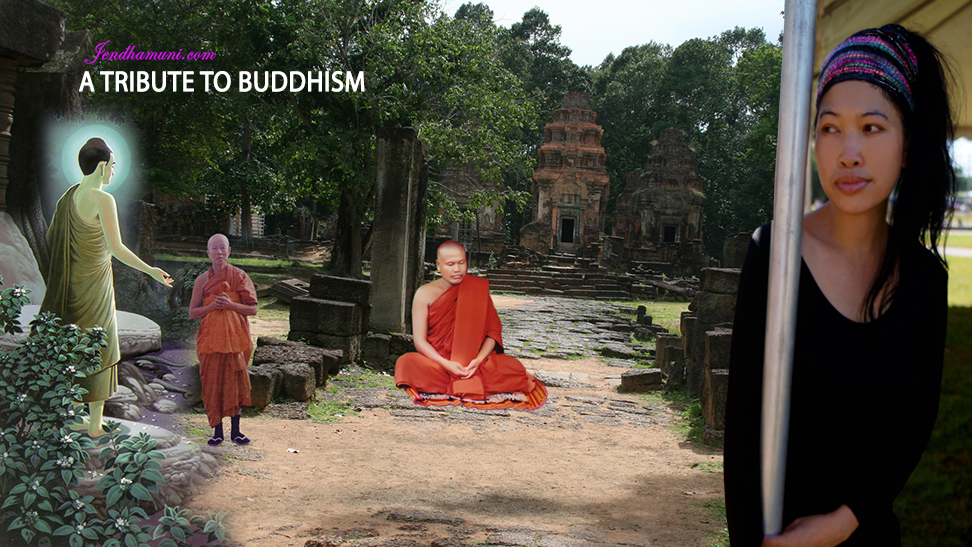
If anybody speaks ill of you
Comment
July 8, 2015
Harsh words cannot pierce your body. If anybody speaks ill of you,
just continue on unperturbed. ~Santabanta sms


Harsh words cannot pierce your body. If anybody speaks ill of you,
just continue on unperturbed. ~Santabanta sms

Devadatta taken refuge as was sinking into the earth.
Samudda-Vanija-Jataka
It was while staying at Jetavana that the Buddha told this story about Devadatta.
After his three attempts to kill the Buddha had failed, Devadatta made five demands–that bhikkhus live only in the forest, that they eat only food received on almsrounds, that they wear only rag robes, that they stay only under trees, and that they eat neither meat nor fish. The Buddha rejected the demands, saying, “Enough, Devadatta! Any bhikkhu who desires to do so may undertake these austerities, but I will not impose them.”
“Whose words are nobler,” Devadatta exclaimed, “the words of the Tathagata or mine? I declare that, for all their lives, bhikkhus should follow these rules. Whoever desires release from suffering, let him come with me!”
At that time, there were five hundred Licchavis who had recently ordained as bhikkhus. These young men were impressed by Devadatta’s bravado, and they decided to follow him. Some laypeople, as well, were persuaded that these austerities were necessary and gave their support to Devadatta.
The Buddha asked Devadatta whether it was indeed his intention to create a separate Sangha, and Devadatta replied that it was. “Devadatta,” the Buddha warned, “creating a schism in this way is a grievous thing to do!”
Completely ignoring the Buddha’s warning, Devadatta announced to Venerable Ananda that, henceforth, he would be observing Patimokkha independently from the Buddha’s Sangha. When this was reported to the Buddha, the Blessed One proclaimed, “Devadatta is doing something which will be of no benefit to himself and which will, in fact, cause him to be tormented in Avici hell.”
On the next Uposatha Day, Devadatta took his followers to Gayasisa to observe the Patimokkha. The Buddha summoned Venerable Sariputta and Venerable Moggallana and asked them to go to Gayasisa and to bring those bhikkhus back to Rajagaha.
Devadatta welcomed the two chief disciples and sat them beside him. As he taught the assembled bhikkhus, he attempted to imitate the Buddha. After a while, still trying to act like the Buddha, he claimed to be suffering from an aching back and asked Venerable Sariputta and Venerable Moggallana to continue instructing the young bhikkhus while he retired to rest.
The two chief disciples taught the Dhamma so clearly and skillfully that all five hundred of those bhikkhus abandoned Devadatta and returned to Rajagaha.
Kokalika, Devadatta’s personal attendant, rushed to his master’s chamber and shouted, “Get up, Devadatta! Sariputta and Moggallana have taken away your monks. Why didn’t you listen to my warning? I told you not to trust those two!”
Without getting out of bed, Devadatta muttered, “Sariputta and Moggallana cherish evil desires! They are under the control of evil desires.” Kokalika was so disgusted by this jibberish that he kicked Devadatta in the chest, causing him to vomit hot blood.
After this incident, Devadatta’s health steadily worsened. One day, he said to his followers, “I desire to see the Teacher. Make it possible for me to see him.”
“When you enjoyed good health,” his disciples retorted, “you were at odds with the Teacher. Now that you are ill, we will not take you to him.”
“Please do not destroy me!” Devadatta begged. “It is true that I have felt hatred toward the Teacher, but the Teacher has not felt even so much as a twinge of animosity toward me. I have thought evil of the Tathagata, but, in his mind, there has never been a single thought of malice toward me. Even among the eighty great disciples there is no hostility toward me. By my own deeds alone am I forlorn, cut off from the Buddha, separated from the great disciples. I must go to the Buddha and reconcile myself with him!”
Hearing this heartfelt plea, his followers relented and prepared a litter. They placed Devadatta on it and carried him slowly toward Savatthi.
Venerable Ananda heard that Devadatta was coming and announced to the Buddha that his cousin was coming to make his peace.
“Ananda,” the Buddha replied, “Devadatta shall not see me.”
Later, Ananda reported that Devadatta and his entourage had reached the city, and the Buddha repeated his statement that Devadatta would not succeed in seeing him.
When Ananda announced that Devadatta had reached the lotus tank, the Buddha declared,”Even if he enters Jetavana Monastery itself, he will not succeed in seeing me.” Continue reading
Only tolerance and patience can protect us from the destructive
effects of anger and hatred. ~Dalai Lama

The less you respond to rude, critical, argumentative people
– the more peaceful your life will become. ~Santabanta sms

Puppies are sometimes rejected by their mother if they are born by cesarean and cleaned up before being given back to her. Small quantities of grapes and raisins can cause renal failure in dogs. Chocolate, macadamia nuts, cooked onions, or anything with caffeine can also be harmful. Source: RandomFacts

Life is like a camera focus on what’s important capture
the good times develop from the negatives;
and if things don’t work out take another shot.
~Santabanta sms

The only things you can take when you leave this world
are the things you’ve packed inside your heart.
~Santabanta sms

Meditate bhikkhu! Don’t be heedless!
Don’t let pleasures whirl the mind!
Heedless, do not gulp a glob of iron!
Bewail not when burning, ‘This is dukkha’!
~Dhammapada
Explanation: O monk, meditate and do not be indolent. Do not allow your mind to loiter among sensual pleasures. If you allow it, it will be like having iron balls forced down your throat in hell. You will bewail your fate crying, “This is suffering,” Do not allow it to happen. Source: Buddhanet

You respect your mind, so you are more careful what you put in it. If you have a nice house, you don’t go out and pick up all the filth from the street and bring it in, you bring in things that will enhance it and make it a refreshing and delightful place.
If you are going to identify with anything, then don’t identify with mortal conditions. See what identification is – investigate your own mind to see clearly the nature of thought, of memory, of sense consciousness, and of feeling as impermanent conditions. Bring your awareness to the slower things, to the transiency of bodily sensation; investigate pain and see it as a moving energy, a changing condition. Emotionally, it seems permanent when you are in pain, but that is just an illusion of the emotions – let go of it all. Even if you have insight, even if you understand everything clearly – let go of the insight.
When the mind is empty, say ‘ Who is it that lets go?’ Ask the question, try to find out who it is, what it is that lets go. Bring up that not-knowing state with the word Who – ‘Who am I? Who lets go?’ A state of uncertainty arises; bring this up, allow it to be . . . and there is emptiness, voidness, the state of uncertainty when the mind just goes blank.
I keep stressing this right understanding, right attitude, right intention, more towards simplifying your life so that you aren’t involved in unskilful and complex activities. So that you don’t live heedlessly, exploiting others and having no respect for yourself or the people around you. Develop the Precepts as a standard, and develop nekkhamma – renunciation of that which is unskilful or unnecessary – and then mentally let go of greed, let go of hatred, let go of delusion. ~Ajahn Sumedho

Buddha-wisdom is just that much: knowing the conditioned as the conditioned, and the Unconditioned as the Unconditioned. Buddhas rest in the Unconditioned, and no longer, unless it’s necessary, seek absorption into anything. They are no longer deluded by any conditions, and they incline to the Unconditioned, the spaciousness, the emptiness, rather than towards the changing conditions within the space.
In your meditation now, as you incline towards the emptiness of the mind, towards the spaciousness of the mind, your habitual grasping, fascination, revulsions, fears, doubts and worries about the conditions lessen. You begin to recognise they’re just things that come and go: they’re not-self, nothing to get excited about or depressed about, they are as they are. We can allow conditions to be just as they are, because they come and go – their nature is to go away, so we don’t have to make them go away. We’re free and patient and enduring enough to allow things to take their natural course. In this way, we liberate ourselves from the struggle, strife, and the confusion of the ignorant mind that has to spend all its time evaluating and discriminating, trying to hold onto something, trying to get rid of something. ~Ajahn Sumedho



ព្រះត្រៃបិដក ប្រែថា កញ្រ្ចែង ឬ ល្អី ៣ សម្រាប់ដាក់ផ្ទុកពាក្យពេចន៍នៃព្រះសម្មាសម្ពុទ្ធ
The Tipitaka or Pali canon, is the collection of primary Pali language texts which form the doctrinal foundation of Theravada Buddhism. The three divisions of the Tipitaka are: Vinaya Pitaka, Sutta Pitaka, Abhidhamma Pitaka.
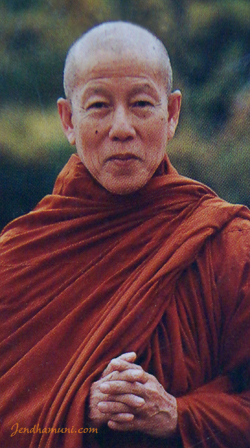
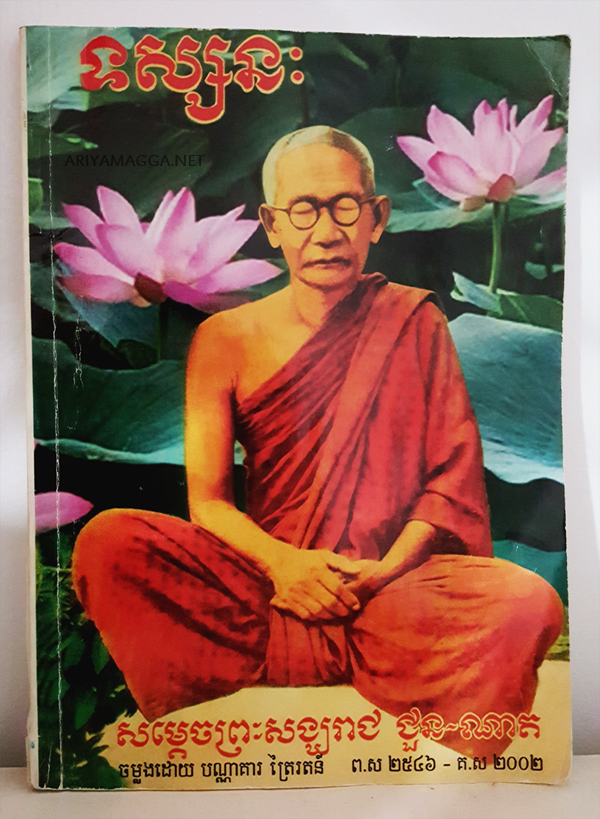
វចនានុក្រមសម្តេចសង្ឃ ជួន ណាត
Desktop version
Listen to Khmer literature and Dhamma talk by His Holiness Jotannano Chuon Nath, Supreme Patriarch of Cambodia Buddhism.
Should anyone wish to ridicule me and make me an object of jest and scorn why should I possibly care if I have dedicated myself to others?
Let them do as they wish with me so long as it does not harm them. May no one who encounters me ever have an insignificant contact.
Regardless whether those whom I meet respond towards me with anger or faith, may the mere fact of our meeting contribute to the fulfilment of their wishes.
May the slander, harm and all forms of abuse that anyone should direct towards me act as a cause of their enlightenment.

As a solid rock is not shaken by the wind, so the wise are not shaken by blame and praise. As a deep lake is clear and calm, so the wise become tranquil after they listened to the truth…
Good people walk on regardless of what happens to them. Good people do not babble on about their desires. Whether touched by happiness or by sorrow, the wise never appear elated or depressed. ~The Dhammapada