Be a Rose
62
April 9, 2013
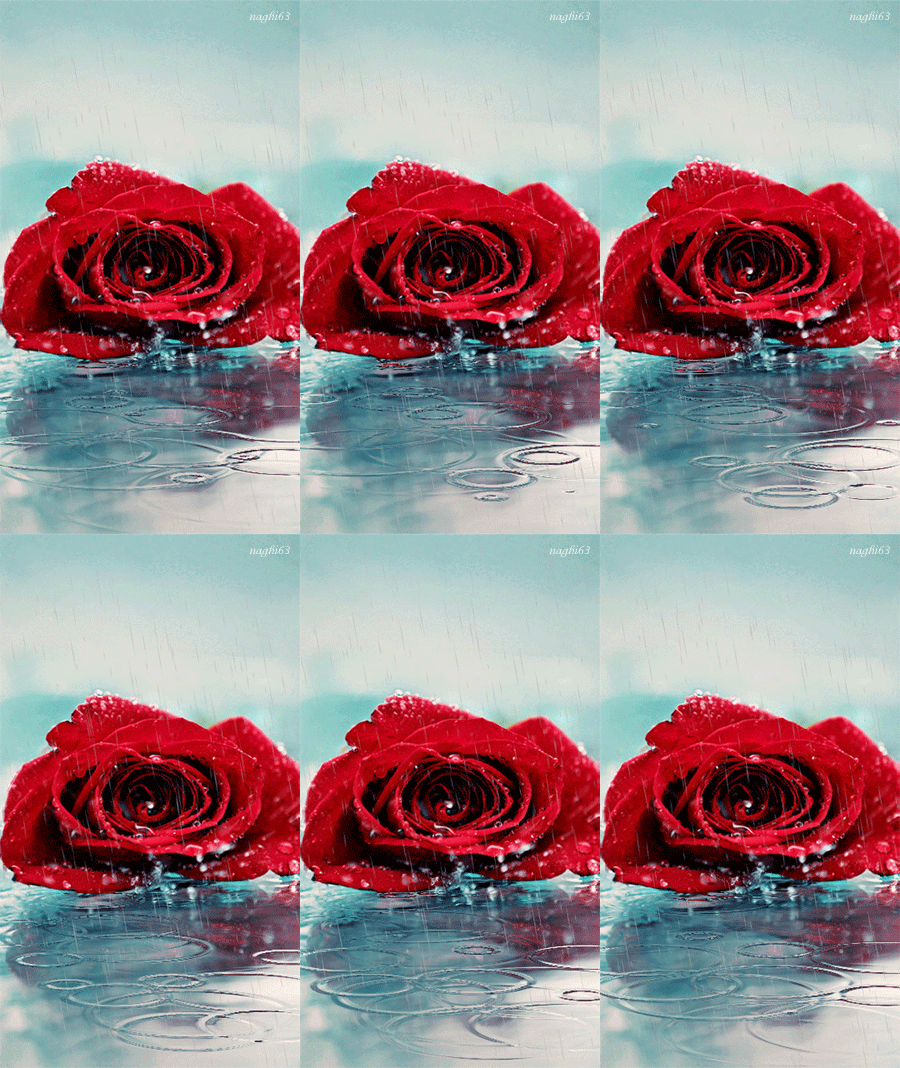
Be a rose which gives fragrance
even to those who crushes it.
~Unknown

The practice of compassion begins at home. We have our parents, our children, and our brothers and sisters, who perhaps irritate us the most, and we begin our practice of loving-kindness and compassion with them. Then gradually we extend our compassion out into our greater community, our country, neighbouring countries, the world, and finally to all sentient beings equally without exception.
Extending compassion in this way makes it evident that it is not very easy to instantly have compassion for “all sentient beings.” Theoretically it may be comfortable to have compassion for “all sentient beings,” but through our practice we realize that “all sentient beings” is a collection of individuals. When we actually try to generate compassion for each and every individual, it becomes much more challenging. But if we cannot work with one individual, then how can we work with all sentient beings? Therefore it is important for us to reflect more practically, to work with compassion for individuals and then extend that compassion further.
~ Dilgo Khyentse Rinpoche, Trainings in Compassion
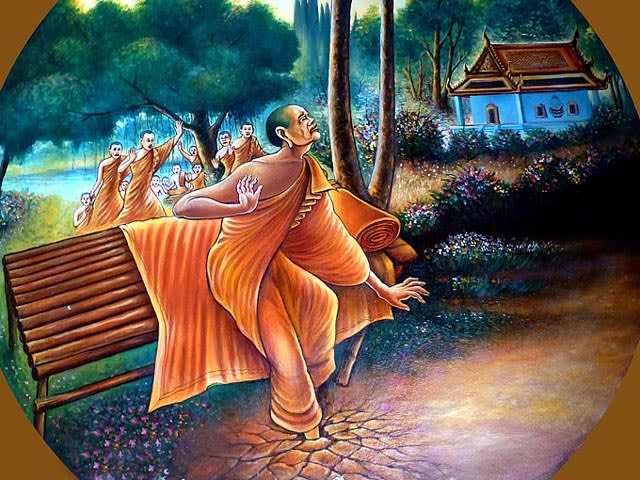
Photo caption: Devadatta is taken to hell (avici), alive, by Mother Earth after his three attempts to kill the Buddha had failed.
Buddhism teaches that everyone is responsible for his own good and bad deeds, and that each individual can mould his own destiny. Says the Buddha, “These evil deeds were only done by you, not by your parents, friends, or relatives; and you yourself will reap the painful results.”
Buddhism is a gentle religion where equality, justice and peace reign supreme. To depend on others for salvation is negative, but to depend on oneself is positive. Dependence on others means surrendering one’s intelligence and efforts.
In Buddhism, actions are merely termed as unskillful or unwholesome, not as sinful. Buddhists do not regard man as sinful by nature of ‘in rebellion against god’. Every human being is a person of great worth who has within himself a vast store of good as well as evil habits. The good in a person is always waiting for a suitable opportunity to flower and to ripen. Remember the saying, ‘There is so much that is good in the worst of us and so much that is bad in the best of us.’
By Venerable K. Sri Dhammananda
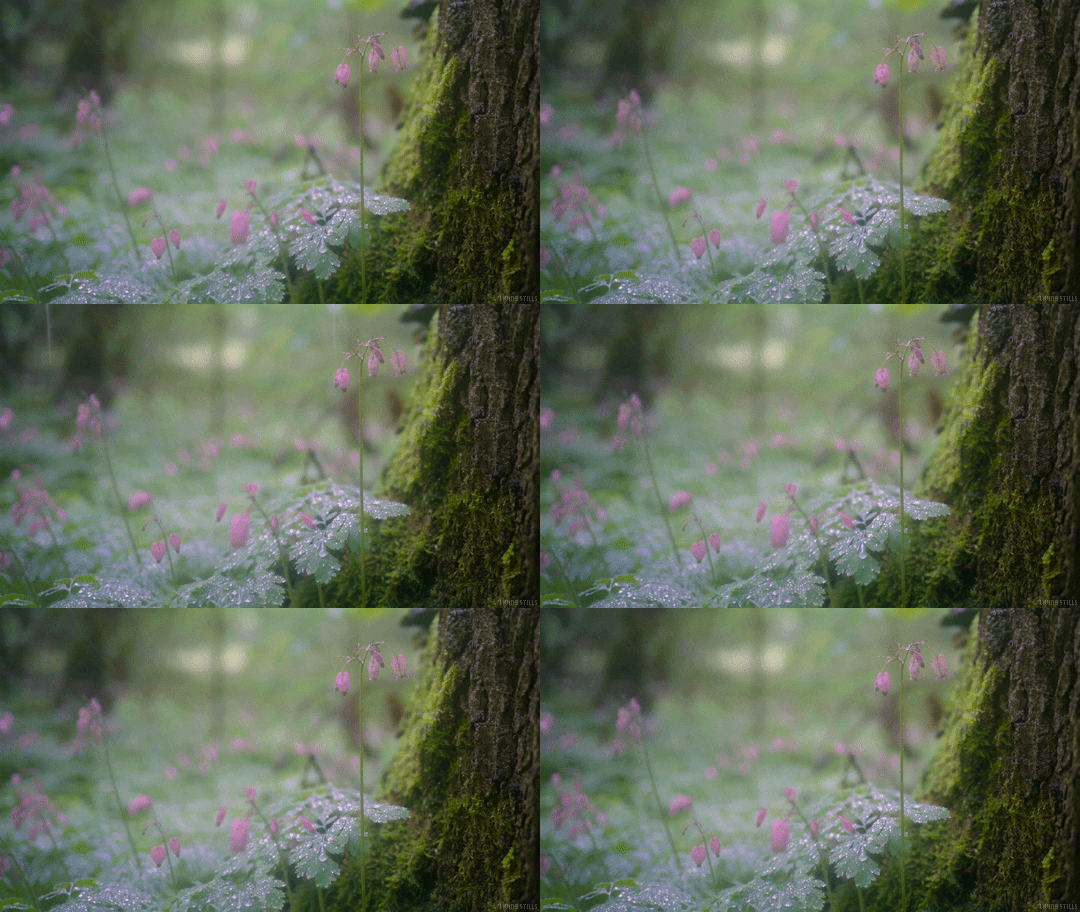
Master your words.
Master your thoughts.
Never allow your body to do harm.
Follow these three roads with purity
And you will find yourself upon the one way,
The way of wisdom.
~Buddha
To develop understanding, you have to practice looking at all living beings with the eyes of compassion. When you understand, you love. And when you love, you naturally act in a way that can relieve the suffering of people.
Understanding and love are not two things, but just one. Suppose your son wakes up one morning and sees that it is already quite late. He decides to wake up his younger sister, to give her enough time to eat breakfast before going to school. It happens that she is grouchy and instead of saying, “Thank you for waking me up,” she says, “Shut up! Leave me alone!” and kicks him. He will probably get angry, thinking, “I woke her up nicely. Why did she kick me?” He may want to go to the kitchen and tell you about it, or even kick her back. But then he remembers that during the night his sister coughed a lot, and he realizes that she must be sick. Maybe she has a could, maybe that is why she behaved so meanly. He is not angry anymore. At that moment there is Buddha in him. He understands, he is awake. When you understand, you cannot help but love. You cannot get angry.
~Thich Nhat Hanh
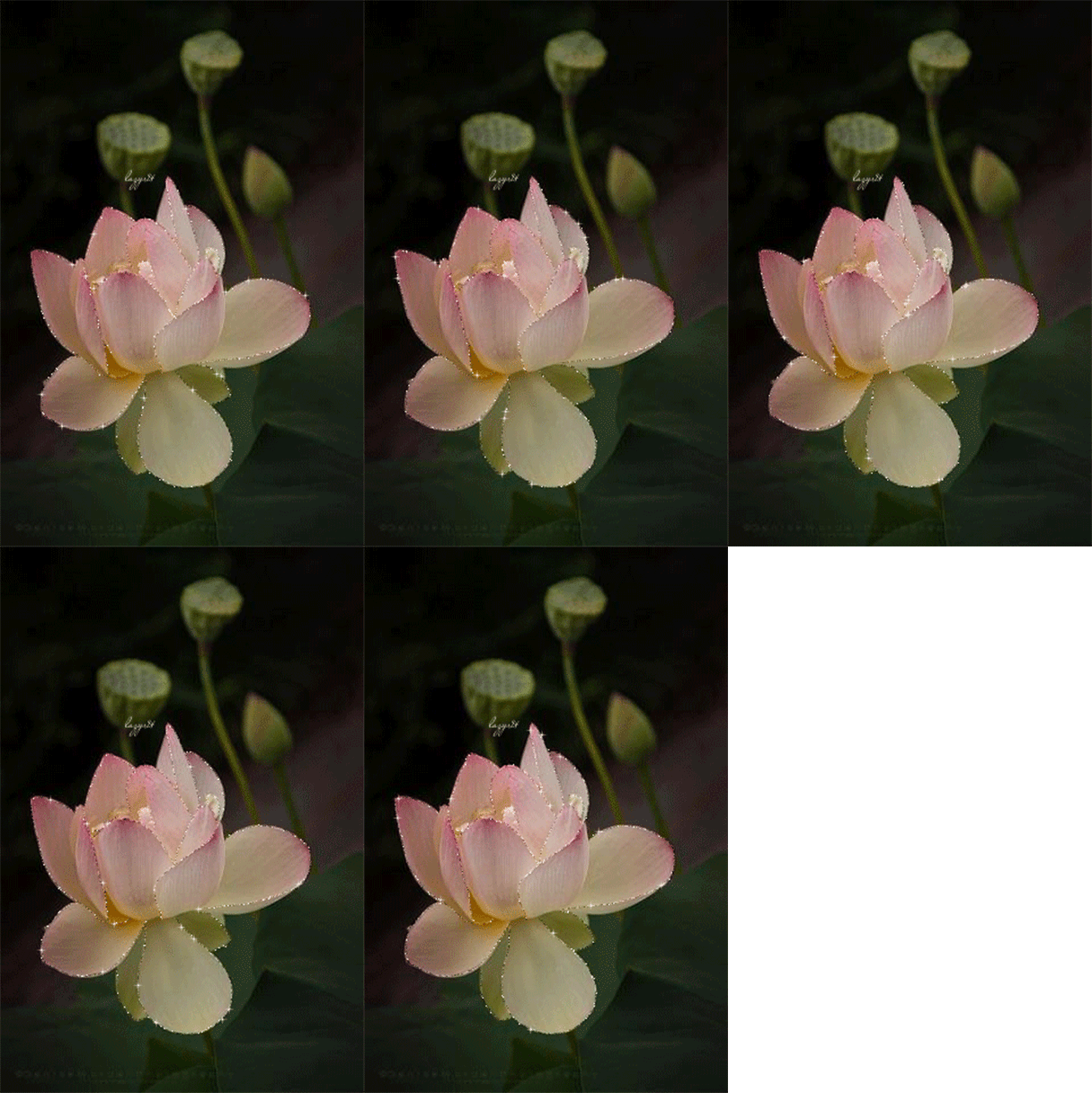
Lotuses are symbols of purity and ‘spontaneous’ generation and hence symbolize divine birth. According to the Lalitavistara, ‘the spirit of the best of men is spotless, like the new lotus in the [muddy] water which does not adhere to it’, and, according to esoteric Buddhism, the heart of the beings is like an unopened lotus: when the virtues of the Buddha develop therein the lotus blossoms. This is why the Buddha sits on a lotus in bloom. In Tantrism, it is the symbol of the feminine principle. The lotuses are usually differentiated by their colour and grouping, in three or five flowers, which may or may not be combined with leaves.
White lotus
This symbolizes Bodhi, the state of total mental purity and spiritual perfection, and the pacification of our nature. It generally has eight petals corresponding to the Noble Eightfold Path of the Good Law. It is the lotus found at the heart of the Garbhadhatu Mandala, being the womb or embryo of the world. It is characteristic of the esoteric sects, and the lotus of the Buddhas.
Red lotus
This symbolizes the original nature of the heart (hrdaya). It is the lotus of love, compassion, passion, activity and all the qualities of the heart. It is the lotus of Avalokitesvara. Continue reading
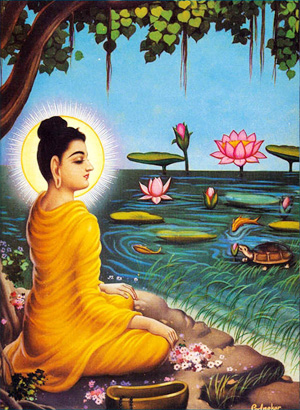
Buddha used to be a turtle in one of his previous lifetimes
A story that is often depicted in Buddhist art is the one where the Buddha in a previous life is a Bodhisattva-turtle (that is: a turtle who has vowed to save all sentient beings).
A group of merchants were sailing, when a storm hit. The giant Bodhisattva-turtle saw the ship wreck and saved the merchants by letting them climb on his back. He brought them safely to land. Tired from the long swim and heavy load he fell asleep on the sand.
The merchants were hungry and thirsty and after the ordeal were still not sure of their lives. They discussed amongst themselves how to find food. One of them said that they should kill and eat the turtle.
The Bodhisattva-turtle heard this and out of compassion for the merchants, decided to stay put and be eaten.
The Jatakas
Jatakas are stories of previous lifetimes of the Buddha

I never forget the day my little turtle came to see me at the lake, after my prayer. It was a miracle. After one hour of visit, Little Turtle would not swim a way from me…
Sometimes we worry too much about eating. We enjoy eating way too much, as though we are born only to eat, without thinking about the welfare of animals – big or little…We hardly take time to contemplate on animals’ lives. As though we do not care one bit about their safety. I think we are too selfish. We think too much about ourselves, we think too much about delicious food… We complain non-stop when someone said bad things to us, speak unpleasant words to us, but we never complain about how we, ourselves, treating others. That is not LOVE
May each day be blessed
With all sorts of wonderful things;
Like the comfort of love and the joy of hope
And the warmth that having a good friend brings
May your tomorrows be carefree;
Free from worries and fears
May each moment be magical
Lasting through the years
May this day find you well
As you cross my mind
And may you know that you’re
An important person in my life
~The Poetry Pad