1. As long as you learn

    Comment

    To live as equals with others requires a wide range of experience. The wise have much experience and fools have little. To gain experience, you need to go through good and bad times. How can you grow if your experiences are always the same? Anything that happens, good or bad, can be constructive in the end — as long as you learn something useful from it. So when you face difficulties, don’t feel too bad! ~17th Karmapa

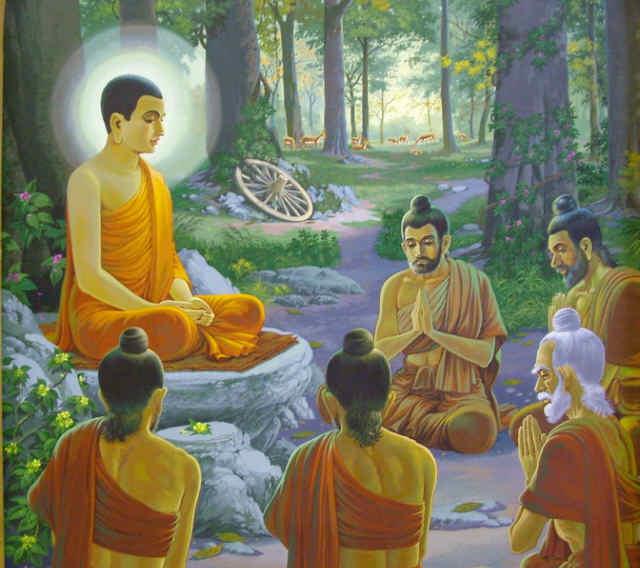
    Buddha sitting

  2. Those who lead others through nonviolent

    Comment

    They are not following dharma who resort to violence to achieve their purpose. But those who lead others through nonviolent means, knowing right and wrong, may be called guardians of the dharma. ~Buddha

    yellow flowers swaying

  3. knowing that the other person is angry

    Comment

    Knowing that the other person is angry, one who remains mindful and calm acts for his one’s own best interest as well as for the other’s interest. ~ Buddha

    angry

  4. Those who cause me suffering

    Comment

    Buddha

    Those who cause me suffering
    Are like Buddhas bestowing their blessings.
    Since they lead me to liberating paths,
    Why should I get angry with them?

    “Don’t they obstruct your virtuous practice?”
    No! There is no virtuous practice greater than patience;
    Therefore, I will never get angry
    With those who cause me suffering.

    If, because of my own shortcomings,
    I do not practice patience with my enemy,
    It is not he, but I, who prevents me from practicing patience,
    The cause of accumulating merit.

    —Shantideva


  5. It’s All Right Here

    Comment

    The Buddha is the Dhamma; the Dhamma is the Buddha. He didn’t take away the knowledge he awakened to. He left it right here. To put it in simple terms, it’s like the teachers in schools. They haven’t been teachers from birth. They had to study the course of study for teachers before they could be teachers, teaching in school and getting paid. After a while, they’ll die away — away from being teachers. But you can say that in a way the teachers don’t die. The qualities that make people into teachers remain right here. It’s the same with the Buddha. The noble truths that made him the Buddha still remain right here. They haven’t run off anywhere at all. ~Ajahn Chah

    “In Simple Terms: 108 Dhamma Similes”, by Ajahn Chah
    translated from the Thai by Thanissaro Bhikkhu.
    Access to Insight (Legacy Edition), 2 November 2013
    Link source


  6. If you develop love truly great

    Comment

    flowers and coffee animation

    LOVE

    If you develop love truly great,
    rid of the desire to hold and possess.
    That strong, clean love untarnished by lust,
    that love which does not expect to be repayed,
    that love which is firm but not grasping,
    enduring but not tied down,
    gentle and settled,
    diamond-hard but unhurting,
    helpful but not interfering,
    cool and refreshing,
    giving more than taking,
    dignified but not proud,
    soft but not weak,
    that love which leads to Enlightenment,
    then you will be washed of all ill-will.

    Gurulugomi (Buddhist Sage~12th Century AD)

  7. Don’t spend your precious time asking

    Comment

    Don’t spend your precious time asking
    “Why isn’t the world a better place?”
    It will only be time wasted.
    The question to ask is
    “How can I make it better?”
    To that there is an answer.

    ― Leo Buscaglia

    Buddha

  8. Buddhist Teachings and Practice Paths

    Comment

    Buddha walking

    The Triple Gem

    1. The Buddha — The self awakened one. The original nature of the Heart;
    2. The Dhamma — The Teaching. The nature of reality;
    3. The Sangha — a. The Awakened Community. b. Any harmonious assembly. c. All Beings.

    The Four Noble Truths

    1. The Noble Truth of Dukkha – stress, unsatisfactoriness, suffering;
    2. The Noble Truth of the causal arising of Dukkha, which is grasping, clinging and wanting;
    3. The Noble Truth of Nirvana, The ending of Dukkha. Awakening, Enlightenment. “Mind like fire unbound”;
    4. The Noble Truth of the Path leading to Nirvana or Awakening.

    All Buddhist teachings flow from the Four Noble Truths. Particularly emphasised in the Theravada.

    The Four Bodhisattva Vows

    1. I vow to rescue the boundless living beings from suffering; (Link to 1st Truth)
    2. I vow to put an end to the infinite afflictions of living beings; (Link to 2nd Truth)
    3. I vow to learn the measureless Dharma-doors; (Link to 4th Truth)
    4. I vow to realise the unsurpassed path of the Buddha. (Link to 3th Truth)

    Foundation of the Mahayana Path, these vows say. ‘Whatever the highest perfection of the human heart-mind may I realise it for the benefit of all that lives!’

    The Eight Fold-Path

    Right, Integral, Complete, Perfected. Continue reading

Live & Die for Buddhism

candle

Me & Grandma

My Reflection

This site is a tribute to Buddhism. Buddhism has given me a tremendous inspiration to be who and where I am today. Although I came to America at a very young age, however, I never once forget who I am and where I came from. One thing I know for sure is I was born as a Buddhist, live as a Buddhist and will leave this earth as a Buddhist. I do not believe in superstition. I only believe in karma.

A Handful of Leaves

A Handful of Leaves

Tipitaka: The pali canon (Readings in Theravada Buddhism). A vast body of literature in English translation the texts add up to several thousand printed pages. Most -- but not all -- of the Canon has already been published in English over the years. Although only a small fraction of these texts are available here at Access to Insight, this collection can nonetheless be a very good place to start.

Major Differences

Major Differences in Buddhism

Major Differences in Buddhism: There is no almighty God in Buddhism. There is no one to hand out rewards or punishments on a supposedly Judgement Day ...read more

Problems we face today

jendhamuni pink scarfnature

Of the many problems we face today, some are natural calamities and must be accepted and faced with equanimity. Others, however, are of our own making, created by misunderstanding, and can be corrected...