1. Difficult, indeed, is self-control

    Comment

    One should do what one teaches others to do; if one would train others, one should be well controlled oneself. Difficult, indeed, is self-control. ~Dhammapada

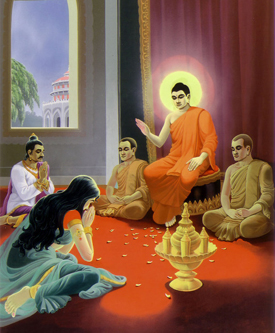
    Buddha and Maras daughters

  2. The Dhamma of the Good does not age

    Comment

    Even gorgeous royal chariots wear out, and indeed this body too wears out. But the Dhamma of the Good does not age; thus the Good make it known to the good. ~Dhammapada

    nature-animation

  3. A genuine smile

    Comment

    A genuine smile comes from deep down in your soul. It is based on the pure joy, peace and happiness you have in your heart. If lost, the smile that replaces it is but a replication and will only last so long. Find your genuine smile, use it generously, and what you will receive in return for sharing it will be amazing. ~ Stephani McLellan

    Jendhamuni and Ananda


  4. Don’t wait until tomorrow

    Comment

    I am only one, but still I am one.
    I cannot do everything,
    but still I can do something;
    and because I cannot do everything,
    I will not refuse to do something I can do.

    ~ Edward Everett Hale

    purple flowers

  5. Bring your own sunshine

    Comment

    Wherever you go, no matter what the weather, always bring your own sunshine.  ~Anthony J. D’Angelo

    Beautiful-Flowers

  6. In our daily life

    Comment

    In our daily life, we encounter people who are angry, deceitful, intent only on satisfying their own needs. There is so much anger, distrust, greed, and pettiness that we are losing our capacity to work well together. Margaret J. Wheatley

    birds and nature

  7. Stay humble, calm and cool

    Comment

    If you want to stay young, beautiful, charming and healthy: Smile a lot, don’t think too much, eat more fruits and veggies, stay humble, calm and cool. Do not be shaken by blame and praise… ~Jendhamuni

    Jendhamuni holding apples

  8. Bring more compassion and healing into the world

    Comment
    Photo credit: KT/ Mai Vireak

    Photo credit: KT/ Mai Vireak

    Metta meditation is a practice of cultivating understanding, love, and compassion by looking deeply, first for ourselves and then for others. Once we love and take care of ourselves, we can be much more helpful to others. Metta meditation can be practiced in part or in full. Just saying one line of the metta meditation will already bring more compassion and healing into the world.

    To love is, first of all, to accept ourselves as we actually are. That is why in this love meditation, “Know thyself” is the first practice of love. When we practice this, we see the conditions that have caused us to be the way we are. This makes it easy for us to accept ourselves, including our suffering and our happiness at the same time.

    Metta means “lovingkindness” in Pali. We begin this with an aspiration: “May I be . . . ” Then we transcend the level of aspiration and look deeply at all the positive and negative characteristics of the object of our meditation, in this case ourselves. The willingness to love is not yet love. We look deeply, with all our being, in order to understand. We don’t just repeat the words, or imitate others, or strive after some ideal. The practice of love meditation is not autosuggestion. We don’t just say, “I love myself. I love all beings.” We look deeply at our body, our feelings, our perceptions, our mental formations, and our consciousness, and in just a few weeks, our aspiration to love will become a deep intention. Love will enter our thoughts, our words, and our actions, and we will notice that we have become “peaceful, happy, and light in body and spirit; safe and free from injury; and free from anger, afflictions, fear, and anxiety.”

    When we practice, we observe how much peace, happiness, and lightness we already have. We notice whether we are anxious about accidents or misfortunes, and how much anger, irritation, fear, anxiety, or worry are already in us. As we become aware of the feelings in us, our self-understanding will deepen. We will see how our fears and lack of peace contribute to our unhappiness, and we will see the value of loving ourselves and cultivating a heart of compassion.

    In this love meditation, “anger, afflictions, fear, and anxiety” refer to all the unwholesome, negative states of mind that dwell in us and rob us of our peace and happiness. Anger, fear, anxiety, craving, greed, and ignorance are the great afflictions of our time. By practicing mindful living, we are able to deal with them, and our love is translated into effective action.

    This is a love meditation adapted from the Visuddhimagga (The Path of Purification) by Buddhaghosa, a 5th-century systematization of the Buddha’s teachings. Continue reading

  9. Karma in Buddhism

    Comment

    Question: Could you explain a little more about karma?

    Answer: Karma is action. Karma is clinging. Body, speech, and mind all make karma when we cling. We make habits. These can make us suffer in the future. This is the fruit of our clinging, of our past defilement. All attachment leads to making karma. Suppose you were a thief before you became a monk. You stole, made others unhappy, made your parents unhappy. Now you are a monk, but when you remember how you made others unhappy, you feel bad and suffer yourself even today. Remember, not only body, but speech and mental action can make conditions for future results. If you did some act of kindness in the past and remember it today, you will be happy. This happy state of mind is the result of past karma. All things are conditioned by cause–both long term and, when examined, moment to moment. But you need not bother to think about past, or present, or future. Merely watch the body and mind. You must figure karma out for yourself. Watch your mind. Practise and you will see clearly. Make sure, however, that you leave the karma of others to them. Don’t cling to and don’t watch others. If I take a poison, I suffer. No need for you to share it with me! Take what is good that your teacher offers. Then you can become peaceful, your mind will become like that of your teacher. If you will examine it, you will see. Even if now you don’t understand, when you practise, it will become clear. You will know by yourself. This is called practising the Dhamma. When we were young, our parents used to discipline us and get angry. Really they wanted to help us. You must see it over the long term. Parents and teachers criticize us and we get upset. Later on we see why. After long practise you will know. Those who are too clever leave after a short time. They never learn. You must get rid of your cleverness. If you think yourself better than others, you will only suffer. What a pity. No need to get upset. Just watch. ~Ajahn Chah

    Buddha with dragon


Live & Die for Buddhism

candle

Me & Grandma

My Reflection

This site is a tribute to Buddhism. Buddhism has given me a tremendous inspiration to be who and where I am today. Although I came to America at a very young age, however, I never once forget who I am and where I came from. One thing I know for sure is I was born as a Buddhist, live as a Buddhist and will leave this earth as a Buddhist. I do not believe in superstition. I only believe in karma.

A Handful of Leaves

A Handful of Leaves

Tipitaka: The pali canon (Readings in Theravada Buddhism). A vast body of literature in English translation the texts add up to several thousand printed pages. Most -- but not all -- of the Canon has already been published in English over the years. Although only a small fraction of these texts are available here at Access to Insight, this collection can nonetheless be a very good place to start.

Major Differences

Major Differences in Buddhism

Major Differences in Buddhism: There is no almighty God in Buddhism. There is no one to hand out rewards or punishments on a supposedly Judgement Day ...read more

Problems we face today

jendhamuni pink scarfnature

Of the many problems we face today, some are natural calamities and must be accepted and faced with equanimity. Others, however, are of our own making, created by misunderstanding, and can be corrected...