1. Demeritorious deeds give rise to more suffering

    8

    The performance of good actions gives rise to merit (punna), a quality which purifies and cleanses the mind. If the mind is unchecked, it has the tendency to be ruled by evil tendencies, leading one to perform bad deeds and getting into trouble. Merit purifies the mind of the evil tendencies of greed, hatred and delusion. The greedy mind encourages a person to desire, accumulate and hoard; the hating mind drags him to dislike and anger; and the deluded mind makes one become entangled in greed and hatred, thinking that these evil roots are right and worthy. Demeritorious deeds give rise to more suffering and reduce the opportunities for a person to know and practise the Dhamma….

    ~Venerable K. Sri Dhammananda Maha Thera

  2. Who is the real Bhikkhu

    Comment

    He who is controlled in hand, controlled in foot, controlled in speech, and possessing the highest control (of mind), delighted within, composed, solitary and contented, him they call a bhikkhu.

    Sayings of the Buddha, by Ven. Dr. K. Sri Dhammananda

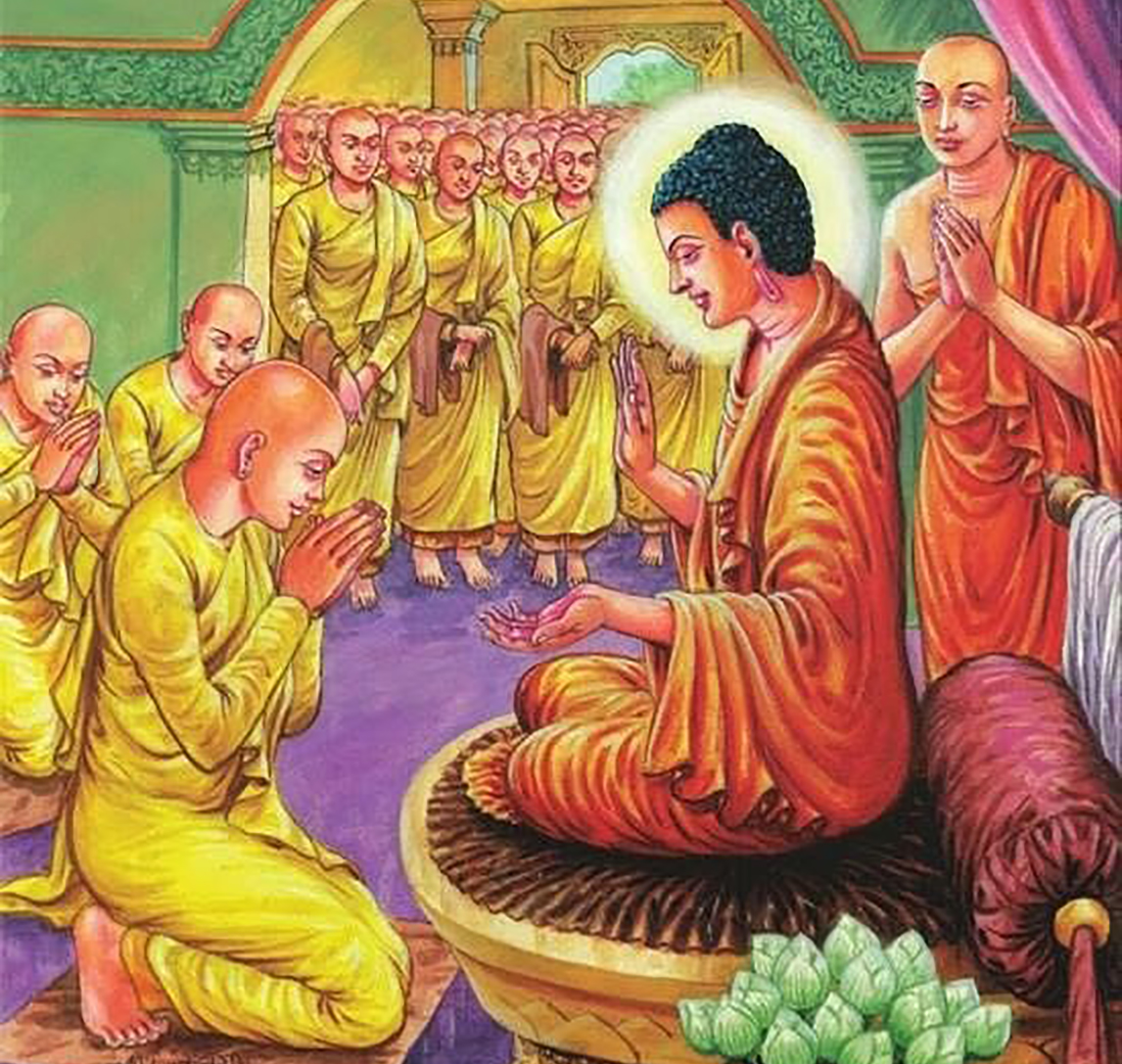
    Buddha with someone


  3. Keep the mind fresh

    Comment

    When your physical body is sick, do not allow your mind also to be sick.
    Sayings of the Buddha, by Ven. Dr. K. Sri Dhammananda

    Buddha

  4. The nature of your perceptions

    Comment

    When you are angry, and you suffer, please go
    back and inspect very deeply the content, the nature
    of your perceptions. If you are capable of removing
    the wrong perception, peace and happiness will
    be restored in you, and you will be able to
    love the other person again. ~Thich Nhat Hanh

    Ananda meditating

  5. Abandoning the dark way…

    Comment

    Abandoning the dark way, let the wise man cultivate the bright path. Having gone from home to homelessness, let him yearn for that delight in detachment, so difficult to enjoy. Giving up sensual pleasures, with no attachment, let the wise man cleanse himself of defilements of the mind.

    Those whose minds have reached full excellence in the factors of enlightenment, who, having renounced acquisitiveness, rejoice in not clinging to things — rid of cankers, glowing with wisdom, they have attained Nibbana in this very life. ~The Dhammapada

    Angulimala

  6. Obituary: Aun Sok

    Comment

    Buddhist funeral services for Mrs. Aun Sok at Glory Buddhist temple in Lowell, Massachusetts, U.S.A. on November 17-18, 2015.
    Two-seat Dhamma talk by Ven. Dhammapanno Chhom Savoeun and Ven. Vimulapanno Noeun Morn.

    Sok Aun 111815 Continue reading

  7. Not for Sure

    Comment

    Two Dhamma Talks by Ajahn Chah

    Still, Flowing Water

    Okay, everyone, pay attention. Don’t let your mind focus on this person or that. Create the feeling that right now you’re sitting alone on a mountain or in a forest somewhere, all by yourself. What do you have sitting here right now? Just body and mind, that’s all, only these two things. Everything sitting in this physical lump here is “body.” “Mind” is what’s aware of sense impressions and is thinking in the present. These two things are also called nama and rupa. Nama refers to what has no rupa, or form. All thoughts and sensations, such as feelings, perceptions, thought-fabrications, and consciousness, are nama. They’re all formless. When the eye sees forms, those forms are called rupa. The awareness of forms is called nama. Together they’re called nama and rupa, or simply body and mind.

    Understand that what’s sitting here in the present moment is just body and mind. Everything comes out of these two things. If you want peace, these are the only things you have to know. But the mind at present is still untrained. It’s dirty. Unclean. It’s not the primal mind. We have to train it by making it peaceful from time to time.

    Some people think that concentration means sitting, but the truth of the matter is that standing, sitting, walking, and lying down are part of the practice, too. You can practice concentration at any time. Concentration literally means “firm intent.” To practice concentration you don’t have to imprison the mind. Some people think, “I have to go look for some peace, to sit without any issues arising at all. I want to sit in total silence,” but that’s a dead person, not a live one. To practice concentration is to give rise to knowledge, to give rise to discernment.

    Concentration is a firm intent, focused on a single object. What kind of object is a single object? The proper object. Ordinarily we want to sit in total silence. People come and say, “I try to sit in concentration, but my mind won’t stay put. First it runs off one place, then it runs off somewhere else. I don’t know how to make it stop still.” It’s not the sort of thing you can stop. You’re not trying to stop it from running, for the running is where it’s aware of itself. People complain, “It runs off and I pull it back again; then it walks off again and I pull it back once more…” So they just sit there pulling back and forth like this.

    They think their mind’s running around, but actually the only things that run are our impressions. For example, look at this hall here: “Wow,” you say, “it’s so big!” But the hall isn’t what’s big, just our impression of it. Actually, this hall is just the size it is, not big, not small, but we run around after our impressions of things. Continue reading

  8. Sunsets are viewed with wonder

    Comment

    Sunsets, like childhood, are viewed with wonder not just because they are beautiful but because they are fleeting. ~Richard Paul Evans

    golden sea


  9. In the Shape of a Circle

    Comment

    Buddha meditating

    by Venerable Ajahn Chah

    When it comes to the Dhamma, we have to understand that our opinions are one thing; the Dhamma is something else.

    As for the practice, start out by establishing your powers of endurance and then contemplate. Contemplate your activities, your comings and goings. Contemplate what you’re up to. Whatever arises, the Buddha has us know all around. Whatever direction things come in from, he has us know all around. If we know all around, whatever comes at us from this way, we see it. Whatever comes at us from that way, we see it. Right we know. Wrong we know. Happy we know. Glad we know. We know all around.

    But our minds, when they contemplate, aren’t yet all around. We know just this side but leave that side wide open. It’s like putting a fence around a field or a house but it doesn’t go all around. If we put it up just on this side, thieves will come in that side, the side that the fence hasn’t gone around. Why is that? We haven’t closed the gate. Our fence isn’t yet good. It’s normal that they’ll have to come through that opening. So we contemplate again, adding more fence, closing things off, continually.

    Putting up a fence means establishing mindfulness and always being alert. If we do this, the Dhamma won’t go anywhere else. It’ll come right here. Good and bad, the Dhamma we should see and should know, will arise right here.

    As for whatever we don’t need to know, we let it go for the time being. We don’t waste our time with the logs we aren’t yet strong enough to lift. Wait until we have a tractor or a ten-wheel truck before trying to move them. Focus for the time being just on the things you can lift. Keep at it, using your powers of endurance, bit by bit.

    If you stick with this steadily, your happy moods and sad moods, your desirable moods and undesirable moods, will all come in right there. That’s when you get to watch them.

    Your moods and preoccupations are one thing; the mind is something else. They’re two different kinds of things. Usually when a mood hits, one that we like, we go running after it. If it’s one we don’t like, we turn our backs on it. When this is the case, we don’t see our own mind. We just keep running after our moods. The mood is the mood; the mind is the mind. You have to separate them out to see what the mind is like, what the mood is like. Continue reading

Live & Die for Buddhism

candle

Me & Grandma

My Reflection

This site is a tribute to Buddhism. Buddhism has given me a tremendous inspiration to be who and where I am today. Although I came to America at a very young age, however, I never once forget who I am and where I came from. One thing I know for sure is I was born as a Buddhist, live as a Buddhist and will leave this earth as a Buddhist. I do not believe in superstition. I only believe in karma.

A Handful of Leaves

A Handful of Leaves

Tipitaka: The pali canon (Readings in Theravada Buddhism). A vast body of literature in English translation the texts add up to several thousand printed pages. Most -- but not all -- of the Canon has already been published in English over the years. Although only a small fraction of these texts are available here at Access to Insight, this collection can nonetheless be a very good place to start.

Major Differences

Major Differences in Buddhism

Major Differences in Buddhism: There is no almighty God in Buddhism. There is no one to hand out rewards or punishments on a supposedly Judgement Day ...read more

Problems we face today

jendhamuni pink scarfnature

Of the many problems we face today, some are natural calamities and must be accepted and faced with equanimity. Others, however, are of our own making, created by misunderstanding, and can be corrected...