
1. The Story of Thera Mahakassapa
    Comment

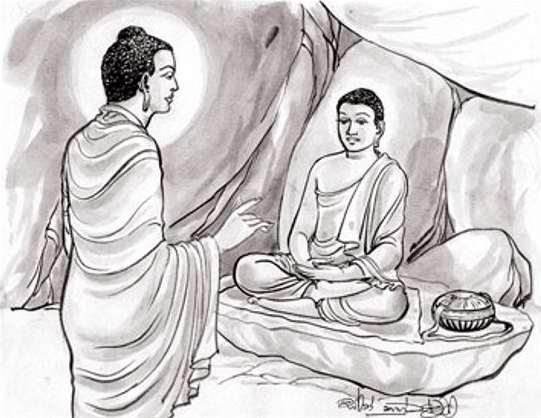
    Buddha and Maha Kassapa

    Verse 28: The wise one dispels negligence by means of mindfulness; he ascends the tower of wisdom and being free from sorrow looks at the sorrowing beings. Just as one on the mountain top looks at those on the plain below, so also, the wise one (the arahat) looks at the foolish and the ignorant (worldlings).

    1. dhiro: the wise one; in this context, the arahat.

    2. bile: the foolish; in this context, the worldings.

    The Story of Thera Mahakassapa

    While residing at the Jetavana monastery, the Buddha uttered Verse (28) of this book, with reference to Thera Mahakassapa.

    On one occasion, while Thera Mahakassapa was staying at Pipphali cave, he spent his time developing the mental image of light (aloka kasina) and trying to find out through Divine Vision, beings who were mindful and beings who were negligent, also those who were about to die and those who were about to be born.

    From his monastery, the Buddha saw through his Divine Vision what Thera Mahakassapa was doing and wanted to warn him that he was wasting his time. So he sent forth his radiance and appeared seated before the thera and exhorted him thus: “My son Kassapa, the number of births and deaths of beings is innumerable and cannot be counted. It is not your concern to count them; it is the concern only of the Buddhas.”

    Then the Buddha spoke in verse as follows:
    Verse 28. The wise one dispels negligence by means of mindfulness; he ascends the pinnacle of wisdom and being free from sorrow looks at the sorrowing beings. Just as one on the mountain top looks at those on the plain below, so also, the wise one (the arahat) looks at the foolish and the ignorant (worldlings).

    Dhammapada Verse 28
    Mahakassapatthera Vatthu

    Pamadam appamadena
    yada nudati pandito
    pannapasadamaruyha
    asoko sokinim pajam
    pabbatatthova bhumatthe
    dhiro1 bale2 avekkhati.

    Source: Tipitaka


  2. True happiness

    Comment

    True happiness is…to enjoy the present, without anxious dependence upon the future. ~Seneca

    purple flower on rain

  3. Letting go gives us freedom…

    Comment

    “Being happy doesn’t mean everything is perfect, it means you have have decided to look beyond imperfections.”
    If you let go a little you will have a little happiness. If you let go a lot you will have a lot of happiness. If you let go completely you will be free. ~Ajahn Chah

    Jendhamuni 120915

    Nothing is permanent…

  4. Realizing the truth…

    Comment

    Meditation student and master Dejapanno

    Happiness is wished for by people in the world. Suffering is not wished for. Nibbāna is something beyond wishing or not wishing. Do you understand? There is no wishing involved in Nibbāna. Wanting to get happiness, wanting to be free of suffering, wanting to transcend happiness and suffering – there are none of these things. It is peace.

    As I see it, realizing the truth doesn’t happen by relying on others. You should understand that all doubts will be resolved by our own efforts, by continuous, energetic practice. We won’t get free of doubt by asking others. We will only end doubt through our own unrelenting efforts.

    Remember this! It’s an important principle in practice. The actual doing is what will instruct you. You will come to know all right and wrong. ”The Brahmin shall reach the exhaustion of doubt through unceasing practice.” It doesn’t matter wherever we go – everything can be resolved through our own ceaseless efforts. But we can’t stick with it. We can’t bear the difficulties we meet; we find it hard to face up to our suffering and not to run away from it. If we do face it and bear with it, then we gain knowledge, and the practice starts instructing us automatically, teaching us about right and wrong and the way things really are. Our practice will show us the faults and ill results of wrong thinking. It really happens like this. But it’s hard to find people who can see it through.

    Everyone wants instant awakening. Rushing here and there following your impulses, you only end up worse off for it. Be careful about this. ~Ajahn Chah


  5. One moment of patience

    Comment

    One moment of patience may ward off great disaster. One moment of impatience may ruin a whole life. ~ Chinese Proverb

    Meditation master Dejapanno, student of the most famous Meditation master Ketodhammo Som Bunthoeun.

    Meditation master Dejapanno, student of the most famous Meditation master Ketodhammo Som Bunthoeun.

  6. Be someone else’s sunshine

    Comment

    Be someone else’s sunshine. Be the reason someone smiles today. Smile at everyone, you never know who’s an angel. ~CoolNsmart

    Jendhamuni

  7. What is undistracted calm abiding?

    Comment

    Buddha2

    What is undistracted calm abiding? It is meditative absorption free of the six types of distraction. What are these six?

    1. Inherent distraction refers to the eye consciousness and the other four collections of consciousness. Because they are naturally directed outward, they [cause one to] emerge from meditative absorption.

    2. External distraction refers to a mental consciousness that reaches out towards or engages objects.

    3. Internal distraction concerns dullness and agitation, as well as savoring one’s meditative absorption.

    4. The distraction of marks occurs when, trusting in meditative absorption, one apprehends marks of it and becomes attached.

    5. Distraction brought about by negative tendencies is when directing the mind involves the apprehending of an ego. This is said to refer to the mental act of pridefully believing oneself to be superior to others, or (simply any mental act) that involves apprehending an “I.”

    6. The distraction of directing the mind occurs when one is caught up in the mindset of, and directs the mind in the style of, the Lesser Vehicle.

    The undistracted calm abiding that is determined by the elimination of those six is the unique calm abiding of the Great Vehicle. This is a state of one-pointed inner rest, a flawless calm abiding. In it, there is no apprehension of marks, as is the case when inner absorption alone is believed to bring liberation. Neither does it involve the ego apprehension that occurs in the concentrations of non-Buddhists. Further, one does not direct the mind as one would when cultivating the supports for the inferior paths [to liberation]. This is how the wise should understand the calm abiding of the Great Vehicle.

    — From Middle Beyond Extremes: Maitreya’s ‘Madhyantavibhaga’ with commentaries by Khenpo Shenga and Ju Mipham, translated by the Dharmachakra Translation Committee, published by Snow Lion Publications


  8. You might “kill time”

    Comment

    You might “kill time” walking, moving, sleeping, or sitting: ineffectual acts which are neither wholesome nor harmful, and which mature into neither good nor bad experiences. But since such actions simply waste this human life, instead of throwing your ability away in idle amusements, make a conscious effort to devote your time exclusively to wholesome action. — Jamgon Kongtrul

    white-flowers-moving


  9. Desire, anger and stupidity

    Comment

    Desire, anger and stupidity–
    Engaging in those creates karma that is non-virtuous.
    The fruit of non-virtue is experienced as suffering.
    Free of attachment, free of aversion, and without stupidity–
    Acting within those states creates karma that is virtuous.
    The fruit of virtue is experienced as happiness.

    — Shantideva

    tree11-2915-Ariyamagga


Live & Die for Buddhism

candle

Me & Grandma

My Reflection

This site is a tribute to Buddhism. Buddhism has given me a tremendous inspiration to be who and where I am today. Although I came to America at a very young age, however, I never once forget who I am and where I came from. One thing I know for sure is I was born as a Buddhist, live as a Buddhist and will leave this earth as a Buddhist. I do not believe in superstition. I only believe in karma.

A Handful of Leaves

A Handful of Leaves

Tipitaka: The pali canon (Readings in Theravada Buddhism). A vast body of literature in English translation the texts add up to several thousand printed pages. Most -- but not all -- of the Canon has already been published in English over the years. Although only a small fraction of these texts are available here at Access to Insight, this collection can nonetheless be a very good place to start.

Major Differences

Major Differences in Buddhism

Major Differences in Buddhism: There is no almighty God in Buddhism. There is no one to hand out rewards or punishments on a supposedly Judgement Day ...read more

Problems we face today

jendhamuni pink scarfnature

Of the many problems we face today, some are natural calamities and must be accepted and faced with equanimity. Others, however, are of our own making, created by misunderstanding, and can be corrected...