When we have acquired an awareness of the fact that all beings have been our mothers, and when this awareness is constant, the result will be that when we see meat, we will be conscious of the fact that it is the flesh of our own mothers. And, far from putting it in our mouths and eating it, we will be unable to even take it into our hands or smell its odor. ~ Shabkar Tsogdruk Rangdrol
“When we bring mindfulness to the dinner table, it suffuses the rest of our life as well. We become more sensitive to the well-being of animals, of the environment, and of ourselves and our families. We are more aware of the choices we make in all areas of our life. We enjoy food more, know that, while the obtaining of even plant foods necessitates some suffering, the amount and kind of suffering is dramatically reduced when we leave meat off our shopping lists and out of our kitchens. We become more aware of how meat consumption feeds violence and anger.” ~Kate Lawrence

There are three ways of killing that we, as Buddhists, have to restrain: either by directly killing, indirectly killing, or rejoicing to see others be killed. Not only does this apply to human life, it should be also extended to all living beings. ~ Zen Master Thich Thanh Tu

Compassion without attachment is possible. Therefore, we need to clarify the distinctions between compassion and attachment. True compassion is not just an emotional response but a firm commitment founded on reason. Because of this firm foundation, a truly compassionate attitude toward others does not change even if they behave negatively. Genuine compassion is based not on our own projections and expectations, but rather on the needs of the other: irrespective of whether another person is a close friend or an enemy, as long as that person wishes for peace and happiness and wishes to overcome suffering, then on that basis we develop genuine concern for their problem. This is genuine compassion. For a Buddhist practitioner, the goal is to develop this genuine compassion, this genuine wish for the well-being of another, in fact for every living being throughout the universe. — Tenzin Gyatso, the Fourteenth Dalai Lama

If there is any religion that would cope with modern scientific needs it would be Buddhism. — Albert Einstein

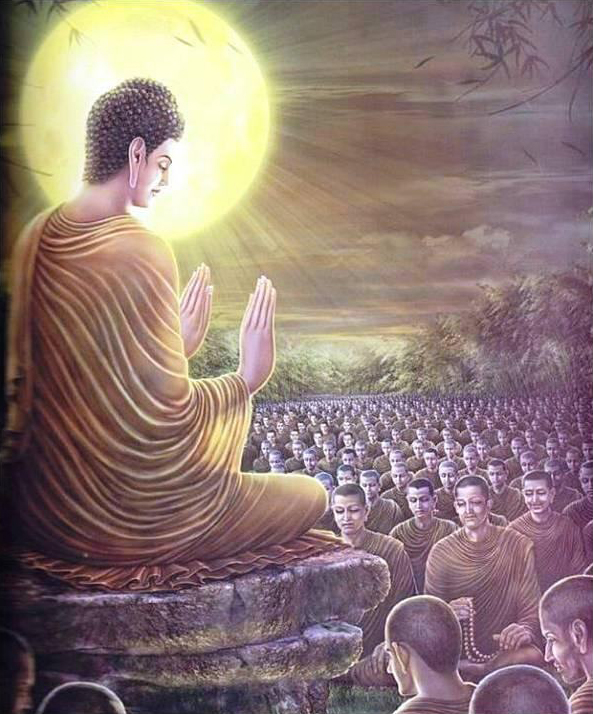
When the Buddha was diligently walking the path of Bodhisattva, he did not only aspire to achieve Buddhahood for himself. He also had a very deep concern for all the distressed sentient beings in this world. The Buddha showed much compassion in his constant actions of helping sentient beings. The world is like a dirty, stinking sewage tank and we are almost drowning in it. No one but the Buddha was willing to come to this suffering world to rescue us. Therefore, when Buddha was born in this world more than two thousand years ago, he denounced the worldly life, practiced diligently, attained enlightenment and then preached his teachings. If there was no distressed sentient beings like us, he wouldn’t have needed to come into this suffering world, as he had already freed himself from the cycle of birth and death and awakened to the truth of all phenomena.
The contributions of Buddha to us are profound and incomparable. As Buddhists we should reinforce the concept of appreciating the Buddha. Otherwise, if we do not understand the Buddha’s sincerity, do not learn his compassion, and do not pursue the vast merits of the great teaching in Buddhism, we do not qualify as the Buddha’s faithful disciples.
Source: BuddhaNet
Link source
Sometimes people mistakenly look on vows and pledges as if these were a type of punishment, but this is not at all the case. For example, just as we follow certain methods of eating and drinking to improve our health and certainly not to punish ourselves, so the rules the Shakymuni Buddha formulated are for controlling counter-productive ill-deeds and ultimately for overcoming afflictive emotions, because these are self-ruinous. Thus, to relieve oneself from suffering, one controls the motivations and deeds producing suffering for one’s own sake. Realizing from his own experience that suffering stems from one’s own afflictive emotions as well as actions contaminated with them, he sets forth styles of behavior to reduce the problem for our own profit, certainly not to give us a hard time. Hence, these rules are for the sake of controlling sources of harm.
— by His Holiness the Dalai Lama, Dzong-ka-ba, and Jeffrey Hopkins, from Yoga Tantra

~17th Karmapa
Vegetarianism involves many ethical issues, but it is also an issue of environmental protection. Our reliance on meat is a major cause of climate change, deforestation, and pollution. There is no shortage of facts to demonstrate this to us. Roughly 20 percent of the world’s greenhouse gas emissions are caused by animals raised for human consumption. The methane gases emitted by livestock contribute more to climate change than does carbon dioxide. This tells us that if we human beings made a significant shift toward becoming vegetarian, by that shift alone we could dramatically reduce global warming.
As vegetarians, we would also make far more efficient use of what our planet offers us. Vast quantities of feed, water, land, fuel, and other resources are required to sustain livestock – far more than what is needed to produce a vegetarian diet. Studies indicate that the land needed to produce food for one meat-eater could support twenty vegetarians. This demonstrates how much smaller our ecological footprint could be just by giving up meat.
[…]
There is also abundant information about the conditions under which animals raised for our food are living, how they are slaughtered, and what you are eating as a result of that. Even though we know there is intense suffering involved as well as devastating environmental consequences, many people still remain unswayed. Some people have taken note and responded accordingly, but most continue as before, as if nothing harmful were going on. Why?
(From: “The Heart Is Noble. Changing the World from the Inside Out”, pp.97-98)


Be ever mindful of the shortcomings of desire’s rewards, and know that all the phenomena of the cycle of existence are never still, like the ripples on a pond, and that these manifestations of delusion, which are no things in themselves, are like magic and dreams. When you have the determination to be free of samsara and are content with your material situation, you will be able to sit quietly with your mind happy and at ease. — Dorje Chang Kalu Rinpoche
Detaching from our emotional responses encourages an objective perspective about our challenges. Our oversensitivity to difficulties is usually caused by our emotional investment in a particular outcome. By choosing instead to step back from our emotions, we give ourselves the ability to remain impartial to the unsettling events in our lives. While we may still feel concerned, interested, and connected to our life circumstances, we are no longer controlled by them. This new, objective perspective gives us the freedom and courage to embrace a peace-oriented state of mind that cannot help but have a positive effect in every aspect of our lives. Stepping back from your emotional attachments can give you the objectivity to make wiser choices. — Lama Karma Chötso

Photo credit: Randy Neufeldt