The Key
While we waited for freedom to take us away from our fear
We searched the earth for love as we knew the key to be
Is the silence which led us here. ~silent lotus

Do you need or enjoy fear, worries and restlessness?
If you don’t, then why do you keep inviting them into your mind?
~Remez Sasson

A Dhamma talk by Ajahn Chah
To calm the mind means to find the right balance. If you try to force your mind too much it goes too far; if you don’t try enough it doesn’t get there, it misses the point of balance.
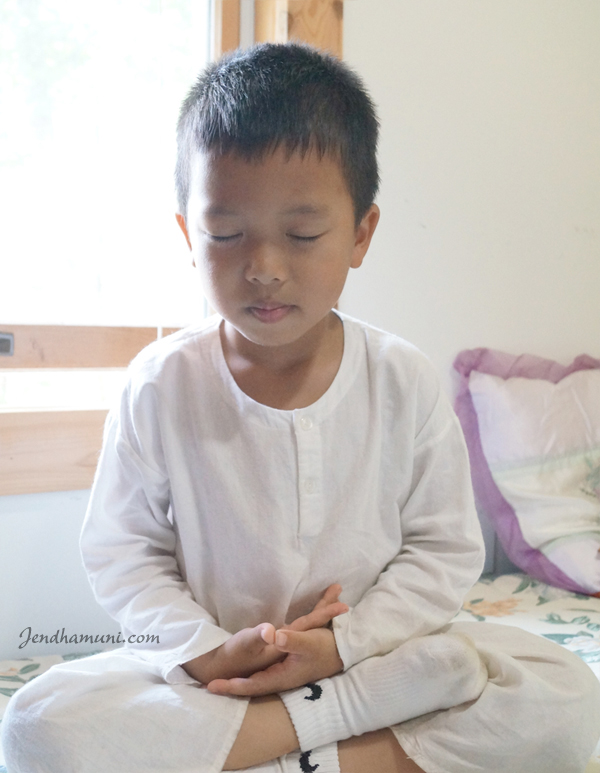
Normally the mind isn’t still, it’s moving all the time. We must strengthen the mind. Making the mind strong and making the body strong are not the same. To make the body strong we have to exercise it, to push it, in order to make it strong, but to make the mind strong means to make it peaceful, not to go thinking of this and that. For most of us the mind has never been peaceful, it has never had the energy of samādhi2, so we must establish it within a boundary. We sit in meditation, staying with the ‘one who knows’.
If we force our breath to be too long or too short, we’re not balanced, the mind won’t become peaceful. It’s like when we first start to use a pedal sewing machine. At first we just practise pedalling the machine to get our coordination right, before we actually sew anything. Following the breath is similar. We don’t get concerned over how long or short, weak or strong it is, we just note it. We simply let it be, following the natural breathing.
When it’s balanced, we take the breathing as our meditation object. When we breathe in, the beginning of the breath is at the nose-tip, the middle of the breath at the chest and the end of the breath at the abdomen. This is the path of the breath. When we breathe out, the beginning of the breath is at the abdomen, the middle at the chest and the end at the nose-tip. Simply take note of this path of the breath at the nosetip, the chest and the abdomen, then at the abdomen, the chest and the tip of the nose. We take note of these three points in order to make the mind firm, to limit mental activity so that mindfulness and self-awareness can easily arise.
When our attention settles on these three points, we can let them go and note the in and out breathing, concentrating solely at the nose-tip or the upper lip, where the air passes on its in and out passage. We don’t have to follow the breath, just to establish mindfulness in front of us at the nose-tip, and note the breath at this one point – entering, leaving, entering, leaving. Continue reading
Those who regard
non-essence as essence
and see essence as non-,
don’t get to the essence,
ranging about in wrong resolves.
But those who know
essence as essence,
and non-essence as non-,
get to the essence,
ranging about in right resolves.
~Dhammapada

RFA photo/Hang Savyouth
Our anger is our actual enemy. It is an obstacle that cuts us off from the cause of higher states of rebirth and the definitive excellence that is liberation. If we do not tame it, then outer enemies will simply multiply. They will increase to the same extent that we try to overpower them. And they could present a danger to our lives and to our ability to keep any of the three sets of vows (individual liberation, bodhisattva, and tantric) we may have taken. Since we are the ones who make one another into enemies, they can proliferate without limit. By creating such projections, we are engaging in actions that are detrimental. Why is this so? Because there is not one living being who has not been our mother or father, and therefore they should all be the objects if our compassion. On the other hand, there is not one living being who has not been our enemy. In this way, all living beings are equally our friends and enemies, so being attached to some and feeling hatred for others makes no sense. Through a mind that sees this equality, we should tame the enemy of our own anger with an army of great compassion. This is the practice of a true bodhisattva. 17th Karmapa

As rain seeps into
an ill-thatched hut,
so passion,
the undeveloped mind.
As rain doesn’t seep into
a well-thatched hut,
so passion does not,
the well-developed mind.
~Dhammapada

RFA/Ouk Savborey

Phenomena are preceded by the heart,
ruled by the heart,
made of the heart.
If you speak or act
with a corrupted heart,
then suffering follows you —
as the wheel of the cart,
the track of the ox
that pulls it.
Phenomena are preceded by the heart,
ruled by the heart,
made of the heart.
If you speak or act
with a calm, bright heart,
then happiness follows you,
like a shadow
that never leaves.
~Dhammapada

The Buddha Speaks about the Deep Kindness of Parents and the Difficulty in Repaying it.
Thus I have heard, at one time, the Buddha dwelt at Shravasti, in the Jeta Grove, in the Garden of the Benefactor of Orphans and the Solitary, together with a gathering of great Bhikshus, twelve hundred fifty in all and with all of the Bodhisattvas, thirty-eight thousand in all.
At that time, the World Honoured One led the great assembly on a walk toward the south. Suddenly they came upon a pile of bones beside the road. The World Honoured One turned to face them, placed his five limbs on the ground, and bowed respectfully.
Ananda put his palms together and asked the World Honoured One, “The Tathagata is the GreatTeacher of the Triple Realm and the compassionate father of beings of the four kinds of births. He has the respect and reverence of the entire assembly. What is the reason that he now bows to a pile of dried bones?
The Buddha told Ananda, “Although all of you are my foremost disciples and have been members of the Sangha for a long time, you still have not achieved far-reaching understanding. This pile of bones could have belonged to my ancestors from former lives. They could have been my parents in many past lives. That is the reason I now bow to them.” The Buddha continued speaking to Ananda, “These bones we are looking at can be divided into two groups. One group is composed of the bones of men, which are heavy and white in color. The other group is composed of the bones of women, which are light and black in color.”
Ananda said to the Buddha, “World Honoured One, when men are alive in the world, they adorn their bodies with robes, belts, shoes, hats and other fine attire, so that they clearly assume a male appearance. When women are alive, they put on cosmetics, perfumes, powders, and elegant fragrances to adorn their bodies, so that they clearly assume a female appearance. Yet, once man and women die, all that is left are their bones. How does one tell them apart? Please teach us how you are able to distinguish them.”
The Buddha answered Ananda, “If when men are in the world, they enter temples, listen to explanations of Sutras and Vinaya texts, make obeisance to the Triple Gem, and recite the Buddha’s names, then when they die, their bones will be heavy and white in colour. Most women in the world have little wisdom and are saturated with emotion. They give birth to and raise children, feeling that this is their duty. Each child relies on its mother’s milk for life and nourishment, and that milk is a transformation of the mother’s blood. Each child can drink up to one thousand two hundred gallons of its mother’s milk. Because of this drain on the mother’s body whereby the child takes milk for its nourishment, the mother becomes worn and haggard and so her bones turn black in colour and are light in weight.” Continue reading