1. Expanding our compassion

    1

    If we allow our compassion to remain only inside of ourselves, our compassion will become powerless, without a function. It would become like a vase that despite having the ability to carry water had been placed high upon a shelf and never used.

    To expand our compassion we can apply our imagination to everyday’s situations. Sometimes when the wind blows I imagine that my compassion mixes with the wind and is carried in every direction to touch all sentient beings. Sometimes when I see beautiful clouds in the sky I imagine that they carry my compassion and that all beings over whom the clouds hover also experience the feeling of compassion. We can also do contemplation involving our five sense faculties. For example, we continually have objects in our visual field. Having first giving rise to compassion mentally we can then spread that compassion to any sentient being who appears before our eyes and imagine that they experience all of our compassion, love and joy. – Karmapa 17th Karmapa

  2. Lamp in the darkness

    Comment

    However much fighting there is in the world, however much darkness there is, we must be able to serve as small lamps in that darkness. ~17th Karmapa

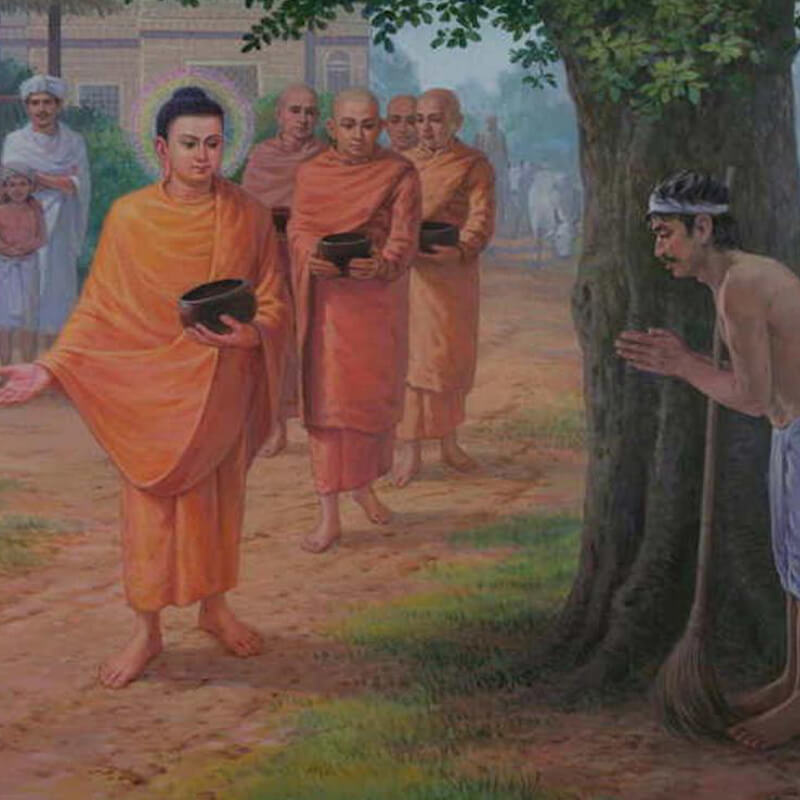
    Buddha and hungry ghosts  - Ariyamagga

  3. Today is one of it’s kind

    Comment

    Today is one of it’s kind; it won’t come again. Bring joy to someone, speak good words and use them to heal, encourage others and learn to care. ~Mufti Ismail Menk

    Jendhamuni with flowers 091815

  4. The Middle Way Within

    Comment

    Buddha dhamma talk

    A Dhammatalk by Ajahn Chah

    The teaching of Buddhism is about giving up evil and practising good. Then, when evil is given up and goodness is established, we must let go of both good and evil. We have already heard enough about wholesome and unwholesome conditions to understand something about them, so I would like to talk about the Middle Way, that is, the path to transcend both of those things.

    All the Dhamma talks and teachings of the Buddha have one aim – to show the way out of suffering to those who have not yet escaped. The teachings are for the purpose of giving us the right understanding. If we don’t understand rightly, then we can’t arrive at peace.

    When all the Buddhas became enlightened and gave their first teachings, they declared these two extremes – indulgence in pleasure and indulgence in pain2. These two ways are the ways of infatuation, they are the ways between which those who indulge in sense pleasures must fluctuate, never arriving at peace. They are the paths which spin around in samsāra.

    The Enlightened One observed that all beings are stuck in these two extremes, never seeing the Middle Way of Dhamma, so he pointed them out in order to show the penalty involved in both. Because we are still stuck, because we are still wanting, we live repeatedly under their sway. The Buddha declared that these two ways are the ways of intoxication, they are not the ways of a meditator, not the ways to peace. These ways are indulgence in pleasure and indulgence in pain, or, to put it simply, the way of slackness and the way of tension.

    If you investigate within, moment by moment, you will see that the tense way is anger, the way of sorrow. Going this way there is only difficulty and distress. Indulgence in Pleasure – if you’ve transcended this, it means you’ve transcended happiness. These ways, both happiness and unhappiness, are not peaceful states. The Buddha taught to let go of both of them. This is right practice. This is the Middle Way.

    These words ‘the Middle Way’ do not refer to our body and speech, they refer to the mind. When a mental impression which we don’t like arises, it affects the mind and there is confusion. When the mind is confused, when it’s ‘shaken up’, this is not the right way. When a mental impression arises which we like, the mind goes to indulgence in pleasure – that’s not the way either.

    We people don’t want suffering, we want happiness. But in fact happiness is just a refined form of suffering. Suffering itself is the coarse form. You can compare them to a snake. The head of the snake is unhappiness, the tail of the snake is happiness. The head of the snake is really dangerous, it has the poisonous fangs. If you touch it, the snake will bite straight away. But never mind the head, even if you go and hold onto the tail, it will turn around and bite you just the same, because both the head and the tail belong to the one snake.

    In the same way, both happiness and unhappiness, or pleasure and sadness, arise from the same parent – wanting. So when you’re happy the mind isn’t peaceful. It really isn’t! For instance, when we get the things we like, such as wealth, prestige, praise or happiness, we become pleased as a result. But the mind still harbours some uneasiness because we’re afraid of losing it. That very fear isn’t a peaceful state. Later on we may actually lose that thing and then we really suffer. Continue reading

  5. The Buddha-Dhamma

    Comment

    The Buddha-Dhamma is not a fiction to be read and forgotten. It deals with life — with real life, the life that you and I lead every day, the value and worth of which is greatly enhanced when the Dhamma is translated into action and built into our character by constant effort and practice.

    The ultimate aim of the Buddha-Dhamma is Nibbana — emancipation from suffering. The immediate objective is to help us to understand and solve the problems that confront us in our daily life, to make us well-rounded, happy, and balanced men and women, able to live in harmony with our environment and our fellow beings. Balance, however, though it is an aim worth striving for, is not easily struck in the contemporary world, with its false ideologies and illusory values.

    In contrast to the relative, often false values of our age, the Buddha’s teaching is a revelation of true and absolute values. Its truth can be tested and tried in one’s own experience. Buddhism teaches clear thinking, self-control, and mental culture as means to these ends. One who builds his daily life upon this firm foundation of appropriate knowledge and clear-sighted ideals is assured of progress and success even as a layman. ~Robert Bogoda

    Buddha looking at woman072715


  6. A well-balanced Buddhist

    Comment

    A well-balanced Buddhist, therefore, must make up his own mind, form his own opinions, and arrive at his own conclusions in facing life’s difficulties according to Buddhist principles. He must not be a moral and intellectual coward. He must be prepared to stand alone, to go his own way irrespective of what others think or say. Of course he will take advice — it is no interference with one’s freedom to seek advice from a more experienced and knowledgeable person — but the decision should be his own.

    Seeing the relationship between craving and suffering, we must maintain a certain degree of detachment from worldly things and, in addition, regulate our lives by strictly observing the Five Precepts. Thereby we preserve the well-being of our whole personality, both here and in the hereafter, by living in harmony with the universal laws governing our mental and moral life. The development of moral and ethical character (sila) is a prerequisite for mind-control and for obtaining the wisdom needed to attain Nibbana. ~Robert Bogoda

  7. The Sacred Lotus

    Comment

    The Sacred Lotus flower grows in the deep mud, far away from the sun. But, sooner or later, it reaches the light becoming the most beautiful flower ever. The Sacred Lotus flower is regarded in many different cultures, especially in eastern religions, as a symbol of purity, enlightenment, self-regeneration and rebirth. Its characteristics are a perfect analogy for the human condition: even when its roots are in the dirtiest waters, the Lotus produces the most beautiful flower.

    Lotus and Jendhamuni

  8. Friends and enemies

    Comment

    Buddha with men and animals072715

    by Tenzin Gyatso, The Fourteenth Dalai Lama

    I must emphasize again that merely thinking that compassion and reason and patience are good will not be enough to develop them. We must wait for difficulties to arise and then attempt to practice them.

    And who creates such opportunities? Not our friends, of course, but our enemies. They are the ones who give us the most trouble, So if we truly wish to learn, we should consider enemies to be our best teacher!

    For a person who cherishes compassion and love, the practice of tolerance is essential, and for that, an enemy is indispensable. So we should feel grateful to our enemies, for it is they who can best help us develop a tranquil mind! Also, itis often the case in both personal and public life, that with a change in circumstances, enemies become friends.

    So anger and hatred are always harmful, and unless we train our minds and work to reduce their negative force, they will continue to disturb us and disrupt our attempts to develop a calm mind. Anger and hatred are our real enemies. These are the forces we most need to confront and defeat, not the temporary enemies who appear intermittently throughout life.

    Of course, it is natural and right that we all want friends. I often joke that if you really want to be selfish, you should be very altruistic! You should take good care of others, be concerned for their welfare, help them, serve them, make more friends, make more smiles, The result? When you yourself need help, you find plenty of helpers! If, on the other hand, you neglect the happiness of others, in the long term you will be the loser. And is friendship produced through quarrels and anger, jealousy and intense competitiveness? I do not think so. Only affection brings us genuine close friends.

    little boy at playground

    In today’s materialistic society, if you have money and power, you seem to have many friends. But they are not friends of yours; they are the friends of your money and power. When you lose your wealth and influence, you will find it very difficult to track these people down.

    The trouble is that when things in the world go well for us, we become confident that we can manage by ourselves and feel we do not need friends, but as our status and health decline, we quickly realize how wrong we were. That is the moment when we learn who is really helpful and who is completely useless. So to prepare for that moment, to make genuine friends who will help us when the need arises, we ourselves must cultivate altruism!

    Though sometimes people laugh when I say it, I myself always want more friends. I love smiles. Because of this I have the problem of knowing how to make more friends and how to get more smiles, in particular, genuine smiles. For there are many kinds of smile, such as sarcastic, artificial or diplomatic smiles. Many smiles produce no feeling of satisfaction, and sometimes they can even create suspicion or fear, can’t they? But a genuine smile really gives us a feeling of freshness and is, I believe, unique to human beings. If these are the smiles we want, then we ourselves must create the reasons for them to appear.

    Compassion and the world

    In conclusion, I would like briefly to expand my thoughts beyond the topic of this short piece and make a wider point: individual happiness can contribute in a profound and effective way to the overall improvement of our entire human community.

    Because we all share an identical need for love, it is possible to feel that anybody we meet, in whatever circumstances, is a brother or sister. No matter how new the face or how different the dress and behavior, there is no significant division between us and other people. It is foolish to dwell on external differences, because our basic natures are the same.

    Ultimately, humanity is one and this small planet is our only home, If we are to protect this home of ours, each of us needs to experience a vivid sense of universal altruism. It is only this feeling that can remove the self-centered motives that cause people to deceive and misuse one another.

    If you have a sincere and open heart, you naturally feel self- worth and confidence, and there is no need to be fearful of others.

    I believe that at every level of society – familial, tribal, national and international – the key to a happier and more successful world is the growth of compassion. We do not need to become religious, nor do we need to believe in an ideology. All that is necessary is for each of us to develop our good human qualities.

    I try to treat whoever I meet as an old friend. This gives me a genuine feeling of happiness.  It is the practice of compassion.

    Link source


  9. Reading the Natural Mind

    Comment

    paying respect

    A Dhammatalk by Ajahn Chah

    Our way of practice is looking closely at things and making them clear. We’re persistent and constant, yet not rushed or hurried. Neither are we too slow. It’s a matter of gradually feeling our way and bringing it together. However, all of this bringing it together is working towards something, there is a point to our practice.

    For most of us, when we first start to practice, it’s nothing other than desire. We start to practice because of wanting. At this stage our wanting is wanting in the wrong way. That is, it’s deluded. It’s wanting mixed with wrong understanding.

    If wanting is not mixed with wrong understanding like this, we say that it’s wanting with wisdom (paññā)2. It’s not deluded – it’s wanting with right understanding. In a case like this we say that it’s due to a person’s pāramī or past accumulations. However, this isn’t the case with everyone.

    Some people don’t want to have desire, or they want not to have desires, because they think that our practice is directed at not wanting. However, if there is no desire, then there’s no way of practice.

    We can see this for ourselves. The Buddha and all his disciples practiced to put an end to defilements. We must want to practice and must want to put an end to defilements. We must want to have peace of mind and want not to have confusion. However, if this wanting is mixed with wrong understanding, then it will only amount to more difficulties for us. If we are honest about it, we really know nothing at all. Or, what we do know is of no consequence, since we are unable to use it properly.

    Everybody, including the Buddha, started out like this, with the desire to practice – wanting to have peace of mind and wanting not to have confusion and suffering. These two kinds of desire have exactly the same value. If not understood then both wanting to be free from confusion and not wanting to have suffering are defilements. They’re a foolish way of wanting – desire without wisdom.

    In our practice we see this desire as either sensual indulgence or self-mortification. It’s in this very conflict that our teacher, the Buddha, was caught up, just this dilemma. He followed many ways of practice which merely ended up in these two extremes. And these days we are exactly the same. We are still afflicted by this duality, and because of it we keep falling from the Way.

    However, this is how we must start out. We start out as worldly beings, as beings with defilements, with wanting devoid of wisdom, desire without right understanding. If we lack proper understanding, then both kinds of desire work against us. Whether it’s wanting or not wanting, it’s still craving (tanhā). If we don’t understand these two things then we won’t know how to deal with them when they arise. We will feel that to go forward is wrong and to go backwards is wrong, and yet we can’t stop. Whatever we do we just find more wanting. This is because of the lack of wisdom and because of craving.

    Pink Orchids. Photo credit: Randy

    Pink Orchids. Photo credit: Randy

    It’s right here, with this wanting and not wanting, that we can understand the Dhamma. The Dhamma which we are looking for exists right here, but we don’t see it. Rather, we persist in our efforts to stop wanting. We want things to be a certain way and not any other way. Or, we want them not to be a certain way, but to be another way. Really these two things are the same. They are part of the same duality.

    Perhaps we may not realize that the Buddha and all of his disciples had this kind of wanting. However the Buddha understood regarding wanting and not wanting. He understood that they are simply the activity of mind, that such things merely appear in a flash and then disappear. These kinds of desires are going on all the time. When there is wisdom, we don’t identify with them – we are free from clinging. Whether it’s wanting or not wanting, we simply see it as such. In reality it’s merely the activity of the natural mind. When we take a close look, we see clearly that this is how it is.

    The Wisdom of Everyday Experience

    So it’s here that our practice of contemplation will lead us to understanding. Let us take an example, the example of a fisherman pulling in his net with a big fish in it. How do you think he feels about pulling it in? If he’s afraid that the fish will escape, he’ll be rushed and start to struggle with the net, grabbing and tugging at it. Before he knows it, the big fish has escaped – he was trying too hard.

    In the olden days they would talk like this. They taught that we should do it gradually, carefully gathering it in without losing it. This is how it is in our practice; we gradually feel our way with it, carefully gathering it in without losing it. Sometimes it happens that we don’t feel like doing it. Maybe we don’t want to look or maybe we don’t want to know, but we keep on with it. We continue feeling for it. This is practice: if we feel like doing it, we do it, and if we don’t feel like doing it, we do it just the same. We just keep doing it.

    If we are enthusiastic about our practice, the power of our faith will give energy to what we are doing. But at this stage we are still without wisdom. Even though we are very energetic, we will not derive much benefit from our practice. We may continue with it for a long time and a feeling will arise that aren’t going to find the Way. We may feel that we cannot find peace and tranquillity, or that we aren’t sufficiently equipped to do the practice. Or maybe we feel that this Way just isn’t possible anymore. So we give up!

    At this point we must be very, very careful. We must use great patience and endurance. It’s just like pulling in the big fish – we gradually feel our way with it. We carefully pull it in. The struggle won’t be too difficult, so without stopping we continue pulling it in. Eventually, after some time, the fish becomes tired and stops fighting and we’re able to catch it easily. Usually this is how it happens, we practice gradually gathering it together.

    It’s in this manner that we do our contemplation. If we don’t have any particular knowledge or learning in the theoretical aspects of the teachings, we contemplate according to our everyday experience. We use the knowledge which we already have, the knowledge derived from our everyday experience. This kind of knowledge is natural to the mind. Actually, whether we study about it or not, we have the reality of the mind right here already. The mind is the mind whether we have learned about it or not. This is why we say that whether the Buddha is born in the world or not, everything is the way it is. Everything already exists according to its own nature. This natural condition doesn’t change, nor does it go anywhere. It just is that way. This is called the Sacca Dhamma. However, if we don’t understand about this Sacca Dhamma, we won’t be able to recognize it.

    holding Buddha's hand072715

    So we practice contemplation in this way. If we aren’t particularly skilled in scripture, we take the mind itself to study and read. Continually we contemplate (lit. talk with ourselves) and understanding regarding the nature of the mind will gradually arise. We don’t have to force anything.

    Constant Effort

    Until we are able to stop our mind, until we reach tranquillity, the mind will just continue as before. It’s for this reason that the teacher says, ”Just keep on doing it, keep on with the practice!” Maybe we think, ”If I don’t yet understand, how can I do it?” Until we are able to practice properly, wisdom doesn’t arise. So we say just keep on with it. If we practice without stopping we’ll begin to think about what we are doing. We’ll start to consider our practice.

    Nothing happens immediately, so in the beginning we can’t see any results from our practice. This is like the example I have often given you of the man who tries to make fire by rubbing two sticks of wood together. He says to himself, ”They say there’s fire here”. and he begins rubbing energetically. He’s very impetuous. He rubs on and on but his impatience doesn’t end. He wants to have that fire. He keeps wanting to have that fire, but the fire doesn’t come. So he gets discouraged and stops to rest for awhile. He starts again but the going is slow, so he rests again. By then the heat has disappeared; he didn’t keep at it long enough. He rubs and rubs until he tires and then he stops altogether. Not only is he tired, but he becomes more and more discouraged until he gives up completely. ”There’s no fire here!” Actually he was doing the work, but there wasn’t enough heat to start a fire. The fire was there all the time but he didn’t carry on to the end.

    This sort of experience causes the meditator to get discouraged in his practice, and so he restlessly changes from one practice to another. And this sort of experience is also similar to our own practice. It’s the same for everybody. Why? Because we are still grounded in defilements. The Buddha had defilements also, but He had a lot of wisdom in this respect. While still worldlings the Buddha and the arahants were just the same as us. If we are still worldlings then we don’t think rightly. Thus when wanting arises we don’t see it, and when not wanting arises we don’t see it. Sometimes we feel stirred up, and sometimes we feel contented. When we have not wanting we have a kind of contentment, but we also have a kind of confusion. When we have wanting this can be contentment and confusion of another kind. It’s all intermixed in this way. Continue reading

Live & Die for Buddhism

candle

Me & Grandma

My Reflection

This site is a tribute to Buddhism. Buddhism has given me a tremendous inspiration to be who and where I am today. Although I came to America at a very young age, however, I never once forget who I am and where I came from. One thing I know for sure is I was born as a Buddhist, live as a Buddhist and will leave this earth as a Buddhist. I do not believe in superstition. I only believe in karma.

A Handful of Leaves

A Handful of Leaves

Tipitaka: The pali canon (Readings in Theravada Buddhism). A vast body of literature in English translation the texts add up to several thousand printed pages. Most -- but not all -- of the Canon has already been published in English over the years. Although only a small fraction of these texts are available here at Access to Insight, this collection can nonetheless be a very good place to start.

Major Differences

Major Differences in Buddhism

Major Differences in Buddhism: There is no almighty God in Buddhism. There is no one to hand out rewards or punishments on a supposedly Judgement Day ...read more

Problems we face today

jendhamuni pink scarfnature

Of the many problems we face today, some are natural calamities and must be accepted and faced with equanimity. Others, however, are of our own making, created by misunderstanding, and can be corrected...