
1. Recognizing who we are

    Comment

    When it comes to the true nature of mind, this isn’t something that we get from a spiritual tradition or religion. It’s not something that we need to seek from a guru or that we need to find by going to a sacred place, but it’s a matter of recognizing who we are, whatever that it is. When we see this completely clearly, when who we actually are becomes completely evident and obvious to us, and we recognize it and appreciate it in a completely perfect way, then that I think is what is called recognizing the true nature of mind. Then we fully make this a reality for ourselves. ~ 17th Karmapa

    Buddha2071815

  2. The essence of Buddhism

    Comment

    The essence of Buddhism is being able to distinguish
    what it is that we need to do from what it is that we need
    to give up. It is taking up virtue and giving up non-virtue.
    We need to identify what it is that will bring benefit to ourselves
    and others, and then we need to do that. We also need to identify
    what it is that will harm ourselves and others, and then we need
    to give that up. So you can condense it all into doing what is beneficial
    and giving up what is harmful. We need to know what the essence
    of dharma is, and then bring it into our lives. ~ 17th Karmapa

    Buddha9071815

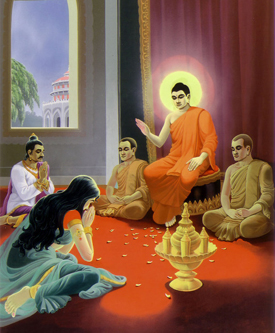
    Sariputta ordained Prince Rahula, Buddha’s son.

  3. I give them all away

    Comment

    My body, thus, and all my good besides,
    And all my merits gained and to be gained,
    I give them all away withholding nothing
    To bring about the benefit of beings.

    ~Shantideva

    Red Tiger Orchids. Photo credit: Randy Neufeldt

    Red Tiger Orchids. Photo credit: Randy Neufeldt

  4. Pleasure…

    Comment

    All the suffering in the world comes from seeking pleasure for oneself.
    All the happiness in the world comes from seeking pleasure for others.
    ~Shantideva

    Soylent Green. Photo credit: Randy Neufeldt

    Soylent Green. Photo credit: Randy Neufeldt

  5. Our priceless pure heart

    Comment

    Our priceless pure heart is not something that can be purchased at a pharmacy, poured into our body, or obtained through a cure. If we went to a major city looking to buy it, we could not purchase this pure heart no matter what price we were willing to pay. How do we find it? With the sincere wish to discover it, we discipline our mind with our mind. When such a motivation is born within us, we and others are benefitted and so our lives become meaningful. With a pure motivation that does not wane and with great courage that does not despair, may each one of us endeavor to make our lives meaningful. ~17th Karmapa

    Buddha and Cousin

    From left: Devadatta and Siddhartha, known as Buddha


  6. In spite of our difficulties

    Comment

    If we cannot be happy in spite of our difficulties, what good is our spiritual practice?

    Great compassion makes a peaceful heart. A peaceful heart makes a peaceful person. A peaceful person makes a peaceful family. A peaceful family makes a peaceful community. A peaceful community makes a peaceful nation. A peaceful nation makes a peaceful world. ~His Holiness Maha Ghosananda

    Maha Ghosananda and Dalai Lama.

    Maha Ghosananda and Dalai Lama.

  7. When you make peace with yourself

    Comment

    When you make peace with yourself, you make peace with the world. ~H.H. Maha Ghosananda

    You have to start giving first and expect absolutely nothing. When you practice contentment
    you can say to yourself, ‘Oh yes I already have everything that I really need’. ~Dalai Lama

    A 6-year-old meditating

    A 6-year-old meditating

  8. Keep it Simple

    Comment

    Once you have committed to a particular path, I suggest that you look for the simplest way forward. You should make things accessible and approachable in your religious community and in your personal practice, rather than more complicated.

    Keep it simple. The life of the spirit is actually very basic and easy. We often don’t appreciate that. In the beginning, our spiritual path may strike us as very simple and perfectly clear. But then, after we have been practicing it for a few years, we sometimes find ourselves going backward, and moving away from that initial simplicity. The spiritual breakthrough we experience may simply consist in rediscovering what we had seen in the beginning.

    Spiritual discovery is not a matter of finding wisdom out there somewhere. It is a matter of discovering what already exists within us. Like cleaning the surface of a stone inscription, the more you clean it, the more the original carving becomes apparent. We are like that stone. With spiritual practice, instead of gaining something we did not have before, we gradually make ourselves clearer to ourselves. ~by 17th Karmapa

    karmapa

    17th Karmapa

  9. Boundless heart

    Comment

    With a boundless heart
    Should one cherish all living beings:
    Radiating love over the entire world
    Spreading upwards to the skies,
    And downwards to the depths…
    ~Maha Ghosananda

    Pope John Paul II is embraced by Cambodian Buddhist monk Maha Ghosananda during an interreligious ecounter in Assisi, Italy, Oct. 27, 1986.

    Pope John Paul II is embraced by Cambodian Buddhist monk Maha Ghosananda during an interreligious ecounter in Assisi, Italy, Oct. 27, 1986.

  10. Negative emotions and thoughts arise inside you

    Comment

    It is very important to cultivate mindfulness right from the beginning. Otherwise, if you let negative emotions and thoughts arise inside you without any sense of restraint, without any mindfulness of their negativity, then in a sense you are giving them free reign. They can then develop to the point where there is simply no way to counter them. However, if you develop mindfulness of their negativity, then when they occur, you will be able to stamp them out as soon as they arise. You will not give them the opportunity or the space to develop into full-blown negative emotional thoughts. The way in which this third verse suggests we apply an antidote is, I think, at the level of the manifested and felt experience of emotion. Instead of getting at the root of emotion in general, what is being suggested is the application of antidotes that are appropriate to specific negative emotions and thoughts. For example, to counter anger, you should cultivate love and compassion. ~H.H. Dalai Lama

    Painted White Orchids. Photo credit: Randy Neufeldt

    Painted White Orchids. Photo credit: Randy Neufeldt

Live & Die for Buddhism

candle

Me & Grandma

My Reflection

This site is a tribute to Buddhism. Buddhism has given me a tremendous inspiration to be who and where I am today. Although I came to America at a very young age, however, I never once forget who I am and where I came from. One thing I know for sure is I was born as a Buddhist, live as a Buddhist and will leave this earth as a Buddhist. I do not believe in superstition. I only believe in karma.

A Handful of Leaves

A Handful of Leaves

Tipitaka: The pali canon (Readings in Theravada Buddhism). A vast body of literature in English translation the texts add up to several thousand printed pages. Most -- but not all -- of the Canon has already been published in English over the years. Although only a small fraction of these texts are available here at Access to Insight, this collection can nonetheless be a very good place to start.

Major Differences

Major Differences in Buddhism

Major Differences in Buddhism: There is no almighty God in Buddhism. There is no one to hand out rewards or punishments on a supposedly Judgement Day ...read more

Problems we face today

jendhamuni pink scarfnature

Of the many problems we face today, some are natural calamities and must be accepted and faced with equanimity. Others, however, are of our own making, created by misunderstanding, and can be corrected...