1. The faithful

    Comment

    Even if the faithful can recite
    only a few of the scriptures,
    if they act accordingly,
    having given up passion, hate, and folly,
    being possessed of true knowledge and serenity of mind,
    craving nothing in this world or the next,
    they are living the holy life.

    Even if the thoughtless can recite many of the scriptures,
    if they do not act accordingly,
    they are not living the holy life,
    but are like a cowherd counting the cows of others.

    ~Buddha,The Dhammapada

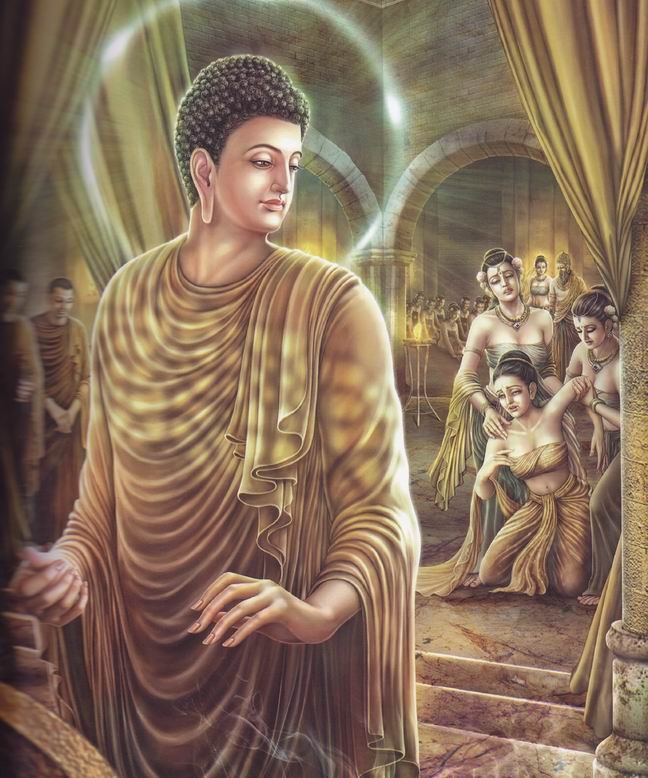
    buddha and mara

  2. The virtuous

    Comment

    The virtuous are happy in this world,
    and they are happy in the next; they are happy in both.
    They are happy when they think of the good they have done.
    They are even happier when going on the good path.

    Wrong-doers suffer in this world,
    and they suffer in the next; they suffer in both.
    They suffer when they think of the wrong they have done.
    They suffer even more when going on the wrong path.

    ~Buddha,The Dhammapada

    Dandelion Season Is Upon Us!

    Photo credit: Randy Neufeldt

  3. A heart without words

    Comment

    Prayer is the key of the morning and the bolt of the evening. It is better in prayer to have a heart without words than words without a heart. In the attitude of silence the soul finds the path in a clearer light, and what is elusive and deceptive resolves itself into crystal clearness. Our life is a long and arduous quest after Truth. ~Gandhi

    Jendhamunireadinghhbook

  4. Real peace — the calming of the defilements

    Comment

    You must contemplate in order to find peace. What people usually refer to as peace is simply the calming of the mind, not the calming of the defilements. The defilements are simply being temporarily subdued, just like grass covered by a rock. In three or four days you take the rock off the grass and in no long time it grows up again. The grass hadn’t really died, it was simply being suppressed. It’s the same when sitting in meditation: the mind is calmed but the defilements are not really calmed. Therefore, samādhi is not a sure thing. To find real peace you must develop wisdom. Samādhi is one kind of peace, like the rock covering the grass… in a few days you take the rock away and the grass grows up again. This is only a temporary peace. The peace of wisdom is like putting the rock down and not lifting it up, just leaving it where it is. The grass can’t possibly grow again. This is real peace, the calming of the defilements, the sure peace which results from wisdom. ~Ajahn Chah

    Photo credit: Randy Neufeldt

    Photo credit: Randy Neufeldt


  5. A temporary kind of peace

    Comment

    What people call sitting in meditation is merely a temporary kind of peace. But even in such a peace there are experiences. If an experience arises there must be someone who knows it, who looks into it, queries it and examines it. If the mind is simply blank then that’s not so useful. You may see some people who look very restrained and think they are peaceful, but the real peace is not simply the peaceful mind. It’s not the peace which says, ”May I be happy and never experience any suffering.” With this kind of peace, eventually even the attainment of happiness becomes unsatisfying. Suffering results. Only when you can make your mind beyond both happiness and suffering will you find true peace. That’s the true peace. This is the subject most people never study, they never really see this one.

    The right way to train the mind is to make it bright, to develop wisdom. Don’t think that training the mind is simply sitting quietly. That’s the rock covering the grass. People get drunk over it. They think that samādhi is sitting. That’s just one of the words for samādhi. But really, if the mind has samādhi, then walking is samādhi, sitting is samādhi… samādhi in the sitting posture, in the walking posture, in the standing and reclining postures. It’s all practice.

    Some people complain, ”I can’t meditate, I’m too restless. Whenever I sit down I think of this and that… I can’t do it. I’ve got too much bad kamma. I should use up my bad kamma first and then come back and try meditating.” Sure, just try it. Try using up your bad kamma…. ~Ajahn Chah

    Photo credit: Randy Neufeldt

    Photo credit: Randy Neufeldt


  6. Still, Flowing Water

    Comment
    Photo credit: Randy Neufeldt

    Photo credit: Randy Neufeldt

    A Dhammatalk by Ajahn Chah

    Now please pay attention, not allowing your mind to wander off after other things. Create the feeling that right now you are sitting on a mountain or in a forest somewhere, all by yourself. What do you have sitting here right now? There are body and mind, that’s all, only these two things. All that is contained within this frame sitting here now is called ”body.” The ”mind” is that which is aware and is thinking at this very moment. These two things are also called ”nāma” and ”rūpa.” ”Nāma” refers to that which has no ”rūpa,” or form. All thoughts and feelings, or the four mental khandhas of feeling, perception, volition and consciousness, are nāma, they are all formless. When the eye sees form, that form is called rūpa, while the awareness is called nāma. Together they are called nāma and rūpa, or simply body and mind.

    Understand that sitting here in this present moment are only body and mind. But we get these two things confused with each other. If you want peace you must know the truth of them. The mind in its present state is still untrained; it’s dirty, not clear. It is not yet the pure mind. We must further train this mind through the practice of meditation.

    Some people think that meditation means to sit in some special way, but in actual fact standing, sitting, walking and reclining are all vehicles for meditation practice. You can practice at all times. Samādhi literally means ”the firmly established mind.” To develop samādhi you don’t have to go bottling the mind up. Some people try to get peaceful by sitting quietly and having nothing disturb them at all, but that’s just like being dead. The practice of samādhi is for developing wisdom and understanding.

    Samādhi is the firm mind, the one-pointed mind. On which point is it fixed? It’s fixed onto the point of balance. That’s its point. But people practice meditation by trying to silence their minds. They say, ”I try to sit in meditation but my mind won’t be still for a minute. One instant it flies off one place, the next instant it flies off somewhere else… How can I make it stop still?” You don’t have to make it stop, that’s not the point. Where there is movement is where understanding can arise. People complain, ”It runs off and I pull it back again; then it goes off again and I pull it back once more…” So they just sit there pulling back and forth like this.

    They think their minds are running all over the place, but actually it only seems like the mind is running around. For example, look at this hall here… ”Oh, it’s so big!” you say… actually it’s not big at all. Whether or not it seems big depends on your perception of it. In fact this hall is just the size it is, neither big nor small, but people run around after their feelings all the time.

    Meditating to find peace… You must understand what peace is. If you don’t understand it you won’t be able to find it. For example, suppose today you brought a very expensive pen with you to the monastery. Now suppose that, on your way here, you put the pen in your front pocket, but at a later time you took it out and put it somewhere else, such as the back pocket. Now when you search your front pocket… It’s not there! You get a fright. You get a fright because of your misunderstanding, you don’t see the truth of the matter. Suffering is the result. Whether standing, walking, coming and going, you can’t stop worrying about your lost pen. Your wrong understanding causes you to suffer. Understanding wrongly causes suffering… ”Such a shame! I’d only bought that pen a few days ago and now it’s lost.”

    But then you remember, ”Oh, of course! When I went to bathe I put the pen in my back pocket.” As soon as you remember this you feel better already, even without seeing your pen. You see that? You’re happy already, you can stop worrying about your pen. You’re sure about it now. As you’re walking along you run your hand over your back pocket and there it is. Your mind was deceiving you all along. The worry comes from your ignorance. Now, seeing the pen, you are beyond doubt, your worries are calmed. This sort of peace comes from seeing the cause of the problem, samudaya, the cause of suffering. As soon as you remember that the pen is in your back pocket there is nirodha, the cessation of suffering.

    So you must contemplate in order to find peace. What people usually refer to as peace is simply the calming of the mind, not the calming of the defilements. The defilements are simply being temporarily subdued, just like grass covered by a rock. In three or four days you take the rock off the grass and in no long time it grows up again. The grass hadn’t really died, it was simply being suppressed. It’s the same when sitting in meditation: the mind is calmed but the defilements are not really calmed. Therefore, samādhi is not a sure thing. To find real peace you must develop wisdom. Samādhi is one kind of peace, like the rock covering the grass… in a few days you take the rock away and the grass grows up again. This is only a temporary peace. The peace of wisdom is like putting the rock down and not lifting it up, just leaving it where it is. The grass can’t possibly grow again. This is real peace, the calming of the defilements, the sure peace which results from wisdom.

    We speak of wisdom (paññā) and samādhi as separate things, but in essence they are one and the same. Wisdom is the dynamic function of samādhi; samādhi is the passive aspect of wisdom. They arise from the same place but take different directions, different functions, like this mango here. A small green mango eventually grows larger and larger until it is ripe. It is all the same mango, the larger one and the ripe one are all the same mango, but its condition changes. In Dhamma practice, one condition is called samādhi, the later condition is called paññā, but in actuality sīla, samādhi, and paññā are all the same thing, just like the mango. Continue reading

  7. It may be like a dream

    Comment

    By Ringu Tulku Rinpoche

    Emptiness, interdependence, impermanence, the nature of beings and things being dreamlike…these do not prevent us from doing things for other people. They do not prevent us doing positive things and reducing negativity. It may be like a dream, but it still affects people. The same question is raised in the Bodhicaryavatara. If everything is emptiness, why is there a need for compassion?  There is a need because people suffer. They do not understand emptiness. Therefore it is important to work for their benefit, to reduce suffering. Its being like a dream does not change anything in that regard.

    Because things are impermanent, interdependent, emptiness, we should try to see them clearly, so that whatever the situation may be, we do not panic. We change our way of experiencing. That does not mean that we should not try to change the situation. Even if we have to live in that situation, we should do so in a peaceful and joyful manner. Within the situation, we should do whatever we can to make it better – without becoming negative, without becoming completely hopeless, or overwhelmed by tragedy. We should live in a way to make things better, both outside and inside.

    Link source

    Photo credit: Randy Neufeldt

    Photo credit: Randy Neufeldt

  8. Praise to Buddha Shakyamuni

    Comment

    Buddha

    Liberating Prayer

    O Blessed One, Shakyamuni Buddha,
    Precious treasury of compassion,
    Bestower of supreme inner peace,

    You, who love all beings without exception,
    Are the source of happiness and goodness;
    And you guide us to the liberating path.

    Your body is a wishfulfilling jewel,
    Your speech is supreme, purifying nectar,
    And your mind is refuge for all living beings.

    With folded hands I turn to you,
    Supreme unchanging friend,
    I request from the depths of my heart:

    Please give me the light of your wisdom
    To dispel the darkness of my mind
    And to heal my mental continuum.

    Please nourish me with your goodness,
    That I in turn may nourish all beings
    With an unceasing banquet of delight.

    Through your compassionate intention,
    Your blessings and virtuous deeds,
    And my strong wish to rely upon you,

    May all suffering quickly cease
    And all happiness and joy be fulfilled;
    And may holy Dharma flourish for evermore.

    Composed by Venerable Geshe Kelsang Gyatso at Manjushri Centre, England, June 2001
    © Geshe Kelsang Gyatso and New Kadampa Tradition 2001

    Link source


  9. Watching a spider can give rise to wisdom

    Comment

    Try watching a spider. A spider spins its web in any convenient niche and then sits in the center, staying still and silent. Later, a fly comes along and lands on the web. As soon as it touches and shakes the web, ”boop!” – the spider pounces and winds it up in thread. It stores the insect away and then returns again to collect itself silently in the center of the web.

    Watching a spider like this can give rise to wisdom. Our six senses have mind at the center surrounded by eye, ear, nose, tongue and body. When one of the senses is stimulated, for instance, form contacting the eye, it shakes and reaches the mind. The mind is that which knows, that which knows form. Just this much is enough for wisdom to arise. It’s that simple.

    Like a spider in its web, we should live keeping to ourselves. As soon as the spider feels an insect contact the web, it quickly grabs it, ties it up and once again returns to the center. This is not at all different from our own minds. ”Coming to the center” means living mindfully with clear comprehension, being always alert and doing everything with exactness and precision – this is our center. There’s really not a lot for us to do; we just carefully live in this way. But that doesn’t mean that we live heedlessly thinking, ”There is no need to do siting or walking meditation!” and so forget all about our practice. We can’t be careless! We must remain alert just as the spider waits to snatch up insects for its food. ~Ajahn Chah

    JendhamunisittingBW

  10. The Two Faces of Reality

    Comment

    A Dhammatalk by Ajahn Chah

    In our lives we have two possibilities: indulging in the world or going beyond the world. The Buddha was someone who was able to free himself from the world and thus realized spiritual liberation.

    In the same way, there are two types of knowledge – knowledge of the worldly realm and knowledge of the spiritual, or true wisdom. If we have not yet practiced and trained ourselves, no matter how much knowledge we have, it is still worldly, and thus cannot liberate us.

    Think and really look closely! The Buddha said that things of the world spin the world around. Following the world, the mind is entangled in the world, it defiles itself whether coming or going, never remaining content. Worldly people are those who are always looking for something – who can never find enough. Worldly knowledge is really ignorance; it isn’t knowledge with clear understanding, therefore there is never an end to it. It revolves around the worldly goals of accumulating things, gaining status, seeking praise and pleasure; it’s a mass of delusion which has us stuck fast.

    Once we get something, there is jealousy, worry and selfishness. And when we feel threatened and can’t ward it off physically, we use our minds to invent all sorts of devices, right up to weapons and even nuclear bombs, only to blow each other up. Why all this trouble and difficulty?

    This is the way of the world. The Buddha said that if one follows it around there is no reaching an end.

    Come to practice for liberation! It isn’t easy to live in accordance with true wisdom, but whoever earnestly seeks the path and fruit and aspires to Nibbāna will be able to persevere and endure. Endure being contented and satisfied with little; eating little, sleeping little, speaking little and living in moderation. By doing this we can put an end to worldliness.

    If the seed of worldliness has not yet been uprooted, then we are continually troubled and confused in a never-ending cycle. Even when you come to ordain, it continues to pull you away. It creates your views, your opinions, it colors and embellishes all your thoughts – that’s the way it is. Continue reading

Live & Die for Buddhism

candle

Me & Grandma

My Reflection

This site is a tribute to Buddhism. Buddhism has given me a tremendous inspiration to be who and where I am today. Although I came to America at a very young age, however, I never once forget who I am and where I came from. One thing I know for sure is I was born as a Buddhist, live as a Buddhist and will leave this earth as a Buddhist. I do not believe in superstition. I only believe in karma.

A Handful of Leaves

A Handful of Leaves

Tipitaka: The pali canon (Readings in Theravada Buddhism). A vast body of literature in English translation the texts add up to several thousand printed pages. Most -- but not all -- of the Canon has already been published in English over the years. Although only a small fraction of these texts are available here at Access to Insight, this collection can nonetheless be a very good place to start.

Major Differences

Major Differences in Buddhism

Major Differences in Buddhism: There is no almighty God in Buddhism. There is no one to hand out rewards or punishments on a supposedly Judgement Day ...read more

Problems we face today

jendhamuni pink scarfnature

Of the many problems we face today, some are natural calamities and must be accepted and faced with equanimity. Others, however, are of our own making, created by misunderstanding, and can be corrected...