
1. Birthplace of Lord Buddha — Lumbini, Nepal

    Comment
    buddha_birthSiddhartha Gautama, the Lord Buddha, was born in 623 B.C. in the famous gardens of Lumbini, which soon became a place of pilgrimage. Among the pilgrims was the Indian emperor Ashoka, who erected one of his commemorative pillars there. The site is now being developed as a Buddhist pilgrimage centre, where the archaeological remains associated with the birth of the Lord Buddha form a central feature.

    As the birthplace of the Lord Buddha – the apostle of peace and the light of Asia was born in 623 BC – the sacred area of Lumbini is one of the holiest places of one of the world’s great religions, and its remains contain important evidence about the nature of Buddhist pilgrimage centres from a very early period. Lumbini, in the South-Western Terai of Nepal, evokes a kind of holy sentiment to the millions of Buddhists all over the world, like Jerusalem to Christians and Mecca to Muslims.

    Lumbini is the place where the Buddha, known as the Tathagata, was born. It is the place which should be visited and seen by a person of devotion and which should cause awareness and apprehension of the nature of impermanence. The site and its surrounding area is endowed with a rich natural setting of domesticable fauna and favourable agricultural environ. Historically, the region is an exquisite treasure-trove of ancient ruins and antiquities, dating back to the pre-Christian era. The site, described as a beautiful garden in the Buddha’s time, still retains its legendary charm and beauty.

    The birthplace of the Gautama Buddha, Lumbini, is one of the four holy places of Buddhism. It is said in the Parinibbana Sutta that Buddha himself identified four places of future pilgrimage: the sites of his birth, Enlightenment, First Discourse, and death. All these events happened outside in nature under trees. There is no particular significance in this, other than it perhaps explains why Buddhists have always respected the environment and natural law.

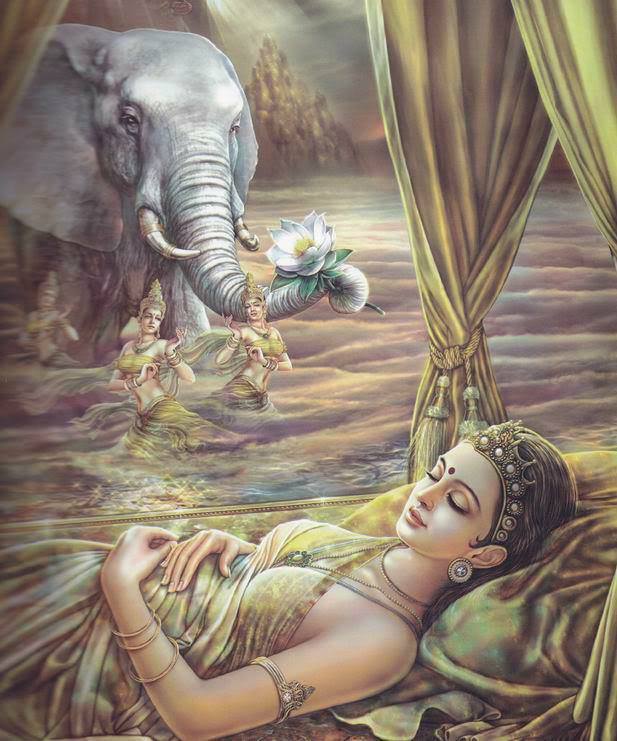
    birth-of-siddharthaLumbini is situated at the foothills of the Himalayas in modern Nepal. In the Buddha’s time, Lumbini was a beautiful garden full of green and shady sal trees (Shorea robusta ). The garden and its tranquil environs were owned by both the Shakyas and the clans. King Suddhodana, father of Gautama Buddha, was of the Shakya dynasty and belonged to the Kshatriya (warrior caste). Maya Devi, his mother, gave birth to the child on her way to her parent’s home in Devadaha while resting in Lumbini under a sal tree in the month of May, 642 BC. The beauty of Lumbini is described in Pali and Sanskrit literature. Maya Devi, it is said, was spellbound to see the natural grandeur of Lumbini. While she was standing, she felt labour pains and catching hold of a drooping branch of a sal tree, she gave birth to a baby, the future Buddha.

    In 249 BC, when the Indian Emperor Ashoka visited Lumbini, it was a flourishing village. Ashoka constructed four stupas and a stone pillar with a figure of a horse on top. The stone pillar bears an inscription, which in translation runs as follows: ‘King Piyadasi (Ashoka), beloved of devas, in the 20th year of the coronation, himself made a royal visit, Buddha Sakyamuni having been born here; a stone railing was built and a stone pillar erected to the Bhagavan having been born here, Lumbini village was taxed reduced and entitled to the eight part (only)’.

    Lumbini remained neglected for centuries. In 1895, Feuhrer, a famous German archaeologist, discovered the great pillar while wandering about the foothills of the Churia range. Further exploration and excavation of the surrounding area revealed the existence of a brick temple and sandstone sculpture within the temple itself, which depicts the scenes of the Buddha’s birth.

    It is pointed out by scholars that the temple of Maya Devi was constructed over the foundations of more than one earlier temple or stupa, and that this temple was probably built on an Ashokan stupa itself. To the south of the Maya Devi temple there is the famous sacred bathing pool known as Puskarni. It is believed that Maya Devi took a bath in this pool before the delivery. By the side of the Ashoka pillar a river which flows south-east and is locally called the Ol. In 1996, an archaeological dig unearthed a ‘flawless stone’ placed there by Ashoka in 249 BC to mark the precise location of the Buddha’s birth more than 2,600 years ago. if authenticated, the find will put Lumbini even more prominently on the map for millions of religious pilgrims.

    Source: UNESCO/CLT/WHC

  2. I pray for a more friendly, more caring…

    Comment

    There are two things important to keep in mind: self-examination and self-correction. We should constantly check our attitude toward others, examining ourselves carefully, and we should correct ourselves immediately when we find we are in the wrong.

    I have written the above lines
    To tell my constant feeling.
    Whenever I meet even a ‘foreigner’,
    I have always the same feeling:
    ‘I am meeting another member of the human family.,
    This attitude has deepened
    My affection and respect for all beings.
    May this natural wish be
    My small contribution to world peace.
    I pray for a more friendly,
    More caring, and more understanding
    Human family on this planet.
    To all who dislike suffering,
    Who cherish lasting happiness –
    This is my heartfelt appeal.

    ~Dalai Lama

    Grandma in Cambodia

    Grandma in Cambodia

  3. Why should we respect and support our parents

    Comment

    children at pond041815

    by Bhikkhu T. Seelananda

    Parents are the fountains of our lives. They are our precious gems. They are the sun and moon in our world, in our family. Father is the Sun and mother is the moon. As Buddhists, as well as grateful and faithful sons and daughters, we cannot think of a life without our parents.

    As the Matchless Teacher, the Knower of the World, the Buddha has taught us that it is our bounden duty, a moral obligation to respect and support our parents unceasingly, especially when they reach old age, and when they are feeble or sick. If one does not support one’s parents in general or in the latter part of their lives in particular; he or she, according to Buddhism, is an ungrateful and uncivilized son or daughter. S/he is an outcaste. The Buddha declared this very clearly in the Wasala sutta, the Discourse on outcastes:

    “Yo mātaram vā pitaram vā
    jinnakam gata yobbanam
    pahusanto na bharati
    tam jaññā vasalo iti”.

    (Having much wealth, if one does not maintain, his/her parents; know that s/he is an outcaste).

    On the contrary, in the Blessing discourse (Mangala Sutta), the Buddha said, “Mātā pitu upatthānam etam mangalam uttamam” means supporting parents is a great blessing. Having good parents, kind-hearted parents, is really a very great blessing to a family, a great fortune.

    As Buddhists, whenever we get together and perform good deeds, meritorious deeds, never forget our parents we commemorate the great virtues of our parents. Specially we commemorate the departed parents affectionately and respect and support our parents while they are alive.

    This is one of the strong Sri Lankan Buddhist traditions in which we respect and become more and more obedient to our parents. In general, we should honour, respect and revere our parents whenever possible. As instructed in the teaching of the Buddha we should respect our parents while they are with us and also after their demise. Intrinsically, we are always ready to listen to our parents. Though we have our own freedom, ideas, and opinions, we keep our parents as the guiding light of our lives. We know very well that without our parents we would not be here today; that is to be understood by all of us very clearly. Who paved the way for all of us to stand on our own two feet? Who sweat days and nights for us, who fed us, who gave us whatever we asked for; in brief, who worked like dogs, like Trojans to make us happy from our earliest days? There was none other than our parents. That is why we should repeatedly respect and support our parents.

    We should respect and support our parents while they are alive. There are some people in our society who try to respect their parents only after their deaths. While they are alive, no one is there to support them and treat them. Sometimes, they die without a sip of water. But right after that the children start to cry and weep and going from place to place build many kinds of monuments spending thousands or millions in their names. But that helps them only a very little. They have gone for good. For the departed ones there is only a very narrow opportunity to receive merit. Therefore, better to do it while alive, today, right now, do your own merit by yourself.

    We see some children who dislike looking after their parents strive to find some excuses saying that they have no time. But when we were little ones our mother or father did not seek such excuses. However, those who seek loopholes are not regarded as truly grateful sons and daughters. This is not the way that we should respect and support our humble and simple parents especially at the time in need. If we are mindful enough we can perform many kinds of meritorious deeds such as generosity, morality and meditation on behalf of our parents while they are still with us and also after their passing away. This is also one of the moral duties of the children. As the Buddha said, this will be certainly a great help for their samsāric journey.

    If the departed ones have been reborn in a place where they can receive our merit, they will definitely receive it. Otherwise, it is not wasting still it’s yours. Anyhow, by the same token, we all should understand clearly that all those who die cannot receive merit as there are only a few states where beings can receive merit. However, again, that is beyond our consciousness. Whether or not they are ready to receive this merit, it is our duty that we share merit with them, whoever departed us.

    Source: Bhavana Society
    Link to this article

  4. Slowly and reverently

    Comment

    Drink your tea slowly and reverently,
    as if it is the axis on which the world earth revolves –
    slowly, evenly, without rushing toward the future.
    Live the actual moment.
    Only this moment is life.

    ~Thich Nhat Hanh

    Buddha

  5. Ministering to the Sick and the Terminally Ill

    Comment

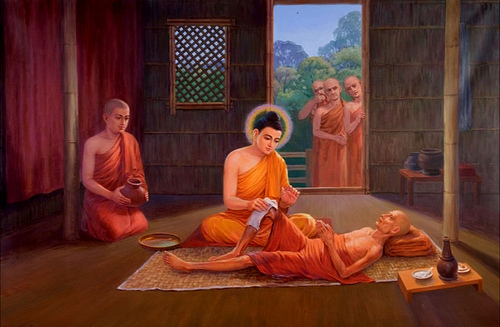
    “He who attends on the sick attends on me,” declared the Buddha, exhorting his disciples on the importance of ministering to the sick. This famous statement was made by the Blessed One when he discovered a monk lying in his soiled robes, desperately ill with an acute attack of dysentery. With the help of Ananda, the Buddha washed and cleaned the sick monk in warm water. On this occasion he reminded the monks that they have neither parents nor relatives to look after them, so they must look after one another. If the teacher is ill, it is the bounden duty of the pupil to look after him, and if the pupil is ill it is the teacher’s duty to look after the sick pupil. If a teacher or a pupil is not available it is the responsibility of the community to look after the sick (Vin.i,301ff.).

    On another occasion the Buddha discovered a monk whose body was covered with sores, his robe sticking to the body with pus oozing from the sores. Unable to look after him, his fellow monks had abandoned him. On discovering this monk, the Buddha boiled water and washed the monk with his own hands, then cleaned and dried his robes. When the monk felt comforted the Buddha preached to him and he became an arahant, soon after which he passed away (DhpA.i,319). Thus the Buddha not only advocated the importance of looking after the sick, he also set a noble example by himself ministering to those who were so ill that they were even considered repulsive by others.

    The Buddha has enumerated the qualities that should be present in a good nurse. He should be competent to administer the medicine, he should know what is agreeable to the patient and what is not. He should keep away what is disagreeable and give only what is agreeable to the patient. He should be benevolent and kind-hearted, he should perform his duties out of a sense of service and not just for the sake of remuneration (mettacitto gilanam upatthati no amisantaro). He should not feel repulsion towards saliva, phlegm, urine, stools, sores, etc. He should be capable of exhorting and stimulating the patient with noble ideas, with Dhamma talk (A.iii,144). Continue reading

  6. Prayer of Lovingkindness

    Comment

    roses in rain

    The Buddha gave a beautiful teaching on the development of lovingkindness called the Metta Sutta (also known as the Karaniya Metta Sutta). I’ve adapted the words of the sutta to formulate them as an aspiration that can be repeated in a prayer-like way.

    In order that I may be skilled in discerning what is good, in order that I may understand the path to peace,

    Let me be able, upright, and straightforward, of good speech, gentle, and free from pride;

    Let me be contented, easily satisfied, having few duties, living simply, of controlled senses, prudent, without pride and without attachment to nation, race, or other groups.

    Let me not do the slightest thing for which the wise might rebuke me. Instead let me think:

    “May all beings be well and safe, may they be at ease. Continue reading

  7. Let us only take care and transform

    Comment

    Sumedha [wise man] giving away all his fortune to become an ascetic in the forest.

    Sumedha [wise man] giving away all his fortune to become an ascetic in the forest.

    Mindfulness has the power, has the capacity of helping us to recognize what is there in the present moment. When anger is there, we recognize the fact that anger is there. When fear is there, we recognize the fact that fear is there. And the practice is not to fight, to suppress, but to recognize and to embrace.

    “Oh my little anger, I know you. You are my old friend. I will take good care of you. Oh my little fear, I know you are always there. I will take good care of you.” That is the attitude of non-duality, the attitude of non-violence, because we know that mindfulness is us; love is us; but fear and anger are us, also.

    Let us not fight. Let us only take care and transform. The organic gardener doesn’t have to fight the garbage placed in (or created by) the garden. She knows exactly what to do in order to handle the garbage, in order to transform it back into cucumber, into tomatoes, et cetera.

    The first function of mindfulness is to recognize what is there, positive or negative. The second function of mindfulness is to embrace it and to get deeply in touch with it. If it is a positive thing like a blue sky or the beautiful face of a child, that becomes something very nourishing, very healing for us. And if it is something negative, like hatred or fear, we should be able to embrace it and bring relief to it.

    The third function of mindfulness is to help us look deeply into the nature of what is there; in this case, fear or anger. The nature of something means the root of that something: how this fear has been created; how this anger has manifested. Look deeply into the nature of our fear and our anger in order to see their true nature. When we understand, when we have insight into the nature of our fear and our anger, that insight will help transform our fear, our anger into positive energies. ~Thich Nhat Hanh

  8. What metta is

    Comment

    Buddha preaching

    Metta is an attitude of recognizing that all sentient beings (that is, all beings that are capable of feeling), can feel good or feel bad, and that all, given the choice, will choose the former over the latter.

    Metta is a recognition of the most basic solidarity that we have with others, this sharing of a common aspiration to find fulfillment and escape suffering.

    Metta is empathy. It’s the willingness to see the world from another’s point of view: to walk a mile in another person’s shoes.

    Metta is the desire that all sentient beings be well, or at least the ones we’re currently thinking about or in contact with. It’s wishing others well.

    Metta is friendliness, consideration, kindness, generosity.
    Metta is an attitude rather than just a feeling. It’s an attitude of friendliness.

    Metta is the basis for compassion. When our Metta meets another’s suffering, then our Metta transforms into compassion.

    Metta is the basis for shared joy. When our Metta meets with another’s happiness or good fortune, then it transmutes into an empathetic joyfulness.

    Metta is boundless. We can feel Metta for any sentient being, regardless of gender, race, or nationality.

    Metta is the most fulfilling emotional state that we can know. It’s the fulfillment of the emotional development of every being.
    It’s our inherent potential. To wish another well is to wish that they be in a state of experiencing Metta.

    Metta is the answer to almost every problem the world faces today. Money won’t do it. Technology won’t do it. Metta will.


    Source: http://www.wildmind.org

  9. Buddha as an animal and human rights activist

    Comment

    BuddhaandelephantBuddha was an animal and human rights activist long before PETA and Amnesty International.

    During the time of Buddha, circa 500 BC, the Vedic religion of the Brahmin priesthood in India had become degenerate and suppressive and engaged in frequent animal sacrifices.

    The Buddha is reputed to have denounced the Vedic religion at the time. He especially denounced the religious animal sacrifices so common during those days.

    “Immense sacrificial ceremonies, such as the sacrifice of the horse (ashvameda), through which the Brahmans imposed their power, ruined the states financially,” writes Alain Danileou in his book While the Gods Play.
    Danileou continues: “Gautama was at first attracted by the antisocial mysticism of the Shaivas (Tantra). For a time, he was also a disciple of Gosala and very close to Mahavira, who was three years younger. For several years he practiced with them the austere and free life of a wandering monk.”

    The Buddha was not alone in denouncing these Vedic practices. His friend Mahavira, the now well known founder of the Jain religion in India, also became an ardent follower of ahimsa, or nonviolence.

    Although it is commonly accepted that the Buddha spoke out against the ritualistic portions of the Vedas (karmakanda), it is doubtful that he rejected the Vedas outright.

    “[Both Buddha and Mahavira] were in open revolt against the karmakanda [prehistoric ritualistic portions] of the Vedas, but they were not so opposed to the the jinanakanda [more recent philosophical portions, including certain Upanishads and Vedanta], because these were quite popular with spiritual aspirants.”

    “Both Buddha and Mahavira vehemently opposed the ritualistic sacrifices, especially of animals, and both of them protested against the hostile attitude of the so-called dharma towards morality.” Quoted from Namami Shiva Shantaya by Shrii Shrii Anandamurti

    In other words, Buddha was an animal and human rights activist long before the popularity of PETA , Amnesty International, vegan and vegetarian activism. About 2500 years before PETA, in fact.

    By Ramesh Bjonneson, May 16, 2010
    Source: Elephant
    Link source


  10. Self — if something is yours…

    Comment

    Buddhaby G.N. Lewis

    If something is yours you have power over it; you can make it into whatever you wish. It will change according to your plans.

    But have you power over your self? Can you make your body larger or smaller or let it be this or that as you desire?

    If it is not governed by your power but by its own laws and processes then it is not yours. If it were the body would not be involved in sickness for you would be able to make it be whatever you wished. Admittedly one has control over the body to an extent but not as much as one has over this house or any other possession. Why?

    Your body was once very much more delicate and smaller than it is now. Now it is bigger and stronger. It will get weaker and degenerate later on. This body which you call yours — has it developed and deteriorated according to your will? Or perhaps the question of ownership does not arise — the body being subject to the same laws of nature as everything else, i.e., birth, decay, and death.

    If this is so, should one be concerned or unconcerned regarding the body? If neglected, the natural processes of destruction act quickly, disease and death soon resulting. Therefore food, exercise, and clothing must be used to maintain it and to stop the natural processes being accelerated.

    Do people feed and dress the body for maintenance only, and, if not, why? Take a person who dresses only to keep his body protected from the elements. What’s wrong with this? Should he be criticized and, if he is, for what? Because others don’t dress similarly doesn’t mean he’s doing something wrong. Someone may say he looks ugly and unsightly but how did we learn what ugliness was in the first place? Is the person criticizing him or his clothes? Well, “him” is not the body; the person criticizing him is not taking offense at the body but just at the clothes.

    This is where opinion together with vanity creep in and facts become concealed.

    Leaving the body let us turn to another aspect of self — feeling.

    Say a man tries to grasp something which continually slips through his fingers. Can he say that thing is his? He tries to keep it but he can never clutch it solidly and he would never dream of calling that thing his own.

    But say he has a fountain pen. That really seems to be his own. It is always with him and it keeps its shape and doesn’t change very much.

    How about feelings — happiness, indifference, and pain? Are not these like the first example? How can we ever say feelings are our own? If they were, happiness would be ours for the rest of our life and not an illusive thing which comes and goes against our wishes.

    Body is born, it decays and dies. Likewise we find on investigation that exactly the same is true for feelings. The body does not come from nothing. It starts off by the fusing of two cells from mother and father. By way of nourishment it grows and develops. Then it dies. Continue reading

Live & Die for Buddhism

candle

Me & Grandma

My Reflection

This site is a tribute to Buddhism. Buddhism has given me a tremendous inspiration to be who and where I am today. Although I came to America at a very young age, however, I never once forget who I am and where I came from. One thing I know for sure is I was born as a Buddhist, live as a Buddhist and will leave this earth as a Buddhist. I do not believe in superstition. I only believe in karma.

A Handful of Leaves

A Handful of Leaves

Tipitaka: The pali canon (Readings in Theravada Buddhism). A vast body of literature in English translation the texts add up to several thousand printed pages. Most -- but not all -- of the Canon has already been published in English over the years. Although only a small fraction of these texts are available here at Access to Insight, this collection can nonetheless be a very good place to start.

Major Differences

Major Differences in Buddhism

Major Differences in Buddhism: There is no almighty God in Buddhism. There is no one to hand out rewards or punishments on a supposedly Judgement Day ...read more

Problems we face today

jendhamuni pink scarfnature

Of the many problems we face today, some are natural calamities and must be accepted and faced with equanimity. Others, however, are of our own making, created by misunderstanding, and can be corrected...