
1. Loving-Kindness

    Comment
    Grandma in Cambodia

    Grandma in Cambodia

    by Venerable K. Sri Dhammananda Maha Thera

    What is lacking in the world today is loving-kindness or goodwill.

    In the world today, there is sufficient material wealth. There are very advanced intellectuals, brilliant writers, talented speaker, philosophers, psychologists, scientists, religious advisors, wonderful poets and powerful world leaders. In spite of these intellectuals, there is no real peace and security in the world today. Something must be lacking. What is lacking is loving-kindness or goodwill amongst mankind.

    Material gain in itself can never bring lasting happiness and peace. Peace must first be established in man’s own heart before he can bring peace to others and to the world at large. The real way to achieve peace is to follow the advice given by religious teachers.

    In order to practise loving-kindness, one must first practise the Noble Principle of non-violence and must always be ready to overcome selfishness and to show the correct path to others. The fighting is not to be done with the physical body, because the wickedness of man is not in his body but in his mind. Non-violence is a more effective weapon to fight against evil than retaliation. The very nature of retaliation is to increase wickedness.

    In order to practise loving-kindness, one must also be free from selfishness. Much of the love in this world of self-centered, only a love of one is own self:

    ‘Not out of love for the husband loved; but the husband is loved for love of self. Children are loved by the parents, not out of love for the children, but for love of self. The gods are loved, not out of love for the gods, but for love for self. Not out of love is anybody loved, but for love of self are loved.’

    Man should learn how to practise selfless love to maintain real peace and his own salvation. Just as suicide kills physically, selfishness kills spiritual progress. Loving-kindness in Buddhism is neither emotional or selfish. It is loving-kindness that radiates through the purified mind after eradicating hatred, jealousy, cruelty, enmity and grudges. According to the Buddha, Metta _ Loving-kindness is the most effective method to maintain purity of mind and to purify the mentally polluted atmosphere.

    The word ‘love’ is used to cover a very wide range of emotions human beings experience. Emphasis on the base animal lust of one sex for another has much debased the concept of a feeling of amity towards another being. According to Buddhism, there are many types of emotions, all of which come under the general term ‘love’ First of all, there is selfish love and there is selfless love. One has selfish love when one is concerned only with the satisfaction to be derived for oneself without any consideration for the partner’s needs or feelings. Jealousy is usually a symptom of selfish love. Selfless love, on the other hand, is felt when one person surrenders his whole being for the good of another _parents feel such love for their children. Usually human beings feel a mixture of both selfless and selfish love in their relationships with each other. For example, while parents make enormous sacrifices for their children, they usually expect something in return. Continue reading

  2. Ten Evil Actions

    Comment

    Little boy

    by Venerable K. Sri Dhammananda Maha Thera

    There are ten demeritorious deeds from which Buddhists are advised to keep away. These deeds are rooted in greed, hatred and delusion, and will bring suffering to others but especially to oneself in this life and later lives. When a person understands the Law of Kamma and realizes that bad deeds bring bad results, he will then practise Right Understanding and avoid performing these actions.

    There are three bodily actions which are kammically unwholesome. They are: (1) Killing of living beings, (2) Stealing, and (3) Unlawful sexual intercourse. These bodily deeds correspond to the first three of the Five Precepts for people to follow.

    The effects of killing to the performer of the deed are brevity of life, ill-health, constant grief due to the separation from the loved, and living in constant fear. The bad consequences of stealing are poverty, misery, disappointment, and a dependent livelihood. The bad consequences of sexual misconduct are having many enemies, always being hated, and union with undesirable wives and husbands.

    Four verbal actions are kammically unwholesome, and they are as follows: (1) Lying, (2) Slander and tale-bearing, (3) Harsh speech, and (4) Frivolous and meaningless talk. Except for lying, the other unwholesome deeds performed by speech may be viewed as extensions of the Fourth Precept.

    The bad consequences of lying to the one who performs the deed are being subject to abusive speech and vilification, untrustworthiness, and physical unpleasantness. The bad effect of slandering is losing one’s friends without any sufficient cause. The results of harsh speech are being detested by others and having a harsh voice. The inevitable effects of frivolous talk are defective bodily organs and speech which no one believes. Continue reading

  3. Everything is Changeable

    Comment

    Red rosesby Ven. Dr. K. Sri Dhammananda Maha Thera

    What exists is changeable and what is not changeable does not exist.

    Looking at life, we notice how it changes and how it continually moves between extremes and contrasts. We notice rise and fall, success and failure, loss and gain; we experience honor and contempt, praise and blame; and we feel how our hearts respond to all that happiness and sorrow, delight and despair, disappointment and satisfaction, fear and hope. These mighty waves of emotion carry us up, fling us down, and no sooner we find some rest, then we are carried by the power of a new wave again. How can we expect a footing on the crest of the waves? Where shall we erect the building of our life in the midst of this ever-restless ocean of existence?

    This is a world where any little joy that is allotted to beings is secured only after many disappointments, failures and defeats. This is a world where scanty joy grows amidst sickness, desperation and death. This is a world where beings who a short while ago were connected with us by sympathetic joy are at the next moment in want of our compassion. Such a world as this needs equanimity. This is the nature of the world where we live with our intimate friends and the next day they become our enemies to harm us.

    The Buddha described the world as an unending flux of becoming. All is changeable, continuous transformation, ceaseless mutation, and a moving stream. Everything exists from moment to moment. Everything is a recurring rotation of coming into being and then passing out of existence. Everything is moving from birth to death. The matter or material forms in which life does or does not express itself, are also a continuous movement or change towards decay. This teaching of the impermanent nature of everything is one of the main pivots of Buddhism. Nothing on earth partakes of the character of absolute reality. That there will be no death of what is born is impossible. Whatever is subject to origination is subject also to destruction. Change is the very constituent of reality.

    In accepting the law of impermanence or change, the Buddha denies the existence of eternal substance. Matter and spirit are false abstractions that, in reality, are only changing factors (Dhamma) which are connected and which arise in functional dependence on each other.

    Today, scientists have accepted the law of change that was discovered by the Buddha. Scientists postulate that there is nothing substantial, solid and tangible in the world. Everything is a vortex of energy, never remaining the same for two consecutive moments. The whole wide world is caught up in this whirl and vortex of change. One of the theories postulated by scientists is the prospect of the ultimate coldness following upon the death or destruction of the sun. Buddhists are not dismayed by this prospect. The Buddha taught that universes or world cycles arise and pass away in endless succession, just as the lives of individuals do. Our world will most certainly come to an end. It has happened before with previous worlds and it will happen again. Continue reading

  4. The Six Realms

    Comment

    Buddha

    If ego decides it likes the situation, it begins to churn up all sorts of ways to possess it. A craving to consume the situation arises and we long to satisfy that craving. Once we do, a ghost of that craving carries over and we look around for something else to consume. We get into the habitual pattern of becoming consumer oriented. Perhaps we order a piece of software for our computer. We play with it for awhile, until the novelty wears out, and then we look around for the next piece of software that has the magic glow of not being possessed yet. Soon we haven’t even got the shrink wrap off the current package when we start looking for the next one. Owning the software and using it doesn’t seem to be as important as wanting it, looking forward to its arrival. This is known as the hungry ghost realm where we have made an occupation out of craving. We can never find satisfaction, it is like drinking salt water to quench our thirst.

    Another realm is the animal realm, or having the mind like that of an animal. Here we find security by making certain that everything is totally predictable. We only buy blue chip stock, never take a chance and never look at new possibilities. The thought of new possibilities frightens us and we look with scorn at anyone who suggests anything innovative. This realm is characterised by ignorance. We put on blinders and only look straight ahead, never to the right or left.

    The hell realm is characterised by acute aggression. We build a wall of anger between ourselves and our experience. Everything irritates us, even the most innocuous, and innocent statement drives us mad with anger. The heat of our anger is reflected back on us and sends us into a frenzy to escape from our torture, which in turn causes us to fight even harder and get even angrier. The whole thing builds on itself until we don’t even know if we’re fighting with someone else or ourselves. We are so busy fighting that we can’t find an alternative to fighting; the possibility of alternative never even occurs to us.

    These are the three lower realms. One of the three higher realms is called the jealous god realm. This pattern of existence is characterised by acute paranoia. We are always concerned with “making it”. Everything is seen from a competitive point of view. We are always trying to score points, and trying to prevent others from scoring on us. If someone achieves something special we become determined to out do them. We never trust anyone; we “know” they’re trying to slip one past us. If someone tries to help us, we try to figure out their angle. If someone doesn’t try to help us, they are being uncooperative, and we make a note to ourselves that we will get even later. “Don’t get mad, get even,” that’s our motto.

    Continue reading

  5. Meditation as the Source of Compassion

    Comment

    by Peter Morrell

    The main purpose of meditation is to purify the mind of bad thoughts and to bring calm and tranquillity to the otherwise chaotic flow of thoughts, sensations and feelings. Meditation aims to dampen these chaotic movements. Buddhist meditation aims to dampen the three poisons and achieve greater equanimity of being, and so slow or stop the karmic treadmill. Detachment, calm abiding and mindfulness are the primary aims, leading ultimately to more advanced practices such as developing greater compassion and practising visualisations. It is the three poisons of desire, hatred and illusion that drive the karmic treadmill upon which we all pound away-wanting things, hating things and self-delusion, which is ignorance of the nature of self and samsara. These form the basis of forming strong likes and dislikes and indulging them endlessly.

    Out of the tranquillity of deep meditation, a pure awareness of mind can emerge that also leads in some cases to an appreciation of all living beings as a pure spiritual essence that we all have in common. This can bring us closer to all living things and an intimate sense of feeling for their welfare. This can form the beginning of a very early form of genuine compassion, because you can then begin to see what are to the fore in people are often mostly the secondary adventitious aspects-the anger, resentment, frustrations and other defilements-these are all secondary overlaid upon a deeper mind. We do not always see below this secondary material, this karmic level, to appreciate the deeper more subtle essence of all living things, which is in fact more like an egoless mindstream. It also leads us to appreciate the egoless nature of mind and how ego is a product a secondary feature, not a primary feature of mind.

    Link source

  6. Unconditional love involves non-attachment

    Comment
    Buddha and Sujata

    Buddha and Sujata

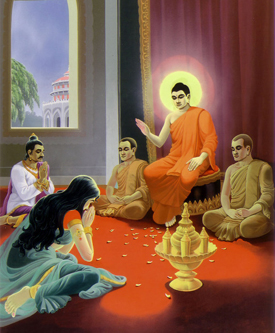
    Parents do not expect to be challenged about their love for their children, but most mothers and fathers inevitably expect their children to repay their care and kindness, especially since the younger generation is nourished by the strength of its forebears. This is by no means an unreasonable expectation, and every rational child will work to repay their debt to their parents as they mature. As sensible as this “temporal contract” of filial love is, however, it is not truly unconditional. Precisely because it is an unspoken agreement made between good parents and upright children, it is not exactly the same unconditional love of the Buddha.

    Practically, the exercise of unconditional love requires the practice of non-attachment. Non-attachment from self-centered motivations is the mark that gives a disciple the lucidity and direction to fulfill his or her potential to love unconditionally. This means that Buddhist compassion really means detached and “disinterested” affection. These words can be easily misconstrued. Of course, non-attachment does not mean that one becomes aloof or unfeeling. Unconditional love involves non-attachment because there can be no self-centered motivation in a life of true love. It is a self-less expression of care, which pertains to the Buddhist striving to destroy the attachment to the self-illusion. By transcending all conditional loves, we reach the love that the Buddha teaches. And this love is cultivated via behaving and thinking in a non-attached manner. Through the exercise of this discipline, one will begin to discover that her love is not limited to several. It will grow to encompass more and more people, and the conditions of her love will seem to fall away.

    Unconditional love is not the only manifestation of beneficial love. It is, however, the most powerful. But all Buddhist traditions teach that it is possible for sentient beings to achieve. This cosmic affirmation is a powerful encouragement that should bring great hope to those who feel that their practice of Buddhism is somehow inadequate. The Buddha Himself would beg to differ.

    Source: Buddhistdoor International

  7. The Elimination of Anger

    Comment

    jendhaandbuddha600Naturally, any bad person may possess some good quality. Some men are evil in mind but speak in deceptive language or slyly perform their deeds in an unsuspecting manner. Some men are coarse only in their language but not in their mind or deeds. Some men are coarse and cruel in their deeds but neither in their speech nor in their mind. Some are soft and kind in mind, speech and deed as well.

    When we feel angry with any person, we should try to find out some good in him, either in his way of thinking, or in his way of speaking or in his way of acting. If we find some redeeming quality in him, we should ponder its value and ignore his bad qualities as natural weaknesses that are to be found in everyone. Whilst we think thus, our mind will soften and we may even feel kindly towards that person. If we develop this way of thinking we will be able to curb or eliminate our anger towards him.

    At times, this method may not be successful and we shall then have to try the third method. Basically, this entails reflecting thus:

    “He has done some wrong to me and in so doing has spoiled his mind. Then why should I spoil or impair my own mind because of his foolishness? Sometimes I ignore support or help offered by my relatives; sometimes their tears even shed because of my activities. Being a person of such type myself, why should I not therefore ignore that foolish man’s deed?”He has done that wrong, being subject to anger, should I too follow him, making my mind subject to anger? Is it not foolish to imitate him? He harboring his hatred destroys himself internally. Why should I, on his account, destroy my reputation?

    “All things are momentary. Both his mind and body are momentary too. The thoughts and the body with which the wrong was done to me are not now existing. What I call the same man now are the thoughts and physical parts which are different from the earlier ones that harmed me although belonging to the same psycho-physical process. Thus, one thought together with one mass of physical parts did me some wrong, and vanished there and then, giving place to succeeding thoughts and material parts to appear. So with which am I getting angry? With the vanished and disappeared thoughts and physical parts or with the thoughts and material parts which do not do any wrong now? Should I get angry with one thing which is innocent whereas another thing has done me wrong and vanished?
    Continue reading

  8. Patience is the highest virtue

    Comment

    Buddha meditating

    He abused me, he beat me, he defeated me, he robbed me of my property. Whosoever harbor such thoughts will never be able to still their enmity.

    Never indeed is hatred stilled by hatred; it will only be stilled by non-hatred — this is an eternal law.

    — Dhp., vv. 4-5

    Do not speak harshly to anyone. Those who are harshly spoken to might retaliate against you. Angry words hurt other’s feelings, even blows may overtake you in return.

    — Dhp., v. 133

    Forbearance is the highest observance. Patience is the highest virtue. So the Buddhas say.

    — Dhp., v. 184

    Let a man remove his anger. Let him root out his pride. Let him overcome all fetters of passions. No sufferings overtake him who neither clings to mind-and-body nor claims anything of the world.

    — Dhp., v. 221

    Conquer anger by non-anger. Conquer evil by good. Conquer miserliness by liberality. Conquer a liar by truthfulness.

    — Dhp., v. 223

    Guard your mind against an outburst of wrong feelings. Keep your mind controlled. Renouncing evil thoughts, develop purity of mind.

    — Dhp., v. 233


    Buddha — Dhammapada

    Link source

  9. Mindfulness Meditation

    Comment

    Buddha meditatingby Gil Fronsdal, February 2006

    While mindfulness can be practiced quite well without Buddhism, Buddhism cannot be practiced without mindfulness. In its Buddhist context, mindfulness meditation has three overarching purposes: knowing the mind; training the mind; and freeing the mind.

    Knowing the Mind

    It is easy to spend an hour, a day, or even a lifetime so caught up with thoughts, concerns, and activities as to preclude understanding deeply what makes us operate the way we do. People can easily be clueless as to what motivates them, the nature of their reactions and feelings, and even, at times, what they are thinking about. The first step in mindfulness practice is to notice and take stock of who we are. What is going on in the body, in the mind, in our emotional life? What underlying dispositions are operating?

    This part of mindfulness practice is a simple process of discovery; it is not judging something as good or bad. Meditative discovery is supported by stillness. Whatever our degree of stillness, it acts as a backdrop to highlight what is going on. It doesn’t take much stillness to notice a racing, agitated mind. Discovery means becoming familiar with what a racing mind is like instead of being critical of it. What is the mind itself like, and what is its effect on the body? What emotions are present? What thoughts and beliefs?

    The knowing aspect of mindfulness is deliberate and conscious. When you know something this way, not only do you know it, but also a presence of mind grows in which you clearly know that you know. It is like being one of two calm people in an unruly crowd. Neither of you gets caught up in the crowd’s agitation, and a spark of recognition, maybe even a smile, passes between you as you share knowing that both of you are not caught.

    When the focus is on knowing, we make no attempt to try to change anything. For people who are always trying to make something happen, just observing the mind can be a radical change and a relief.

    Training the Mind

    The mind is not static. It is a process or, more accurately, a series of interacting processes. As such, the mind is malleable and pliable: it can be trained and shaped in new ways. An important part of Buddhist practice is taking responsibility for the dispositions and activities of our own mind so that it can operate in ways that are beneficial. When we don’t take responsibility for our own mind, external forces will do the shaping: media, advertisements, companions, and other parts of society.

    A good starting point is to train the mind in kindness and compassion. Even a little mindfulness will sometimes prove the cliche, “Self-knowledge is seldom good news.” Mindfulness may reveal mental conflict with ourselves, others, or the inconstant nature of life. Such conflict can take the form of aversion, confusion, anger, despair, ambition, or discouragement. Meeting conflict with further conflict will only add to our suffering. Instead, we can begin exploring how to be kinder, more forgiving and spacious with ourselves. Continue reading

  10. A garden of Love grows in a Grandmother’s heart

    Comment

    Grandmas hold our tiny hands for just a little while, but our hearts forever. A garden of Love grows in a Grandmother’s heart. A grandmother is a little bit parent, a little bit teacher, and a little bit best friend. ~Author Unknown

    Novice and grandma

    Five-year-old novice monk.


Live & Die for Buddhism

candle

Me & Grandma

My Reflection

This site is a tribute to Buddhism. Buddhism has given me a tremendous inspiration to be who and where I am today. Although I came to America at a very young age, however, I never once forget who I am and where I came from. One thing I know for sure is I was born as a Buddhist, live as a Buddhist and will leave this earth as a Buddhist. I do not believe in superstition. I only believe in karma.

A Handful of Leaves

A Handful of Leaves

Tipitaka: The pali canon (Readings in Theravada Buddhism). A vast body of literature in English translation the texts add up to several thousand printed pages. Most -- but not all -- of the Canon has already been published in English over the years. Although only a small fraction of these texts are available here at Access to Insight, this collection can nonetheless be a very good place to start.

Major Differences

Major Differences in Buddhism

Major Differences in Buddhism: There is no almighty God in Buddhism. There is no one to hand out rewards or punishments on a supposedly Judgement Day ...read more

Problems we face today

jendhamuni pink scarfnature

Of the many problems we face today, some are natural calamities and must be accepted and faced with equanimity. Others, however, are of our own making, created by misunderstanding, and can be corrected...