Suffering: Everyone suffers from these thing
One of the Four Noble Truths
Birth- When we are born, we cry.
Sickness- When we are sick, we are miserable.
Old age- When old, we will have ache and pains and find it hard to get around.
Death- None of us wants to die. We feel deep sorrow when someone dies.
Other things we suffer from are:
Being with those we dislike,
Being apart from those we love,
Not getting what we want,
All kinds of problems and disappointments that are unavoidable.
The Buddha did not deny that there is happiness in life, but he pointed out it does not last forever. Eventually everyone meets with some kind of suffering. He said:
“There is happiness in life,
happiness in friendship,
happiness of a family,
happiness in a healthy body and mind,
…but when one loses them, there is suffering.”
~Dhammapada
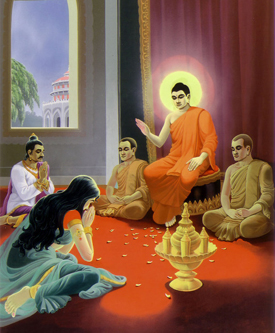
The central focus of inspiration and devotion for Buddhists
is the Triple Gem (also known as the Three Treasures and
the Three Refuges). These three are Buddha, Dhamma
(Dharma), and Sangha.
Buddha means ‘Enlightened One’ or ‘Awakened One,’ and
is generally used to refer to the founder of Buddhism. There
have been other Buddhas before him, however, and will be
other Buddhas in the future.
The word Dhamma (in Sanskrit, Dharma) is often used to
refer to the Buddha’s teachings, but it also means the eternal
Truth which the teachings convey to us. Dhamma is threefold:
the Dhamma that we study, that which we practice, and the
Dhamma of Realization.
Sangha literally means ‘community’ or ‘assembly.’ The word
has two meanings in proper Buddhist usage: the community of
disciples (whether ordained or not) who have gained Realization
of any of the stages of Awakening; and the community of ordained
disciples–bhikkhus (monks) and bhikkhunis (nuns).
Source: http://mettajon.tripod.com
The first truth is that nothing is lost in the universe. Matter turns into energy, energy turns into matter. A dead leaf turns into soil. A seed sprouts and becomes a new plant. Old solar systems disintegrate and turn into cosmic rays. We are born of our parents, our children are born of us.
We are the same as plants, as trees, as other people, as the rain that falls. We consist of that which is around us, we are the same as everything. If we destroy something around us, we destroy ourselves. If we cheat another, we cheat ourselves. Understanding this truth, the Buddha and his disciples never killed any animal. Link source
Love is a mind that brings peace, joy, and happiness to another person. Compassion is a mind that removes the suffering that is present in the other. We all have the seeds of love and compassion in our minds, and we can develop these fine and wonderful sources of energy. We can nurture the unconditional love that does not expect anything in return and therefore does not lead to anxiety and sorrow. The essence of love and compassion is understanding, the ability to recognize the physical, material, and psychological suffering of others, to put ourselves “inside the skin” of the other. We go “inside” their body, feelings, and mental formations, and witness for ourselves their suffering. Shallow observation as an outsider is not enough to see their suffering. We must become one with the object of our observation. When we are in contact with another’s suffering, a feeling of compassion is born in us. Compassion means, literally, “to suffer with.” ~Thich Nhat Hanh