
1. The Turtle Who Saved Lives
    21

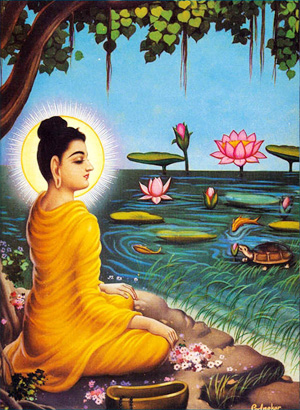
    Buddha used to be a turtle in one of his previous lifetimes

    A story that is often depicted in Buddhist art is the one where the Buddha in a previous life is a Bodhisattva-turtle (that is: a turtle who has vowed to save all sentient beings).

    A group of merchants were sailing, when a storm hit. The giant Bodhisattva-turtle saw the ship wreck and saved the merchants by letting them climb on his back. He brought them safely to land. Tired from the long swim and heavy load he fell asleep on the sand.

    The merchants were hungry and thirsty and after the ordeal were still not sure of their lives. They discussed amongst themselves how to find food. One of them said that they should kill and eat the turtle.

    The Bodhisattva-turtle heard this and out of compassion for the merchants, decided to stay put and be eaten.

    The Jatakas
    Jatakas are stories of previous lifetimes of the Buddha

  2. Death is certain

    16

    There is no possible way to escape death. No-one ever has. Death comes in a moment and its time is unexpected. All that separates us from the next life is one breath. The young can die before the old, the healthy before the sick, etc. There are many causes and circumstances that lead to death, but few that favour the sustenance of life. Even things that sustain life can kill us, for example food, motor vehicles, property. The weakness and fragility of one’s physical body contribute to life’s uncertainty. The body can be easily destroyed by disease or accident, for example cancer, AIDS, vehicle accidents, other disasters.

    THE ONLY THING THAT CAN HELP US AT THE TIME OF DEATH IS OUR MENTAL/SPIRITUAL DEVELOPMENT

    (because all that goes on to the next life is our mind with its karmic (positive or negative) imprints.)

    ♥ Worldly possessions such as wealth, position, money can’t help

    ♥ Relatives and friends can neither prevent death nor go with us.

    ♥ Even our own precious body is of no help to us. We have to leave it behind like a shell, an empty husk, an overcoat. Continue reading

  3. Working For Peace

    Comment

    By Thich Nhat Hanh

    There is a lot of anger, frustration, and misunderstanding in the peace movement. The peace movement can write very good protest letters, but they are not yet able to write a love letter. We need to learn to write a letter to the Congress or to the president of the United States that they will want to read, and not just throw away. The way you speak, the kind of understanding, the kind of language you use should not turn people off. The president is a person like any of us.

    Can the peace movement talk in loving speech, showing the way for peace? I think that will depend on whether the people in the peace movement can be peace. Because without being peace, we cannot do anything for peace. If we cannot smile, we cannot help other people to smile. If we are not peaceful, then we cannot contribute to the peace movement.

    I hope we can bring a new dimension to the peace movement. The peace movement is filled with anger and hatred. It cannot fulfill the path we expect from them. A fresh way of being peace, of doing peace is needed. That is why it is so important for us to practice meditation, to acquire the capacity to look, to see, and to understand. It would be wonderful if we could bring to the peace movement our contribution, our way of looking at things, that will diminish aggression and hatred. Peace work means, first of all, being peace. Meditation is meditation for all of us. We rely on each other. Our children are relying on us in order to have a future.

  4. Every person alive wants happiness

    16

    The Honest Truth

    Every person alive wants happiness — even common animals struggle to find happiness — but our actions for the most part aren’t in line with our intentions. This is why we don’t get to realize the happiness we want, simply because there’s no truth to us. For example, when people come to the monastery: If they come to make offerings, observe the precepts, and sit in meditation for the sake of praise or a good reputation, there’s no real merit to what they’re doing. They don’t gain any real happiness from it, so they end up disappointed and dissatisfied. Then they start saying that offerings, precepts, and meditation don’t give any good results. Instead of reflecting on the fact that they weren’t right and honest in doing these things, they say that there’s no real good to the Buddha, Dhamma, and Sangha, that the Buddha’s teachings are a lot of nonsense and lies. But actually the Buddha’s teachings are an affair of the truth. If a person isn’t true to the Buddha’s teachings, the Buddha’s teachings won’t be true to that person — and that person won’t be able to know what the Buddha’s true teachings are.

    Source: Access to Insight
    Translated from the Thai by Thanissaro Bhikkhu

  5. The Four Noble Truths

    Comment

    1. Life means suffering.

    2. The origin of suffering is attachment.

    3. The cessation of suffering is attainable.

    4. The path to the cessation of suffering.


    1. Life means suffering

    To live means to suffer, because the human nature is not perfect and neither is the world we live in. During our lifetime, we inevitably have to endure physical suffering such as pain, sickness, injury, tiredness, old age, and eventually death; and we have to endure psychological suffering like sadness, fear, frustration, disappointment, and depression. Although there are different degrees of suffering and there are also positive experiences in life that we perceive as the opposite of suffering, such as ease, comfort and happiness, life in its totality is imperfect and incomplete, because our world is subject to impermanence. This means we are never able to keep permanently what we strive for, and just as happy moments pass by, we ourselves and our loved ones will pass away one day, too. Continue reading

  6. The Noble Eightfold Path

    3

    Wisdom

    Ethical Conduct

    Mental Development

    1. Right View 3. Right Speech 6. Right Effort
    2. Right Intention 4. Right Action 7. Right Mindfulness
    5. Right Livelihood 8. Right Concentration


    The Noble Eightfold Path describes the way to the end of suffering, as it was laid out by Siddhartha Gautama. It is a practical guideline to ethical and mental development with the goal of freeing the individual from attachments and delusions; and it finally leads to understanding the truth about all things. Together with the Four Noble Truths it constitutes the gist of Buddhism. Great emphasis is put on the practical aspect, because it is only through practice that one can attain a higher level of existence and finally reach Nirvana. The eight aspects of the path are not to be understood as a sequence of single steps, instead they are highly interdependent principles that have to be seen in relationship with each other. Continue reading

  7. The Filial Piety Sutra

    Comment

    The Buddha Speaks about the Deep Kindness of Parents and the Difficulty in Repaying it.

    Thus I have heard, at one time, the Buddha dwelt at Shravasti, in the Jeta Grove, in the Garden of the Benefactor of Orphans and the Solitary, together with a gathering of great Bhikshus, twelve hundred fifty in all and with all of the Bodhisattvas, thirty-eight thousand in all.

    At that time, the World Honoured One led the great assembly on a walk toward the south. Suddenly they came upon a pile of bones beside the road. The World Honoured One turned to face them, placed his five limbs on the ground, and bowed respectfully.

    Ananda put his palms together and asked the World Honoured One, “The Tathagata is the GreatTeacher of the Triple Realm and the compassionate father of beings of the four kinds of births. He has the respect and reverence of the entire assembly. What is the reason that he now bows to a pile of dried bones?

    The Buddha told Ananda, “Although all of you are my foremost disciples and have been members of the Sangha for a long time, you still have not achieved far-reaching understanding. This pile of bones could have belonged to my ancestors from former lives. They could have been my parents in many past lives. That is the reason I now bow to them.” The Buddha continued speaking to Ananda, “These bones we are looking at can be divided into two groups. One group is composed of the bones of men, which are heavy and white in color. The other group is composed of the bones of women, which are light and black in color.” Continue reading

  8. Holding up the Mirror

    Comment

    Transcribed talks by Ratnaghosa

    Talk six of six on patience or kshanti

    I began the first talk in this series of talks on Kshanti with a quote from the novel Kim, by Rudyard Kipling. The quote was a description of the Tibetan Wheel of Life. The Tibetan Wheel of Life is as you know a visual depiction of the cycle of mundane existence. As the centre of the wheel of life are a cock a snake and a pig biting each others tails. They represent greed, hatred and spiritual ignorance, the basic mental poisons which keep the whole cyclic process going. T

    he second circle of the wheel shows people descending and ascending, which indicates that within the round of mundane existence it is possible to go downwards into more negative mental states or upwards into more positive mental states. The third circle of the Wheel shows six realms of conditioned existence into which we can be reborn. They are the god realm, the realm of the titans, the hungry ghost realm, the hell realm, the animal realm and the human realm. These can also be seen to represent mental states that we inhabit from day to day or even from minute to minute. Continue reading

  9. Creative Listening

    Comment

    Transcribed talks by Ratnaghosa
    Talk five of six on patience or kshanti

    At the beginning of this series of talks I was keen to point out that Kshanti is not a passive virtue. To practise Kshanti requires energy. You need to make an effort in order to be patient, or to practise forgiveness or tolerance. I have chosen the title “creative listening” to indicate that the topic of this talk, receptivity, also requires energy and effort. It is perhaps understandable that receptivity should be thought of as passive.

    You don’t have to make an effort to receive. Or so we think, at least. But what about receiving criticism or praise, don’t we have to make an effort to listen to what is being said and remain open to it? Receptivity as an aspect of Kshanti is receptivity to the Dharma. To be receptive to the Dharma means to hear the Dharma, to listen to the Dharma and to allow oneself to be affected by it. Listening includes reading by the way.

    Creative listening or creative reading is listening or reading in a way that is not passive. It means actively engaging with whatever is being heard or read, asking oneself how does it apply to me, how is it related to the actual practice of the spiritual life. Continue reading

  10. The Art of Disagreement

    Comment

    Transcribed talks by Ratnaghosa
    Talk four of six on patience or kshanti 

    Tolerance is not always seen as a virtue. Some of the connotations of the term tolerance are not very pleasant. For instance, to tolerate can mean to put up with something in a rather grudging or resentful manner or tolerance can be associated with weakness, an inability to stand your ground and assert yourself. I have heard tolerance defined as supercilious condescension. And tolerance is often thought to mean agreement. Tolerance is not always seen as a virtue and even when it is seen as a virtue it is often misunderstood.

    From a Buddhist perspective, tolerance is extremely important and it has been a hallmark of Buddhism down the twenty five centuries of its history. Tolerance is the acceptance that other people hold different views from ourselves. Tolerance is the willingness to allow others to be different in their views and actions. Above all tolerance is the absolute avoidance of using power, violence or coercion to force oth Õer people to think and believe as we do.

    Tolerance is an attitude of loving kindness (metta) towards those who hold views which are different from ours and even towards those who hold views which are repugnant to us. Intolerance on the other hand is the willingness to use and the use of force, violence and coercion to make other people behave as we want them to and hold the views we want them to hold. Continue reading

Live & Die for Buddhism

candle

Me & Grandma

My Reflection

This site is a tribute to Buddhism. Buddhism has given me a tremendous inspiration to be who and where I am today. Although I came to America at a very young age, however, I never once forget who I am and where I came from. One thing I know for sure is I was born as a Buddhist, live as a Buddhist and will leave this earth as a Buddhist. I do not believe in superstition. I only believe in karma.

A Handful of Leaves

A Handful of Leaves

Tipitaka: The pali canon (Readings in Theravada Buddhism). A vast body of literature in English translation the texts add up to several thousand printed pages. Most -- but not all -- of the Canon has already been published in English over the years. Although only a small fraction of these texts are available here at Access to Insight, this collection can nonetheless be a very good place to start.

Major Differences

Major Differences in Buddhism

Major Differences in Buddhism: There is no almighty God in Buddhism. There is no one to hand out rewards or punishments on a supposedly Judgement Day ...read more

Problems we face today

jendhamuni pink scarfnature

Of the many problems we face today, some are natural calamities and must be accepted and faced with equanimity. Others, however, are of our own making, created by misunderstanding, and can be corrected...