1. The Story of Nanda, the Herdsman

    Comment

    Verse 42: A thief may harm a thief; an enemy may harm an enemy; but a wrongly directed mind can do oneself far greater harm.2

    1. diso: lit.; an enemy; a thief in this context. (The Commentary)
    2. According to the Commentary, the mind, wrongly set on the ten-fold evil path, will cause ruin and destruction not only in this life, but also, even in a hundred. thousand future existences in Apaya.

    The Story of Nanda, the Herdsman

    While on a visit to a village in the kingdom of Kosala, the Buddha uttered Verse (42) of this book, with reference to Nanda, the herdsman.

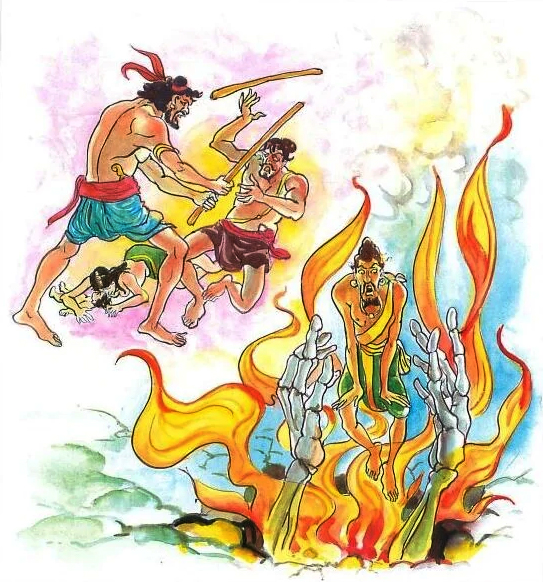
    Nanda was a herdsman who looked after the cows of Anathapindika. Although only a herdsman, he had some means of his own. Occasionally, he would go to the house of Anathapindika and there he sometimes met the Buddha and listened to his discourses. Nanda requested the Buddha to pay a visit to his house. But the Buddha did not go to Nanda’s house immediately, saying that it was not yet time.

    After some time, while travelling with his followers, the Buddha went off his route to visit Nanda, knowing that the time was ripe for Nanda to receive his teaching properly. Nanda respectfully received the Buddha and his followers; he served them milk and milk products and other choice food for seven days. On the last day, after hearing the discourse given by the Buddha, Nanda attained Sotapatti Fruition. As the Buddha was leaving that day, Nanda carrying the bowl of the Buddha, followed him for some distance, paid obeisance and turned back to go home. Continue reading

  2. The Elephant

    Comment

    Buddha with elephant and monkey

    I shall endure painful words
    as the elephant in battle endures arrows shot from the bow;
    for most people are ill-natured.
    They lead a tamed elephant into battle;
    the king mounts a tamed elephant.

    The tamed are the best of people,
    who endure patiently painful words.
    Mules are good, if tamed,
    and noble Sindhu horses and elephants with large tusks;
    but whoever tames oneself is better still.
    For with these animals no one reaches the untrodden country
    where a tamed person goes on one’s own tamed nature.

    The elephant called Dhanapalaka is hard to control
    when his temples are running with pungent sap.
    He does not eat a morsel when bound;
    the elephant longs for the elephant grove.

    If one becomes lazy and a glutton,
    rolling oneself about in gross sleep,
    like a hog fed on grains,
    that fool is born again and again.

    This mind of mine used to wander
    as it liked, as it desired, as it pleased.
    I shall now control it thoroughly,
    as the rider holding the hook controls the elephant in rut.

    Do not be thoughtless; watch your thoughts.
    Extricate yourself from the wrong path,
    like an elephant sunk in the mud.

    If you find an intelligent companion
    who will walk with you,
    who lives wisely, soberly, overcoming all dangers,
    walk with that person in joy and thoughtfulness.

    If you find no intelligent companion
    who will walk with you,
    who lives wisely and soberly,
    walk alone like a king who has renounced a conquered kingdom
    or like an elephant in the forest.

    It is better to live alone;
    there is no companionship with a fool.
    Let a person walk alone with few wishes, committing no wrong,
    like an elephant in the forest.

    Companions are pleasant when an occasion arises;
    sharing enjoyment is pleasant.
    At the hour of death it is pleasant to have done good.
    The giving up of all sorrow is pleasant.

    Motherhood is pleasant in this world;
    fatherhood is pleasant.
    Being an ascetic is pleasant;
    being a holy person is pleasant.

    Virtue lasting to old age is pleasant;
    faith firmly rooted is pleasant;
    attainment of wisdom is pleasant;
    avoiding wrong is pleasant.

    ~The Dhammapada

  3. Calm mind brings inner strength

    Comment

    Too much self-centered attitude, you see, brings, you see, isolation. Result: loneliness, fear, anger. The extreme self-centered attitude is the source of suffering. World belongs to humanity, not this leader, that leader or that king or prince or religious leader. World belongs to humanity. ~Dalai Lama

  4. An Enchanted Garden

    394

    How true it is that,
    if we are cheerful and contented,
    all nature smiles,
    the air seems more balmy,
    the sky clearer,
    the earth has a brighter green…
    the flowers are more fragrant…
    and the sun, moon, and stars
    all appear more beautiful,
    and seem to rejoice with us.

    ~Orison Swett Marden


  5. It’s Not Too Late

    204

    It’s not too late… the angel said.
    Even though the world’s a mess…
    Even though you’re not as young…
    Even though you’ve made mistakes and have been afraid
    It’s not too late…
    And then I saw the world through the angels’ eyes…
    I saw the colors I could paint
    The bridges I could build
    The lives that I could touch
    The dreams that could still come true
    And it became very clear to me…
    That it’s not too late.

    ~Written by Ron Atchison


  6. Bird sings

    51

    I hear the bird sings
    It is so beautiful
    I will sing along.

    ~Zach Aurel Henderson

  7. Miracle of Love

    241

    Miracle of love
    shines its radiant ray
    giving hard or hopeless hearts
    a chance to see the Way.
    Miracle of love
    brings you consolation,
    calls you from your apathy
    to a place of expectation.
    Love highlights your soul,
    transforming all you are
    and others in dark places
    see your light as Hope’s bright star!

    ~Written by Roslyn (Ros) Mansell

  8. The Story of Tissa, the Thera with a Stinking Body

    Comment

    Buddha and sick monk

    Verse 41: Before long, alas, this body, deprived of consciousness, will lie on the earth, discarded like a useless log.

    While residing at the Jetavana monastery, the Buddha uttered Verse (41) of this book, with reference to Thera Tissa.

    After taking a subject of meditation from the Buddha, Thera Tissa was diligently practising meditation when he was afflicted with a disease. Small boils appeared all over his body and these developed into big sores. When these sores burst, his upper and lower robes became sticky and stained with pus and blood, and his whole body was stinking. For this reason, he was known as Putigattatissa, Tissa the thera with stinking body.

    As the Buddha surveyed the universe with the light of his own intellect, the thera appeared in his vision. He saw the sorrowful state of the thera, who had been abandoned by his resident pupils on account of his stinking body. At the same time, he also knew that Tissa would soon attain arahatship. So, the Buddha proceeded to the fire-shed, close to the place where the thera was staying. There, he boiled some water, and then going, to where the thera was lying down, took hold of the edge of the couch. It was then only that the resident pupils gathered round the thera, and as instructed by the Buddha, they carried the thera to the fire-shed, where he was washed and bathed. While he was being bathed, his upper and lower robes were washed and dried. After the bath, the thera became fresh in body and mind and soon developed one-pointedness of concentration. Standing at the head of the couch, the Buddha said to him that this body when devoid of life would be as useless as a log and would be laid on the earth.

    Then the Buddha spoke in verse as follows:

    Verse 41: Before long, alas, this body, deprived of consciousness, will lie on the earth, discarded like a useless log.
    At the end of the discourse Thera Tissa attained arahatship together with Analytical Insight, and soon passed away.

    Dhammapada Verse 41
    Putigattatissatthera Vatthu

    Aciram vata’ yam kayo
    pathavim adhisessati
    chuddho apetavinnano
    niratthamva kalingaram.

    Source: Tipitaka


  9. The Worldly Way and Liberation

    Comment

    Tapussa and Bhallika two merchant brothers with Buddha

    By Ajahn Chah

    Some people die, some people almost die — that’s how it is to be stuck in the way of the world. Worldly wisdom seeks after the senses and their objects. However wise it is, it’s only wise in a worldly sense. No matter how appealing it is, it’s only appealing in a worldly sense. However much happiness it is, it’s only happiness in a worldly sense. It isn’t the happiness of liberation; it won’t free you from the world.

    We have come to practice as monks in order to penetrate true wisdom, to rid ourselves of attachment. Practice to be free of attachment! Investigate the body, investigate everything around you until you become weary and fed up with it all and then dispassion will set in. Dispassion will not arise easily however, because you still don’t see clearly.

    We come and ordain — we study, we read, we practice, we meditate. We determine to make our minds resolute but it’s hard to do. We resolve to do a certain practice, we say that we’ll practice in this way — only a day or two goes by, maybe just a few hours pass and we forget all about it. Then we remember and try to make our minds firm again, thinking, “This time I’ll do it right!” Shortly after that we are pulled away by one of our senses and it all falls apart again, so we have to start all over again! This is how it is.

    Like a poorly built dam, our practice is weak. We are still unable to see and follow true practice. And it goes on like this until we arrive at true wisdom. Once we penetrate to the Truth, we are freed from everything. Only peace remains.

    Our minds aren’t peaceful because of our old habits. We inherit these because of our past actions and thus they follow us around and constantly plague us. We struggle and search for a way out, but we’re bound by them and they pull us back. These habits don’t forget their old grounds. They grab onto all the old familiar things to use, to admire and to consume — that’s how we live.

    The sexes of man and woman — woman cause problems for men, men cause problems for women. That’s the way it is, they are opposites. If men live together with men, then there’s no trouble. If women live together with women, then there’s no trouble. When a man sees a woman his heart pounds like a rice pounder, “deung, dung, deung, dung, deung, dung.” What is this? What are those forces? It pulls and sucks you in — no one realizes that there’s a price to pay!

    It’s the same in everything. No matter how hard you try to free yourself, until you see the value of freedom and the pain in bondage, you won’t be able to let go. People usually just practice enduring hardships, keeping the discipline, following the form blindly and not in order to attain freedom or liberation. You must see the value in letting go of your desires before you can really practice; only then is true practice possible.

    Everything that you do must be done with clarity and awareness. When you see clearly, there will no longer be any need for enduring or forcing yourself. You have difficulties and are burdened because you miss this point! Peace comes from doing things completely with your whole body and mind. Whatever is left undone leaves you with a feeling of discontent. These things bind you with worry wherever you go. You want to complete everything, but it’s impossible to get it all done.

    Take the case of the merchants who regularly come here to see me. They say, “Oh, when my debts are all paid and property in order, I’ll come to ordain.” They talk like that but will they ever finish and get it all in order? There’s no end to it. They pay up their debts with another loan, they pay off that one and do it all again. A merchant thinks that if he frees himself from debt he will be happy, but there’s no end to paying things off. That’s the way worldliness fools us — we go around and around like this never realizing our predicament.

    Link source

     

  10. God Loves Everybody

    63

    If you are white, God loves you.
    If you are black, he loves you too.
    He loves you if you’re Asian, Mexican or an Indian.
    God loves all races, he loves everyone.
    God loves you and he loves me.
    He loves all of his children equally.

    ~Written by Randy Johnson

    RFA photo


Live & Die for Buddhism

candle

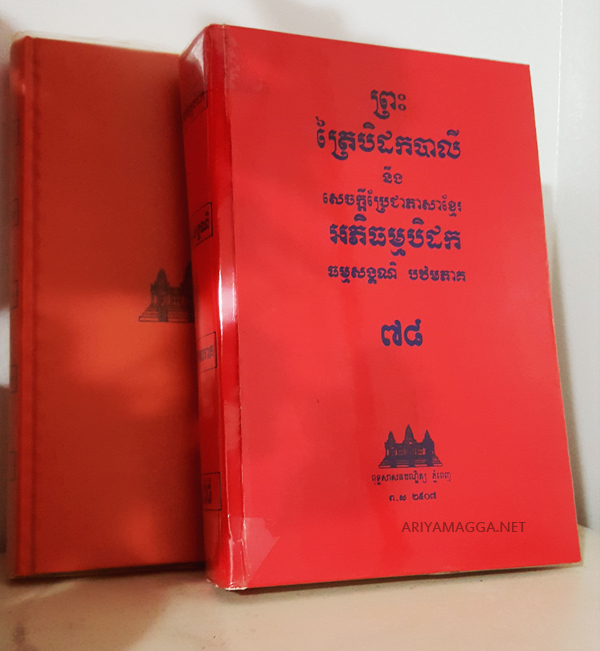
Khmer Tipitaka 1 – 110

 ព្រះត្រៃបិដក

ព្រះត្រៃបិដក ប្រែថា កញ្រ្ចែង ឬ ល្អី​ ៣ សម្រាប់ដាក់ផ្ទុកពាក្យពេចន៍នៃព្រះសម្មាសម្ពុទ្ធ

The Tipitaka or Pali canon, is the collection of primary Pali language texts which form the doctrinal foundation of Theravada Buddhism. The three divisions of the Tipitaka are: Vinaya Pitaka, Sutta Pitaka, Abhidhamma Pitaka.

Maha Ghosananda

Maha Ghosananda

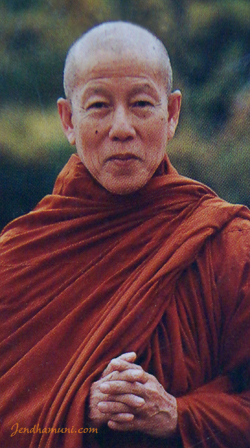
Supreme Patriarch of Cambodian Buddhism (5/23/1913 - 3/12/07). Forever in my heart...

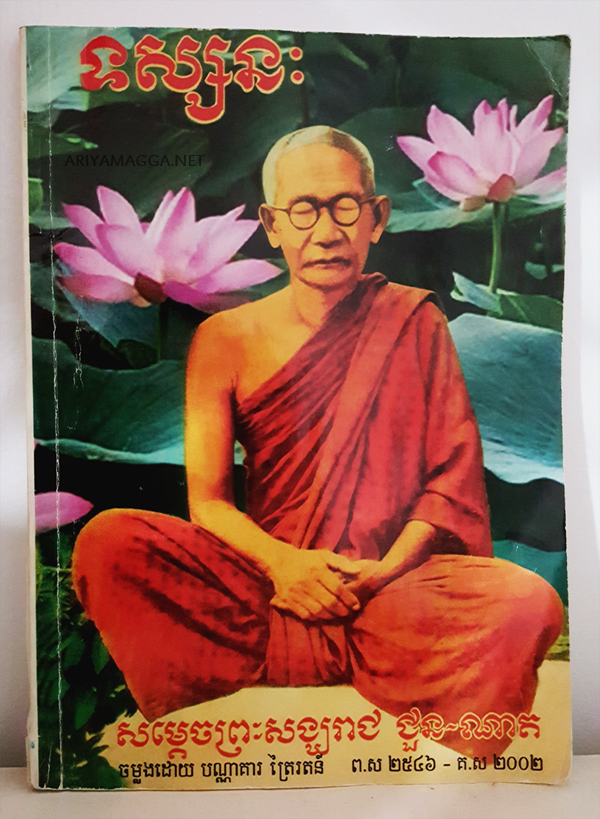
Samdech Chuon Nath

My reflection

វចនានុក្រមសម្តេចសង្ឃ ជួន ណាត
Desktop version

Listen to Khmer literature and Dhamma talk by His Holiness Jotannano Chuon Nath, Supreme Patriarch of Cambodia Buddhism.

Shantidevas’ Bodhisattva vows

My reflection

Should anyone wish to ridicule me and make me an object of jest and scorn why should I possibly care if I have dedicated myself to others?

Let them do as they wish with me so long as it does not harm them. May no one who encounters me ever have an insignificant contact.

Regardless whether those whom I meet respond towards me with anger or faith, may the mere fact of our meeting contribute to the fulfilment of their wishes.

May the slander, harm and all forms of abuse that anyone should direct towards me act as a cause of their enlightenment.

As a solid rock is not shaken by the wind, so the wise are not shaken by blame and praise. As a deep lake is clear and calm, so the wise become tranquil after they listened to the truth…

Good people walk on regardless of what happens to them. Good people do not babble on about their desires. Whether touched by happiness or by sorrow, the wise never appear elated or depressed. ~The Dhammapada

Hermit of Tbeng Mountain

Sachjang Phnom Tbeng សច្ចំ​​ ភ្នំត្បែង is a very long and interesting story written by Mr. Chhea Sokoan, read by Jendhamuni Sos. You can click on the links below to listen. Part 1 | Part 2

Beauty in nature

A beautiful object has no intrinsic quality that is good for the mind, nor an ugly object any intrinsic power to harm it. Beautiful and ugly are just projections of the mind. The ability to cause happiness or suffering is not a property of the outer object itself. For example, the sight of a particular individual can cause happiness to one person and suffering to another. It is the mind that attributes such qualities to the perceived object. — Dilgo Khyentse Rinpoche

Nature is loved by what is best in us. The sky, the mountain, the tree, the animal, give us a delight in and for themselves. — Ralph Waldo Emerson


Our journey for peace
begins today and every day.
Each step is a prayer,
Each step is a meditation,
Each step will build a bridge.

—​​​ Maha Ghosananda