1. Religion teaches a person

    106

    Religion teaches a person how to calm down the senses and make the heart and mind peaceful. The secret of calming down the senses is to eliminate desire which is the root of our disturbances. It is very important for us to have contentment. The more people crave for their property, the more they have to suffer. Property does not give happiness to man. Most of the rich people in the world today are suffering from numerous physical and mental problems. With all the money they have, they cannot buy a solution to their problems. Yet, the poorest men who have learnt to have contentment may enjoy their lives far more than the richest people do. As one rhyme goes:

    'Some have too much and yet do crave I have little and seek no more; They are but poor though much more they have And I am rich with little store. They poor, I rich, they beg, I give; They lack, I have; they pine, I live.' Searching for a purpose in life The aim in life varies among individuals. An artist may aim to paint masterpieces that will live long after he is gone. A scientist may want to discover some laws, formulate a new theory, or invent a new machine. A politician may wish to become a prime minister or a president. A young executive may aim to be a managing director of multinational company. However, when you ask the artist, scientist, politician and the young executive why they aim such, they will reply that these achievements will give them a purpose in life and make them happy. Everyone aims for happiness in life, yet experience shows time and again that its attainment is so elusive. 

    ~Ven. Dr. K Sri Dhammananda 

    http://leelavadeeflower.blogspot.com/2014/07/religion-teaches-person.html

  2. The word ‘love’

    Comment

    By Ven. Dr. K Sri Dhammananda

    The word ‘love’ is used to cover a very wide range of emotions human beings experience. Emphasis on the base animal lust of one sex for another has much debased the concept of a feeling of amity towards another being. According to Buddhism, there are many types of emotions, all of which come under the general term ‘love’ First of all, there is selfish love and there is selfless love. One has selfish love when one is concerned only with the satisfaction to be derived for oneself without any consideration for the partner’s needs or feelings. Jealousy is usually a symptom of selfish love. Selfless love, on the other hand, is felt when one person surrenders his whole being for the good of another _parents feel such love for their children. Usually human beings feel a mixture of both selfless and selfish love in their relationships with each other. For example, while parents make enormous sacrifices for their children, they usually expect something in return.

    Another kind of love, but closely related to the above, is brotherly love or the love between friends. In a sense, this kind of love can also be considered selfish because the love is limited to particular people and does not encompass others. In another category we have sexual love, where partners are drawn towards each other through physical attraction. It is the kind that is most exploited by modern entertainment and it can cover anything from uncomplicated teenage infatuations to the most complex of relationships between adults.

    Continue reading

  3. Love is an active force

    252

    Love is an active force. Every act of the loving one is done with the stainless mind to help, to succor, to cheer, to make the paths of others easier, smoother and more adapted to the conquest of sorrow, the winning of the highest bliss.

    The way to develop love is through thinking out the evils of hate, and the advantages of non-hate; through thinking out according to actuality, according to karma, that really there is none to hate, that hate is a foolish way of feeling which breeds more and more darkness, that obstructs right understanding. Hate restricts; love release. Hatred strangles; love enfranchises. Hatred brings remorse; love brings peace. Hatred agitates; love quietens, stills, calms. Hatred divides; love unites. Hatred hardens; love softens. Hatred hinders; love helps. And thus through a correct study and appreciation of the effects of hatred and the benefits of love, should one develop love.

    The Buddha’s Ancient Path Ven. Piyadassi

  4. Four kinds of happiness

    Comment

    By Ven. Dr. K Sri Dhammananda

    Remember there are four kinds of happiness:

    1. Happiness of Possession – In owning your own property, house, land, business, bank account.

    2. Happiness of Enjoyment – Using what you have earned (which) you can enjoy good food, nice house, (comfortable clothing)  without abusing, bluffing and cheating others.

    3. Happiness of Debtlessness – Try best not to borrow from others. By spending within your own means, you gain self respect.

    4. Happiness of Blamelessness – Try to lead life without bringing harm to anyone.

    (You must constantly cultivate) these four kinds of happiness. (Never) be lazy, do some (productive) work, do not neglect what you have earned. Maintain and protect what you have earned.

    Later on, you can then decide upon adopting a Buddhist way of life, right up to becoming an Arahant. (But first, you have to) know how to adjust your way of life and how to associate with others. Who are (these others)?

    Associate with good people, not harmful, wicked people. Support your father and mother and look after your wife and children. Don’t neglect relatives, help them (when needful). Develop your mind to the extent that you are not shaken by the eight winds of change – praise and blame, fame and shame, gain and loss, pleasure and pain and treat all the same. (If you do this well) at this stage nothing will affect you.

    All meetings end in partings,
    That which rises must fall,
    That which is collected will be dispersed,
    Birth ends with death

    Edited by Ang Choo Hong

  5. Craving and Attachment

    Comment

    When craving and attachment is completely removed,
    the mind is then completely pure. Remember,
    this body is not life. It is just a house built
    by energy and the four cosmic elements.

     By Ven. Dr. K Sri Dhammananda

  6. Beautiful Lotus pond at the Japanese Pagoda

    Comment

    So many frogs and fishes in this beautiful lotus pond, next to the Japanese Pagoda, in the forest.
    Very peaceful too. I was there with the children for four hours, playing with water and the lotus flowers. No one wanted to get out of the pond.

  7. Moment-to-moment mindfulness…

    Comment

    Love is moment-to-moment mindfulness where communication becomes a spiritual transaction.
    And when love fails to be mindful, falling again and again? Love takes a breath. Stops. Opens up rather than closes down. Listens and forgives. Love grows deeper through all the trials and errors. Forgiving grace in action, instead of bolting the other way.

    Source: Rebelle Society


Live & Die for Buddhism

candle

Khmer Tipitaka 1 – 110

 ព្រះត្រៃបិដក

ព្រះត្រៃបិដក ប្រែថា កញ្រ្ចែង ឬ ល្អី​ ៣ សម្រាប់ដាក់ផ្ទុកពាក្យពេចន៍នៃព្រះសម្មាសម្ពុទ្ធ

The Tipitaka or Pali canon, is the collection of primary Pali language texts which form the doctrinal foundation of Theravada Buddhism. The three divisions of the Tipitaka are: Vinaya Pitaka, Sutta Pitaka, Abhidhamma Pitaka.

Maha Ghosananda

Maha Ghosananda

Supreme Patriarch of Cambodian Buddhism (5/23/1913 - 3/12/07). Forever in my heart...

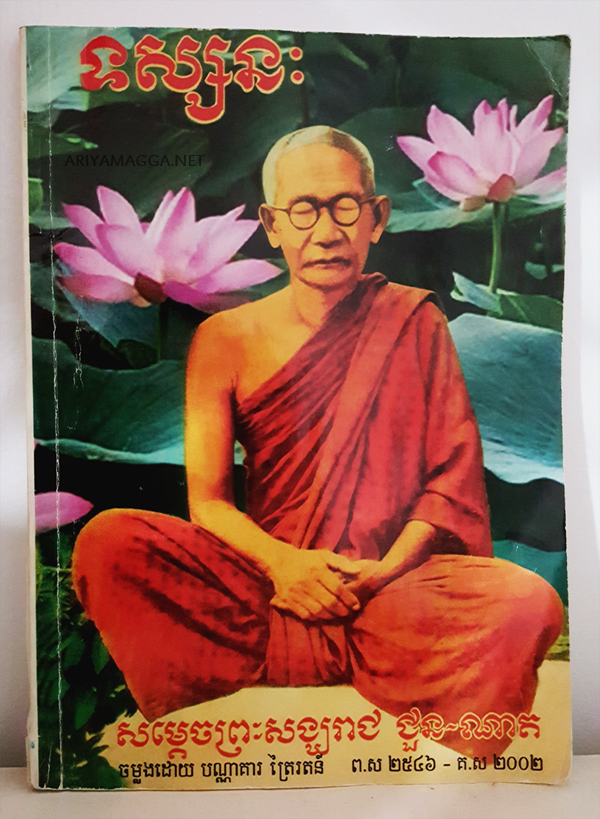
Samdech Chuon Nath

My reflection

វចនានុក្រមសម្តេចសង្ឃ ជួន ណាត
Desktop version

Listen to Khmer literature and Dhamma talk by His Holiness Jotannano Chuon Nath, Supreme Patriarch of Cambodia Buddhism.

Shantidevas’ Bodhisattva vows

My reflection

Should anyone wish to ridicule me and make me an object of jest and scorn why should I possibly care if I have dedicated myself to others?

Let them do as they wish with me so long as it does not harm them. May no one who encounters me ever have an insignificant contact.

Regardless whether those whom I meet respond towards me with anger or faith, may the mere fact of our meeting contribute to the fulfilment of their wishes.

May the slander, harm and all forms of abuse that anyone should direct towards me act as a cause of their enlightenment.

As a solid rock is not shaken by the wind, so the wise are not shaken by blame and praise. As a deep lake is clear and calm, so the wise become tranquil after they listened to the truth…

Good people walk on regardless of what happens to them. Good people do not babble on about their desires. Whether touched by happiness or by sorrow, the wise never appear elated or depressed. ~The Dhammapada

Hermit of Tbeng Mountain

Sachjang Phnom Tbeng សច្ចំ​​ ភ្នំត្បែង is a very long and interesting story written by Mr. Chhea Sokoan, read by Jendhamuni Sos. You can click on the links below to listen. Part 1 | Part 2

Beauty in nature

A beautiful object has no intrinsic quality that is good for the mind, nor an ugly object any intrinsic power to harm it. Beautiful and ugly are just projections of the mind. The ability to cause happiness or suffering is not a property of the outer object itself. For example, the sight of a particular individual can cause happiness to one person and suffering to another. It is the mind that attributes such qualities to the perceived object. — Dilgo Khyentse Rinpoche

Nature is loved by what is best in us. The sky, the mountain, the tree, the animal, give us a delight in and for themselves. — Ralph Waldo Emerson


Our journey for peace
begins today and every day.
Each step is a prayer,
Each step is a meditation,
Each step will build a bridge.

—​​​ Maha Ghosananda