Mind’s ultimate nature, emptiness endowed with vividness,
I was told is the real Buddha.
Recognizing this should help me
Not to be stuck with thoughts of hierarchy.
Mind’s ultimate nature, its emptiness aspect,
I was told is the real Dharma.
Recognizing this should help me
Not to be stuck with thoughts of political correctness.
Mind’s ultimate nature, its vivid aspect,
I was told is the real Sangha.
Recognizing this should help me
Not to be stuck with thoughts of equal rights.
One cannot disassociate emptiness from vividness.
This inseparability I was told is the Guru.
Recognizing this should help me
Not to be stuck with depending on chauvinist lamas.
This nature of mind has never been stained by duality,
This stainlessness I was told is the deity.
Recognizing this should help me
Not to be stuck with the categories of “gender” or “culture.”
This nature of mind is spontaneously present.
That spontaneity I was told is the dakini aspect.
Recognizing this should help me
Not to be stuck with fear of being sued.
~ Dzongsar Khyentse Rinpoche
The method that the Buddha discovered is meditation. He discovered that struggling to find answers did not work. It was only when there were gaps in his struggle that insights came to him. He began to realize that there was a sane, awake quality within him that manifested itself only in the absence of struggle. So the practice of meditation involves “letting be.” ~ Chögyam Trungpa
The most crucial prerequisite for the practise of dharma is complete isolation because when we are alone, we are subject to fewer distractions, creating the perfect conditions for sadness to grow in our minds.
For those who know how to use it, sadness is a fertile ground from which all kinds of beneficial thoughts can spring with very little effort.
Jigme Lingpa described sadness as one of the most invaluable kinds of noble wealth, and in the sutras Buddha hailed sadness as the trailblazer for all subsequent good qualities.
With sadness comes trust and devotion, which, once developed, mean the practises of shamatha and vipashyana require very little effort. Shamatha practise ensures that mind becomes malleable and workable, and a flexible mind makes vipashyana relatively easy to accomplish. ~ Dzongsar Khyentse Rinpoche
To believe straight away is foolishness, to believe after having seen clearly is good sense. That is the Buddhist policy in belief; not to believe stupidly, or to rely only on people, textbooks, conjecture, reasoning, or whatever the majority believes, but rather to believe what we see clearly for ourselves to be the case. This is how it is in Buddhism. ~Buddhadasa
Those who read books cannot understand the teachings and, what’s more, may even go astray. But those who try to observe the things going on in the mind, and always take that which is true in their own minds as their standard, never get muddled. They are able to comprehend suffering, and ultimately will understand Dharma. Then, they will understand the books they read. ~Buddhadasa
The entire cosmos is a cooperative. The sun, the moon, and the stars live together as a cooperative. The same is true for humans and animals, trees, and the Earth. When we realize that the world is a mutual, interdependent, cooperative enterprise — then we can build a noble environment. If our lives are not based on this truth, then we shall perish. ~Buddhadasa
Loving-kindness means showing kindness to others so that they will be well and happy. Another word for loving-kindness is Metta.
We show loving-kindness to others by wishing them to be well and happy. One way to show loving-kindness is to help other people so that they will be able to do things by themselves.
We wish ourselves to be well and happy so that we can do good and help others – and because we all want to be happy.
We should try to make our parents and teachers well and happy because they teach us so many interesting things that we do not know about.
We should try to make animals well and happy. Animals are just like human beings because they also suffer pain and sadness.
Before going to bed, we should generate loving-kindness for all beings. If we always do this, we will be happy and peaceful.
Source: Buddhanet
“Each day we are born again. What we do today is what matters most.” – Buddha
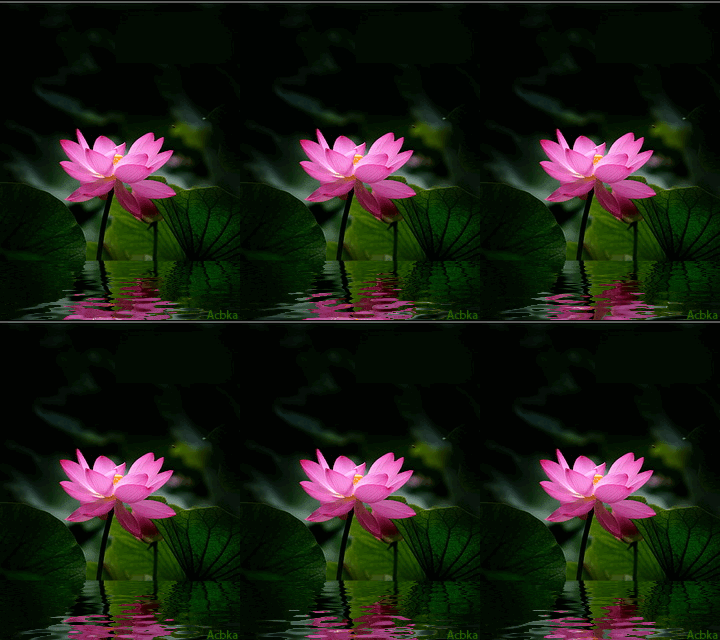
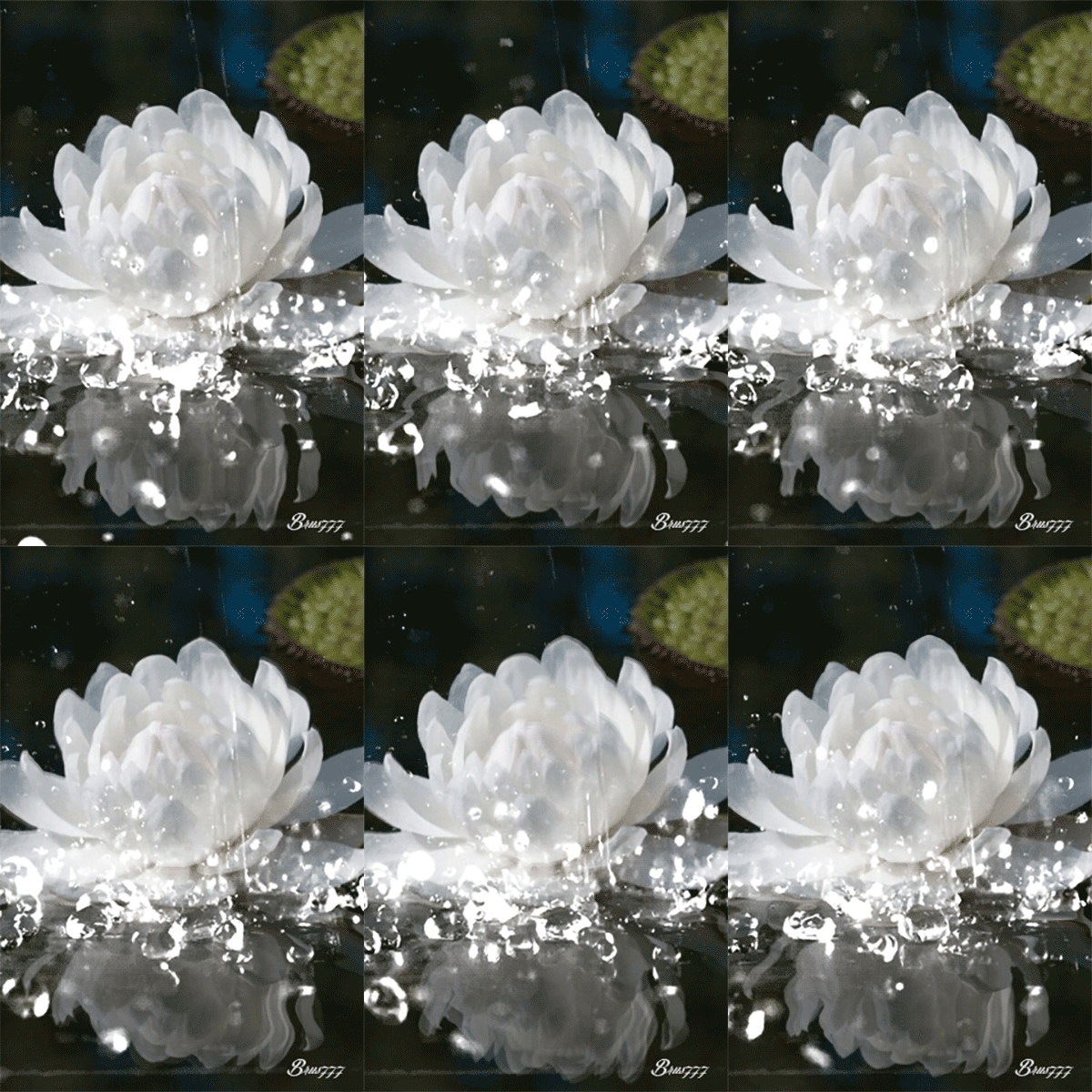
In order to blossom, the lotus flower must grow through mud, dirty pond water, and generally rough conditions—but it blooms anyway. Like the lotus, we too can grow through dark times and difficulties, and we can rise again and again to shine from a pure place within.
The lotus is a reminder that in a word riddled with fear, we can stay loving inside and, one by one, open our petals to spread that peace into the world.
When the lotus flower first begins to sprout, it does so underwater. Though conditions are tough, the lotus heeds the call of the sun each morning, breaks the surface of the water and blooms untouched by the mud; each petal remains clean and pure. Closing at night, it sinks below the water’s surface, only to resurface again in the morning.
Fully grounded in earth, yet aspiring toward the divine, the lotus flower lives unsoiled by its surroundings, ever blooming from within toward the light. It’s a growth of pure beauty from the mud of its origins, a testament to the potential that lies within and which is revealed through persistence.
May these lotus flower quotes inspire you to free yourself from harsh conditions by trusting the ancient power within you. No matter how muddy your surroundings, remember that you’re budding with potential.