
1. Lightening the Heart

    Comment

    I have noticed from experience that taking things too seriously can be debilitating. It can paralyze us.

    It is usually more effective to approach problems with a light heart – a willingness to laugh at them and at ourselves. Otherwise, if we are too somber, we could be stricken with a heart attack before we even have the chance to do anything to improve the situation! Instead, we can be playful. A sense of humor can be very helpful in preventing us from feeling stuck or overwhelmed by a difficult situation.

    Especially if a situation is critical, you have to be able to approach it with some openness, just in order to see the possible solutions clearly. For example, sometimes there are serious issues that you feel you need to address, but that you cannot resolve. What do you end up doing? Worrying. There can also be serious issues that you actually can do something about. In those cases, too, if you are not careful, you may also find yourself worrying. Once you are overwhelmed by anxiety and other unhelpful emotions, it will be very difficult to plan or make clearheaded decisions. You will not be able to look beyond the obstacles to notice the opportunities.  ~ 17th Karmapa

    Jendhamuni


  2. The Mirror of the Mind

    Comment

    There is a story that reminds us how crucial it is that we take responsibility for what we ourselves contribute to the problem, rather than laying all the blame for our harmful food systems on others – or waiting for someone else to fix the problem.

    This story tells of a king of a small, remote kingdom in ancient Tibet. In this kingdom, mirrors were extremely rare – practically unheard of. Yet somehow the king managed to acquire a hand mirror, and picked it up one day as he was talking to his faithful old servant. The king took a good look at himself in that mirror, and was not pleased by what he saw. It seems this king was a singularly unattractive man. He felt thoroughly disgusted by the face staring at him from his mirror. He tossed the mirror aside and exclaimed, “Who is that ugly man? I don’t ever want to see him again! Banish this mirror from my kingdom!”

    The servant could not keep silent at this. After all the years he had spent gazing on the king’s unattractive face, he seized this opportunity to say: “My Lord, I have had to look at you all these years. I do not have the option of just banishing the mirror!”

    Like the king in this story, we seem to have a tendency to look at others, but not want to see ourselves. There is a saying in Tibetan: “To see others, you need a pair of eyes. To see yourself, you need the mirror of your own mind. ~ 17th Karmapa

    pink-flower-water-reflection-082915


  3. Winter Melon

    Comment

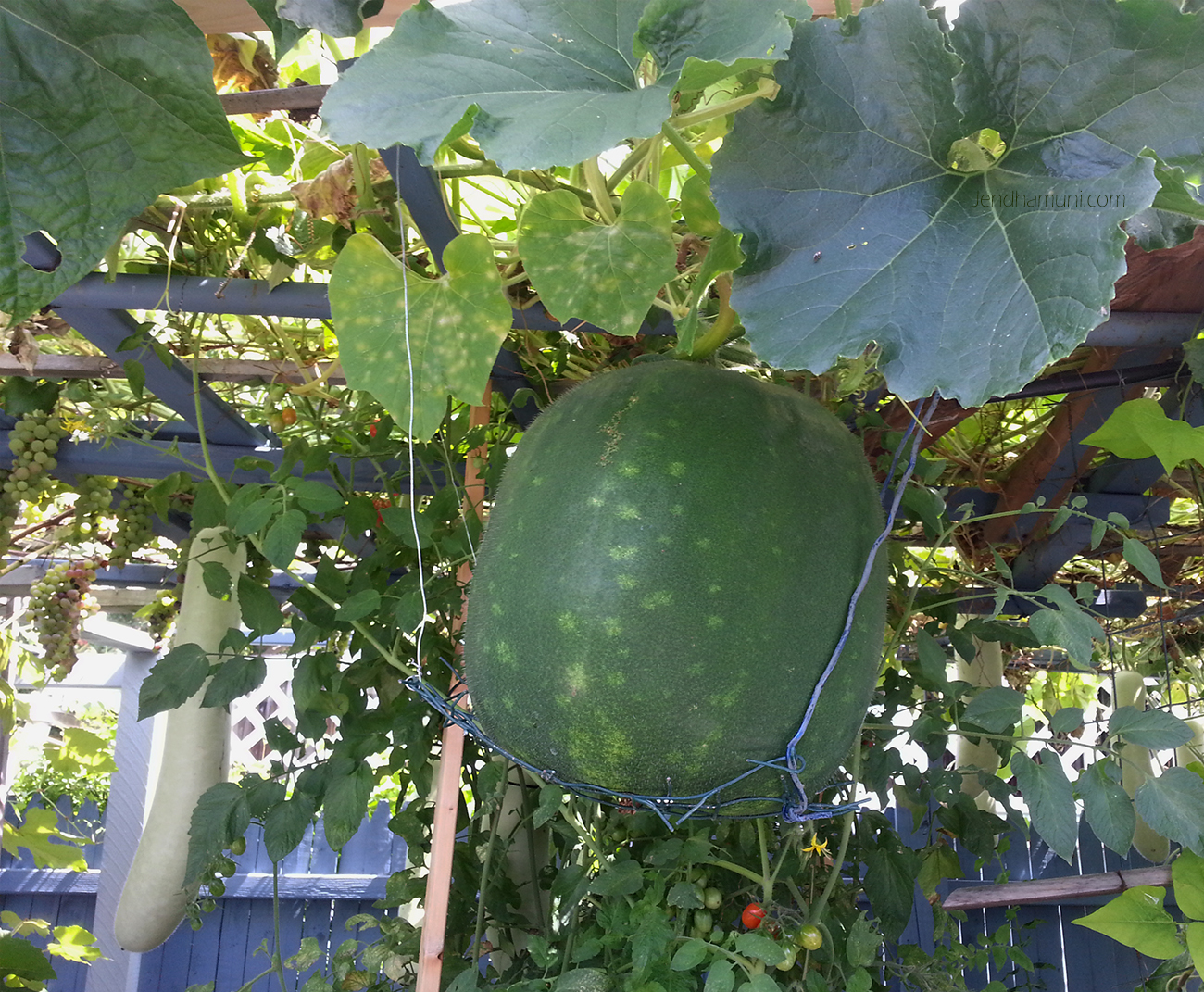
    Winter melon in Veggie garden 082915

    Seasons/Availability
    Just as the name suggests, Winter melons are available during the winter season.

    Current Facts
    Known by several names, Winter melon is called Tung Gwa, Dong Gua and Doan Gwa in China; Sufed Kaddu, Petha and Lauki in India; Togan in Japan; Fak in Thailand; Wax gourd; White gourd; and Winter gourd. It is the fruit of the Asian vine Benincasa hispida and is used most extensively in Chinese cuisine.

    Description/Taste
    Winter melons are perhaps the largest cold season melons. They can measure 15 inches in diameter and can weigh in excess of thirty pounds at maturity. They are most often marketed by the slice due to their extreme size. Winter melons first impression is a hard, thin, chalky pistachio colored skin with a waxy feel. Its snow white flesh is mild flavored with a similar water rich texture of a watermelon. It bears a large seed cavity that takes up a considerable amount of the flesh.

    Applications
    Cubed or sliced, Winter melon can be steamed, simmered, braised or parboiled and added to stir-fries. Best used in soups, season this rather mild and bland melon with strong spices and herbs. Winter melon are suitable for pickling and may be diced and candied. Whole Winter melons will keep in a cool place for months.

    Ethnic/Cultural Info
    Winter melon is most acclaimed as the ingredient in the Chinese soup known as tung qwa chung or dong gwa jong, or Winter Melon Pond. The skin of the Winter melon is elaborately carved with motifs such as the mythical dragon and phoenix.

    Geography/History
    Winter melons grow best in warm weather with maximum sunshine. The Winter melon is an ancient food staple of China and was first cultivated in ancient Egypt. Introduced into Europe during the Renaissance, today this melon is cultivated throughout the world. It is grown in Europe, Asia, the Americas and Australia.

    Source: Specialty Produce
    Link source


  4. Kitten is very sleepy

    Comment

    In English, cat is “cat.”   In French, cat is “Chat.”  In German, your cat is “katze.”   The Spanish word for cat is “gato,” and the Italian word is “gatto.”  Japanese prefer “neko” and Arabic countries call a cat a “kitte.” Source: FPTR

  5. Pug climbing the stairs

    Comment

    Pugs go by a number of different names, including Chinese pug, Dutch bulldog, Dutch mastiff, Mini mastiff, Carlin, and for some strange reason, Mops. The Pug tail is high-set and curled – sometimes twice — over the back. The short coat is soft, fine, and smooth, and comes in apricot, fawn, black, and silver colors. Adult Pugs range in height from 10 to 14 inches, and weigh from 13 to 20 pounds. Average lifespan is 12 to 15 years. Source: HealthyPets

  6. The present moment

    Comment

    What matters most is how much joy you’re currently experiencing in the present moment. If you’re putting off your happiness until you accomplish something, you’re failing at life. ~Unknown

  7. We tend to forget…

    Comment

    We tend to forget that happiness doesn’t come as a result of getting something we don’t have, but rather of recognizing and appreciation what we do have. ~Frederick Keonig

  8. Tree squirrel are terrific climbers

    Comment

    Squirrels are familiar to almost everyone. More than 200 squirrel species live all over the world, with the notable exception of Australia.

    The tiniest squirrel is the aptly named African pygmy squirrel—only five inches (thirteen centimeters) long from nose to tail. Others reach sizes shocking to those who are only familiar with common tree squirrels. The Indian giant squirrel is three feet (almost a meter) long.

    Like other rodents, squirrels have four front teeth that never stop growing so they don’t wear down from the constant gnawing. Tree squirrels are the types most commonly recognized, often seen gracefully scampering and leaping from branch to branch. Other species are ground squirrels that live in burrow or tunnel systems, where some hibernate during the winter season.

    Ground squirrels eat nuts, leaves, roots, seeds, and other plants. They also catch and eat small animals, such as insects and caterpillars. These small mammals must always be wary of predators because they are tasty morsels with few natural defenses, save flight. Sometimes groups of ground squirrels work together to warn each other of approaching danger with a whistling call.

    Tree squirrels are commonly seen everywhere from woodlands to city parks. Though they are terrific climbers, these squirrels do come to the ground in search of fare such as nuts, acorns, berries, and flowers. They also eat bark, eggs, or baby birds. Tree sap is a delicacy to some species.

    Flying squirrels are a third, adaptable type of squirrel. They live something like birds do, in nests or tree holes, and although they do not fly, they can really move across the sky. Flying squirrels glide, extending their arms and legs and coasting through the air from one tree to another. Flaps of skin connecting limbs to body provide a winglike surface. These gliding leaps can exceed 150 feet (46 meters). Flying squirrels eat nuts and fruit, but also catch insects and even baby birds.

    Whether they dwell high in a tree or in an underground burrow, female squirrels typically give birth to two to eight offspring. Babies are blind and totally dependent on their mothers for two or three months. Mothers may have several litters in a year, so most squirrel populations are robust.

    Source: National Geographic
    Link to this article

Live & Die for Buddhism

candle

Me & Grandma

My Reflection

This site is a tribute to Buddhism. Buddhism has given me a tremendous inspiration to be who and where I am today. Although I came to America at a very young age, however, I never once forget who I am and where I came from. One thing I know for sure is I was born as a Buddhist, live as a Buddhist and will leave this earth as a Buddhist. I do not believe in superstition. I only believe in karma.

A Handful of Leaves

A Handful of Leaves

Tipitaka: The pali canon (Readings in Theravada Buddhism). A vast body of literature in English translation the texts add up to several thousand printed pages. Most -- but not all -- of the Canon has already been published in English over the years. Although only a small fraction of these texts are available here at Access to Insight, this collection can nonetheless be a very good place to start.

Major Differences

Major Differences in Buddhism

Major Differences in Buddhism: There is no almighty God in Buddhism. There is no one to hand out rewards or punishments on a supposedly Judgement Day ...read more

Problems we face today

jendhamuni pink scarfnature

Of the many problems we face today, some are natural calamities and must be accepted and faced with equanimity. Others, however, are of our own making, created by misunderstanding, and can be corrected...