1. Four short sentences

    173

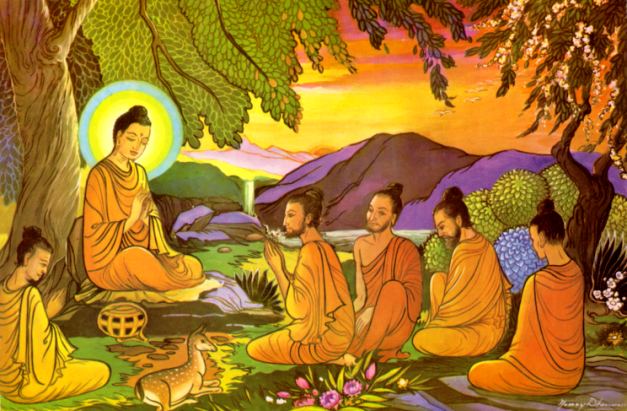
    The teachings of the Buddha could be summarized in four short sentences. … [The Buddha] said …
    The bad things, don’t do them.
    The good things, try to do them.
    Try to purify, subdue your own mind.
    That is the teaching of all Buddhas.

    ~Thich Nhat Hanh

  2. Criticism

    Comment

    Criticism is the act of pointing out the inadequacies or faults in a person or thing.

    While criticism is often perceived as negative it can actually have a crucial role in helping to distinguish truth from falsehood and right from wrong, particularly when assessing the different claims of religions. Given this dual quality, the Buddha said that while criticism is valid, it has to be done with circumspection.

    A man once said to the Buddha that some people criticise the wrong but do not praise the worthy, others praise the worthy without criticising the wrong, some criticise the wrong and praise the worthy and others refrain from either criticising the wrong or praising the worthy. He then said to the Buddha that he believed the person who refrained from both criticism and praise is the best of the four. The Buddha responded to these observations by saying:

    ‘I maintain that one who criticises that which deserves criticism and praises that which deserves praise, at the right time, saying what is factual and true, is the best. And why? Because their timing is admirable.’ (A.II,97).

    Two things are suggested here. Before we point out the shortcomings in something or someone, we must make sure we are acquainted with the facts and that our criticism is valid. Secondly, our criticism must be done at the right time – e.g.

    when it is more likely to stimulate positive change. Criticising other people is better done in private rather than in public, to their face rather than behind their back, when we ourselves are free from the fault we are criticising and when we can honestly say that our motive is a desire to help the person.

    Referring to constructive criticism, the Buddhist philosopher Nāgarjuna wrote in his Ratanavāli, ‘Rare are helpful speakers, rarer still are good listeners, but rarest of all are words that though unpleasant are helpful.’


    Source: http://www.buddhisma2z.com

     

  3. A Law of the Universe

    31

    It is a law of the universe that retaliation, hatred, and revenge only continue the cycle and never stop it. Reconciliation does not mean that we surrender rights and conditions, but rather that we use love in our negotiations. It means that we see ourselves in the opponent — for what is the opponent but a being in ignorance, and we ourselves are also ignorant of many things. Therefore, only compassion and mindfulness can free us. ~Maha Ghosananda

  4. What is wrong with you?

    14

    We almost always see only what’s wrong with other people and not what’s wrong with us. ~Joyce Meyer

  5. Lucky or Unlucky

    Comment

    It is our custom to say that someone is “lucky” or “unlucky” if they meet with fortunate or unfortunate circumstances, respectively.  It is however, too simplistic to think in terms of random “luck.”  Even from a scientific point of view, this is not a sufficient explanation.  Should something unfortunate happen, we immediately think, “Oh, how unlucky!”  And yet this is not sufficient to explain what happened- there must be a cause.  We seem to call “luck” that factor which overrides external conditions to bring about a positive situation.  But that too is a cause; it is an inner cause, which we call “merit.” ~Dalai Lama


  6. Patience is the ballast of the soul

    Comment

    Patience is the ballast of the soul, that will keep it from rolling and tumbling in the greatest storms: and he, that will venture out without this to make him sail even and steady will certainly make shipwreck, and drown himself; first, in the cares and sorrows of this world; and, then, in perdition. ~Ezekiel Hopkins

  7. Motivated by Love

    Comment

    The more you are motivated by Love,
    The more Fearless & Free your action will be.
    ― Dalai Lama

  8. We are sometimes too sensitive toward minor things

    Comment

    So from the Buddhist viewpoint, in our daily life we are sometimes too sensitive toward minor things. At the same time, toward other major problems that can create long-term consequences, we are not so sensitive. Because of this, we find in the scriptures that ordinary people like ourselves are described as childlike or childish. In fact, the term ‘jhipa’ (Tib. ‘byis pa’), or childish, is used in different ways: sometimes it is used in terms of age, which is the conventional usage; sometimes it is used for ordinary sentient beings, as opposed to the Arya beings, the superior beings. Then sometimes it is used to described people who are concerned only with affairs of this life and have no interest or regard for the affairs of their future life, or life after death. So, the tendency of our childish nature is to take small things too seriously and get easily offended, whereas when we are confronted with situations which have long-term consequences, we tend to take things less seriously. ~Dalai Lama


Live & Die for Buddhism

candle

Me & Grandma

My Reflection

This site is a tribute to Buddhism. Buddhism has given me a tremendous inspiration to be who and where I am today. Although I came to America at a very young age, however, I never once forget who I am and where I came from. One thing I know for sure is I was born as a Buddhist, live as a Buddhist and will leave this earth as a Buddhist. I do not believe in superstition. I only believe in karma.

A Handful of Leaves

A Handful of Leaves

Tipitaka: The pali canon (Readings in Theravada Buddhism). A vast body of literature in English translation the texts add up to several thousand printed pages. Most -- but not all -- of the Canon has already been published in English over the years. Although only a small fraction of these texts are available here at Access to Insight, this collection can nonetheless be a very good place to start.

Major Differences

Major Differences in Buddhism

Major Differences in Buddhism: There is no almighty God in Buddhism. There is no one to hand out rewards or punishments on a supposedly Judgement Day ...read more

Problems we face today

jendhamuni pink scarfnature

Of the many problems we face today, some are natural calamities and must be accepted and faced with equanimity. Others, however, are of our own making, created by misunderstanding, and can be corrected...