
1. The Story of Kalayakkhini

    Comment

    Buddha dhamma talk


    Verse 5: Hatred is, indeed, never appeased by hatred in this world. It is appeased only by loving-kindness. This is an ancient law.

    1. esa dhammo sanantano: This is the same as “poranako dhammo,” the doctrine followed by the Budhha and his disciples. The exhortation is not to return hatred for hatred but to conquer it by loving-kindness (absence of hatred).

    While residing at the Jetavana monastery in Savatthi, the Buddha uttered Verse (5) of this book, with reference to a certain woman who was barren, and her rival.

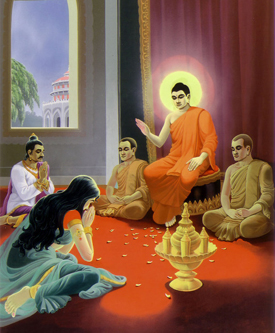
    Once there lived a householder, whose wife was barren; later he took another wife. The feud started when the elder wife caused abortion of the other one, who eventually died in child birth. In later existences the two were reborn as a hen and a cat; a doe and a leopardess; and finally as the daughter of a nobleman in Savatthi and an ogress named Kali. The ogress (Kalayakkhini) was in hot pursuit of the lady with the baby, when the latter learned that the Buddha was nearby, giving a religious discourse at the Jetavana monastery. She fled to him and placed her son at his feet for protection. The ogress was stopped at the door by the guardian spirit of the monastery and was refused admission. She was later called in and both the lady and the ogress were reprimanded by the Buddha. The Buddha told them about their past feuds as rival wives of a common husband, as a cat and a hen, and as a doe and a leopardess. They were made to see that hatred could only cause more hatred, and that it could only cease through friendship, understanding and goodwill.

    Then the Buddha spoke in verse as follows:

    Verse 5: Hatred is, indeed, never appeased by hatred in this world. It is appeased only by loving-kindness. This is an ancient law.
    At the end of the discourse, the ogress was established in Sotapatti Fruition and the long-standing feud came to an end.

    Dhammapada Verse 5
    Kalayakkhini Vatthu

    Na hi verena verani
    sammantidha kudacanam
    averena ca sammanti
    esa dhammo sanantano.

    Source: Tipitaka
     

  2. The Story of Thera Cakkhupala

    Comment


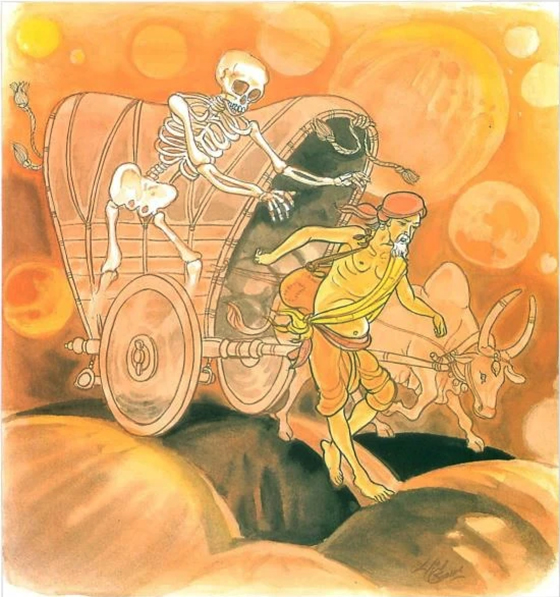
    Verse 1: All mental phenomena have mind as their forerunner; they have mind as their chief; they are mind-made. If one speaks or acts with an evil mind, ‘dukkha’ 3 follows him just as the wheel follows the hoofprint of the ox that draws the cart.

    1. manopubbangama dhamma: All mental phenomena have Mind as their forerunner in the sense that Mind is the most dominant, and it is the cause of the other three mental phenomena, namely, Feeling (vedana), Perception (sanna) and Mental Formations or Mental Concomitants (sankhara). These three have Mind or Consciousness (vinnana) as their forerunner, because although they arise simultaneously with Mind they cannot arise if Mind does not arise. (The Commentary)
    2. manasa ce padutthena (Verse 1) and manasi ce pasannena (Verse 2): Manasa here means intention or volition (cetana); volition leads one to the performance of volitional actions, both good and evil. This volition and the resultant actions constitute kamma; and kamma always follows one to produce results. Cakkhupala’s blindness (Verse 1) was the consequence of his having acted with an evil intention in a previous existence and Matthakundali’s happy existence in Tavatimsa celestial world (Verse 2) was the result of his mental devotion (manopasada) to the Buddha.

    3. dukkha: In this context, dukkha mens suffering, or physical or mental pain, misfortune, unsatisfactoriness, evil consequences, etc., and rebirth in the lower planes of existence or in the lower strata of human society if born in the human world.

    The Story of Thera Cakkhupala

    While residing at the Jetavana monastery in Savatthi, the Buddha uttered Verse (1) of this book, with reference to Cakkhupala, a blind thera. Continue reading

  3. The Story of Thera Tissa

    Comment

    Meditation class - Ariyamagga

    While residing at the Jetavana monastery in Savatthi, the Buddha uttered Verses (3) and (4) of this book, with reference to Thera Tissa.

    Tissa, son of the Buddha’s maternal aunt, was at one time staying with the Buddha. He had become a bhikkhu only in his old age, but he posed as a senior bhikkhu and was very pleased when visiting bhikkhus asked his permission to do some service for him. On the other hand, he failed to perform the duties expected of junior bhikkhus; besides, he often quarrelled with the younger bhikkhus. Should anyone rebuke him on account of his behaviour he would go complaining to the Buddha, weeping, very much dissatisfied and very upset. The others also followed him to the presence of the Buddha. The Buddha told them not to harbour thoughts of enmity, for enmity could only be appeased by not harbouring enmity.

    Then the Buddha spoke in verse as follows:

    Verse 3: “He abused me, he ill-treated me, he got the better of me, he stole my belongings;”… the enmity of those harbouring such thoughts cannot be appeased.

    Verse 4: “He abused me, he ill-treated me, he got the better of me, he stole my belongings;”… the enmity of those not harbouring such thoughts can be appeased.

    At the end of the discourse, one hundred thousand bhikkhus attained Sotapatti Fruition.

    Dhammapada Verses 3 and 4
    Tissatthera Vatthu

    Akkocchi mam avadhi mam
    ajini mam ahasi me
    ye ca tam upanayhanti
    veram tesam na sammati.

    Akkocchi mam avadhi mam
    ajini mam ahasi me
    ye ca tam nupanayhanti
    veram tesupasammati.

    Source: Tipitaka


  4. The Story of Matthakundali

    Comment

    1. Sukham/sukha: in this context, happiness, satifactoriness, fortune, etc., and rebirth in the three upper planes of happy existence.

    The Story of Matthakundali

    While residing at the Jetavana monastery in Savatthi, the Buddha uttered Verse (2) of this book, with reference to Matthakundali, a young Brahmin. Matthakundali was a young brahmin, whose father, Adinnapubbaka, was very stingy and never gave anything in charity. Even the gold ornaments for his only son were made by himself to save payment for workmanship. When his son fell ill, no physician was consulted, until it was too late. When he realized that his son was dying, he had the youth carried outside on to the verandah, so that people coming to his house would not see his possessions.

    On that morning, the Buddha arising early from his deep meditation of compassion saw, in his Net of Knowledge, Matthakundali lying on the verandah. So when entering Savatthi for alms-food with his disciples, the Buddha stood near the door of the brahmin Adinnapubbaka. The Buddha sent forth a ray of light to attract the attention of the youth, who was facing the interior of the house. The youth saw the Buddha; and as he was very weak he could only profess his faith mentally. But that was enough. When he passed away with his heart in devotion to the Buddha he was reborn in the Tavatimsa celestial world. Continue reading

  5. Prince Goodspeaker and the Water Demon

    Comment

    Buddha and monks

    [Chapter 2. The Teaching of the Gods]

    In time, the queen gave birth to another son, who was named Prince Moon. Shortly after both children began walking about, their mother suddenly became very sick, and died.

    To help him look after his playful children, the king found a princess to become his new queen. In a few years, this queen gave birth to a beautiful bright little boy. He was named Prince Sun. Since the king was so happy, he wanted to please his queen, and reward her for bringing up all three children. So he promised to grant her one wish. The queen considered, and said, “Thank you my lord, I will make my wish at some time in the future.”

    As time went on, the three princes grew into wonderful playful youngsters. The queen saw that Prince Goodspeaker was intelligent and understanding. She thought, “If these two older princes remain in the palace, my son, Prince Sun, will never get a chance to be king. Therefore, I must do something to make him the next king.”

    One day, when the king was in a good mood, the queen respectfully approached him and reminded him of the promised wish. He was very happy and said, “Ask whatever you want!” The queen said, “Oh my husband and king, grant that after the course of your life is over, my son, Prince Sun, will be the next king.”

    The king was shocked by this request. He became angry and said, “My first two children are like bright stars! How can I give the kingdom to my third son? All the people will blame me. That cannot be done!” The queen kept silent.

    As happy as the king had been, he now became just as unhappy. He was afraid and filled with doubt. He suspected that the queen might destroy his first-born children by some wicked means. He decided that he must make sure his children were safe.

    Secretly, the king called Prince Goodspeaker and Prince Moon to him. He told them of the queen’s dangerous desire. He sadly said that the only safe thing for them to do was to leave the kingdom. They should return only after their father’s death, and take their rightful places ruling the kingdom. The two obedient princes accepted their father’s order and prepared to leave.

    In a few days they were ready. They said their sad good-byes to their father and friends, and left the palace. On their way through the royal gardens, they came upon Prince Sun. He had always been very affectionate and friendly towards his two older half-brothers. He was upset to hear that they were leaving for a very long time. So he decided that he too would leave the kingdom. The three friendly princes departed together.

    For several months they travelled, until they reached the forest country of the mighty Himalayas. They were very tired and sat down under a tree. The oldest brother, Prince Goodspeaker, said to the youngest, Prince Sun, “Please go down to the nearby lake and fill some lotus leaves with water. Bring them back here so we all can drink.” Continue reading

  6. Mr Monkey and Sir Crocodile (Good Manners)

    Comment

    rainsing-sceneOnce upon a time, Mr. Monkey was living by himself near a riverbank. He was very strong, and he was a great jumper.

    In the middle of the river there was a beautiful island covered with mango, jackfruit and other fruit trees. There happened to be a rock sticking out of the water halfway between the bank and the island. Although it looked impossible, Mr. Monkey was used to jumping from the riverbank to the rock, and from the rock to the island. He would eat fruits all day and then return home by the same route each evening.

    A high-class couple was living next to the same river – Sir Crocodile and Lady Crocodile. They were expecting their first brood of baby crocks. Because she was pregnant Lady Crocodile sometimes wished for strange things to eat. So she made unusual demands on her faithful husband.

    Lady Crocodile had been amazed, just like the other animals, by the way Mr. Monkey jumped back and forth to the island. One day she developed a sudden craving to eat the heart of Mr. Monkey! She told Sir Crocodile about her desire. To please her, he promised to get Mr. Monkey’s heart for her in time for dinner.

    Sir Crocodile went and laid himself down on the rock between the riverbank and the island. He waited for Mr. Monkey to return that evening, planning to catch him.

    As usual, Mr. Monkey spent the rest of the day on the island. When it was time to return to his home on the riverbank, he noticed that the rock seemed to have grown. It was higher above water than he remembered it. He investigated and saw that the river level was the same as in the morning, yet the rock was definitely higher. Immediately he suspected the cunning Sir Crocodile.

    To find out for sure, he called out in the direction of the rock, “Hi there, Mr. Rock! How are you?” He yelled this three times. Then he shouted, “You used to answer me when I spoke to you. But today you say nothing. What’s wrong with you, Mr. Rock?”

    Sir Crocodile thought, “No doubt on other days this rock used to talk to the monkey. I can’t wait any longer for this dumb rock to speak! I will just have to speak for the rock, and trick the monkey.” So he shouted, “I’m fine, Mr. Monkey. What do you want?”

    Mr. Monkey asked, “Who are you?”

    Without thinking, the crocodile replied, “I’m Sir Crocodile.”

    “Why are you lying there?” asked the monkey.

    Sir Crocodile said, “I’m expecting to take your heart! There’s no escape for you, Mr. Monkey.”

    The clever monkey thought, “Aha! He’s right – there’s no other way back to the riverbank. So I will have to trick him.”

    Then he yelled, “Sir Crocodile my friend, it looks like you’ve got me. So I’ll give you my heart. Open your mouth and take it when I come your way.” Continue reading

  7. A Huge Lump of Gold (Moderation)

    Comment

    Buddha in heaven 081515

    Once upon a time there was a rich village. The wealthiest of the villagers decided to hide a huge lump of gold to protect it from bandits and robbers. So he buried it in a nearby rice field.

    Many years later, the village was no longer rich, and the rice field was abandoned and unused. A poor farmer decided to plow the field. After some time plowing, it just so happened that his plow struck the long forgotten buried treasure.

    At first he thought it must be a very hard tree root. But when he uncovered it, he saw that it was beautiful shining gold. Since it was daytime he was afraid to try and take it with him. So he covered it up again and waited for nightfall.

    The poor farmer returned in the middle of the night. Again he uncovered the golden treasure. He tried to lift it, but it was far too heavy. He tied ropes around it and tried to drag it. But it was so huge he couldn’t budge it an inch. He became frustrated, thinking he was lucky to find a treasure, and unlucky to not be able to take it with him. He even tried kicking the huge lump of gold. But again it wouldn’t budge an inch!

    Then he sat down and began to consider the situation. He decided the only thing to do was to break the lump of gold into four smaller lumps. Then he could carry home one piece at a time.

    He thought, “One lump I will use for ordinary day-to-day living. The second lump I will save for a rainy day. The third lump I will invest in my farming business. And I will gain merit with the fourth lump by giving it to the poor and needy and for other good works.”

    With a calm mind he divided the huge lump of gold into these four smaller lumps. Then it was easy to carry them home on four separate trips.

    Afterwards he lived happily.

    The moral is: “Don’t bite off more than you can chew.”

    Link source


  8. The story of Kisa Gautami

    Comment
    Mother of dead child072715

    Kisa Gautami carried the dead child to the Buddha and told Him her sad story.

    Kisa Gautami was a young woman from a wealthy family who was happily married to an important merchant. When her only son was one-year-old, he fell ill and died suddenly. Kisa Gautami was struck with grief, she could not bare the death of her only child. Weeping and groaning, she took her dead baby in her arms and went from house to house begging all the people in the town for news of a way to bring her son back to life.

    Of course, nobody could help her but Kisa Gautami would not give up. Finally she came across a Buddhist who advised her to go and see the Buddha himself.

    When she carried the dead child to the Buddha and told Him her sad story, He listened with patience and compassion, and then said to her, “Kisa Gautami, there is only one way to solve your problem. Go and find me four or five mustard seeds from any family in which there has never been a death.”

    Kisa Gautami was filled with hope, and set off straight away to find such a household. But very soon she discovered that every family she visited had experienced the death of one person or another. At last, she understood what the Buddha had wanted her to find out for herself — that suffering is a part of life, and death comes to us all. Once Kisa Guatami accepted the fact that death is inevitable, she could stop her grieving. She took the child’s body away and later returned to the Buddha to become one of His followers.

    Source: Buddhanet  |  Link source


  9. The Whatnot Tree (Prudence)

    Comment

    Once upon a time there was a caravan leader. He went from country to country selling various goods. His caravans usually had at least 500 bullock carts.

    On one of these trips his path led through a very thick forest. Before entering it, he called together all the members of the caravan. He warned them, “My friends, when you go through this forest be careful to avoid the poisonous trees, poisonous fruits, poisonous leaves, poisonous flowers and even poisonous honeycombs.

    “Therefore, whatever you have not eaten before – whether a fruit, leaf, flower or anything else – must not be eaten without asking me first.” They all said respectfully, “Yes, sir.”

    There was a village in the forest. Just outside the village stood a tree called a ‘whatnot tree’. Its trunk, branches, leaves, flowers and fruits look very similar to a mango tree. Even the colour, shape, smell and taste are almost exactly the same as a mango tree. But unlike a mango, the whatnot fruit is a deadly poison!

    Some went ahead of the caravan and came upon the whatnot tree. They were all hungry, and the whatnot fruits looked like delicious ripe mangoes. Some started eating the fruits immediately, without thinking at all. They devoured them before anyone could say a word. Continue reading

  10. Prince Five-Weapons and Sticky-Hair (The Diamond Weapon)

    Comment

    Once upon a time, the Enlightenment Being was born as the son of the King and Queen of Benares. On the day of his naming, 800 fortune tellers were invited to the palace. As presents, they were given whatever they desired to make them happy for the moment. Then they were asked to tell the fortune of the newborn prince. This was so they could find a good name for him.

    One of the fortune tellers was an expert in reading the marks on the body. He said, “My lord, this is a being of great merit. He will be king after you.”

    The fortune tellers were very clever. They told the king and queen whatever they wanted to hear. They said, “Your son will be skilled in five weapons. He will become famous as the greatest master of all five weapons throughout India.” Based on this, the king and queen named their son ‘Prince Five-Weapons’.

    When the prince turned 16, the king decided to send him to college. He said, “Go, my son, to the city of Takkasila. There you will find a world famous teacher. Learn all you can from him. Give him this money as payment.” He gave him a thousand gold coins and sent him on his way.

    The prince went to the world famous teacher of Takkasila. He studied very hard and became his best pupil. When the teacher had taught him all he knew, he gave the prince a special graduation award. He gave him five weapons. Then he sent him back to Benares. Continue reading

Live & Die for Buddhism

candle

Me & Grandma

My Reflection

This site is a tribute to Buddhism. Buddhism has given me a tremendous inspiration to be who and where I am today. Although I came to America at a very young age, however, I never once forget who I am and where I came from. One thing I know for sure is I was born as a Buddhist, live as a Buddhist and will leave this earth as a Buddhist. I do not believe in superstition. I only believe in karma.

A Handful of Leaves

A Handful of Leaves

Tipitaka: The pali canon (Readings in Theravada Buddhism). A vast body of literature in English translation the texts add up to several thousand printed pages. Most -- but not all -- of the Canon has already been published in English over the years. Although only a small fraction of these texts are available here at Access to Insight, this collection can nonetheless be a very good place to start.

Major Differences

Major Differences in Buddhism

Major Differences in Buddhism: There is no almighty God in Buddhism. There is no one to hand out rewards or punishments on a supposedly Judgement Day ...read more

Problems we face today

jendhamuni pink scarfnature

Of the many problems we face today, some are natural calamities and must be accepted and faced with equanimity. Others, however, are of our own making, created by misunderstanding, and can be corrected...