1. The punishing wave

    Comment
    Devadatta

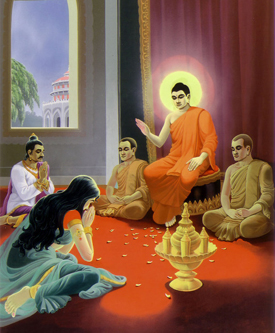
    Devadatta taken refuge as was sinking into the earth.

    Samudda-Vanija-Jataka

    It was while staying at Jetavana that the Buddha told this story about Devadatta.

    After his three attempts to kill the Buddha had failed, Devadatta made five demands–that bhikkhus live only in the forest, that they eat only food received on almsrounds, that they wear only rag robes, that they stay only under trees, and that they eat neither meat nor fish. The Buddha rejected the demands, saying, “Enough, Devadatta! Any bhikkhu who desires to do so may undertake these austerities, but I will not impose them.”

    “Whose words are nobler,” Devadatta exclaimed, “the words of the Tathagata or mine? I declare that, for all their lives, bhikkhus should follow these rules. Whoever desires release from suffering, let him come with me!”

    At that time, there were five hundred Licchavis who had recently ordained as bhikkhus. These young men were impressed by Devadatta’s bravado, and they decided to follow him. Some laypeople, as well, were persuaded that these austerities were necessary and gave their support to Devadatta.

    The Buddha asked Devadatta whether it was indeed his intention to create a separate Sangha, and Devadatta replied that it was. “Devadatta,” the Buddha warned, “creating a schism in this way is a grievous thing to do!”

    Completely ignoring the Buddha’s warning, Devadatta announced to Venerable Ananda that, henceforth, he would be observing Patimokkha independently from the Buddha’s Sangha. When this was reported to the Buddha, the Blessed One proclaimed, “Devadatta is doing something which will be of no benefit to himself and which will, in fact, cause him to be tormented in Avici hell.”

    On the next Uposatha Day, Devadatta took his followers to Gayasisa to observe the Patimokkha. The Buddha summoned Venerable Sariputta and Venerable Moggallana and asked them to go to Gayasisa and to bring those bhikkhus back to Rajagaha.

    Devadatta welcomed the two chief disciples and sat them beside him. As he taught the assembled bhikkhus, he attempted to imitate the Buddha. After a while, still trying to act like the Buddha, he claimed to be suffering from an aching back and asked Venerable Sariputta and Venerable Moggallana to continue instructing the young bhikkhus while he retired to rest.

    The two chief disciples taught the Dhamma so clearly and skillfully that all five hundred of those bhikkhus abandoned Devadatta and returned to Rajagaha.

    Kokalika, Devadatta’s personal attendant, rushed to his master’s chamber and shouted, “Get up, Devadatta! Sariputta and Moggallana have taken away your monks. Why didn’t you listen to my warning? I told you not to trust those two!”

    Without getting out of bed, Devadatta muttered, “Sariputta and Moggallana cherish evil desires! They are under the control of evil desires.” Kokalika was so disgusted by this jibberish that he kicked Devadatta in the chest, causing him to vomit hot blood.

    After this incident, Devadatta’s health steadily worsened. One day, he said to his followers, “I desire to see the Teacher. Make it possible for me to see him.”

    “When you enjoyed good health,” his disciples retorted, “you were at odds with the Teacher. Now that you are ill, we will not take you to him.”

    “Please do not destroy me!” Devadatta begged. “It is true that I have felt hatred toward the Teacher, but the Teacher has not felt even so much as a twinge of animosity toward me. I have thought evil of the Tathagata, but, in his mind, there has never been a single thought of malice toward me. Even among the eighty great disciples there is no hostility toward me. By my own deeds alone am I forlorn, cut off from the Buddha, separated from the great disciples. I must go to the Buddha and reconcile myself with him!”

    Hearing this heartfelt plea, his followers relented and prepared a litter. They placed Devadatta on it and carried him slowly toward Savatthi.

    Venerable Ananda heard that Devadatta was coming and announced to the Buddha that his cousin was coming to make his peace.

    “Ananda,” the Buddha replied, “Devadatta shall not see me.”

    Later, Ananda reported that Devadatta and his entourage had reached the city, and the Buddha repeated his statement that Devadatta would not succeed in seeing him.

    When Ananda announced that Devadatta had reached the lotus tank, the Buddha declared,”Even if he enters Jetavana Monastery itself, he will not succeed in seeing me.” Continue reading

  2. A proud beetle in a lump of cow dung

    Comment

    skymoving

    There once was a beetle which came upon a lump of cow dung. He worked himself into it and liking what he saw, he invited his friends to join him in building a city in it. After working feverishly for a few days they built a magnificent `city´ in the dung and feeling very proud of their achievement they decided to elect the first beetle as their king. Now to honour their new `king´ they organised a grand parade through their `city´.

    While these impressive proceedings were taking place, An elephant happened to pass by and seeing the lump of cow dung he lifted his foot to avoid stepping on it. The king beetle saw the elephant and angrily shouted at the huge beast. `Hey you! Don´t you have any respect for royalty? Don´t you know it is rude to lift your leg over my majestic head? Apologies at once or I´ll have you punished.´ The elephant looked down and said, `Your most gracious majesty, I humbly crave your pardon.´ Thus saying he knelt down on the lump of cow dung and crushed king, city, citizens and pride in one act of obeisance.

    ~Ven. Dr. K Sri Dhammananda


  3. The tail

    Comment

    Jendhamunismilingatrainsy052405There is a story about a princess who had a small eye problem that she felt was really bad. Being the king’s daughter, she was rather spoiled and kept crying all the time. When the doctors wanted to apply medicine, she would invariably refuse any medical treatment and kept touching the sore spot on her eye. In this way it became worse and worse, until finally the king proclaimed a large reward for whoever could cure his daughter. After some time, a man arrived who claimed to be a famous physician, but actually was not even a doctor.

    He declared that he could definitely cure the princess and was admitted to her chamber. After he had examined her, he exclaimed, “Oh, I’m so sorry!” “What is it?” the princess inquired. The doctor said, “There is nothing much wrong with your eye, but there is something else that is really serious.” The princess was alarmed and asked, “What on earth is so serious?” He hesitated and said, “It is really bad. I shouldn’t tell you about it.” No matter how much she insisted, he refused to tell her, saying that he could not speak without the king’s permission.

    When the king arrived, the doctor was still reluctant to reveal his findings. Finally the king commanded, “Tell us what is wrong. Whatever it is, you have to tell us!” At last the doctor said, “Well, the eye will get better within a few days – that is no problem. The big problem is that the princess will grow a tail, which will become at least nine fathoms long. It may start growing very soon. If she can detect the first moment it appears, I might be able to prevent it from growing.” At this news everyone was deeply concerned. And the princess, what did she do? She stayed in bed, day and night, directing all her attention to detecting when the tail might appear. Thus, after a few days, her eye got well.

    This shows how we usually react. We focus on our little problem and it becomes the center around which everything else revolves. So far, we have done this repeatedly, life after life. We think, “My wishes, my interests, my likes and dislikes come first!” As long as we function on this basis, we will remain unchanged. Driven by impulses of desire and rejection, we will travel the roads of samsara without finding a way out. As long as attachment and aversion are our sources of living and drive us onward, we cannot rest.

    From Daring Steps toward Fearlessness: The Three Vehicles of Buddhism, by Ringu Tulku Rinpoche


  4. The worm

    Comment

    buddhateaching

    by Ajahn Brahmavamso

    There is a wonderful little story about two monks who lived together in a monastery for many years; they were great friends. Then they died within a few months of one another. One of them got reborn in the heaven realms, the other monk got reborn as a worm in a dung pile. The one up in the heaven realms was having a wonderful time, enjoying all the heavenly pleasures. But he started thinking about his friend, “I wonder where my old mate has gone?” So he scanned all of the heaven realms, but could not find a trace of his friend. Then he scanned the realm of human beings, but he could not see any trace of his friend there, so he looked in the realm of animals and then of insects. Finally he found him, reborn as a worm in a dung pile… Wow! He thought: “I am going to help my friend. I am going to go down there to that dung pile and take him up to the heavenly realm so he too can enjoy the heavenly pleasures and bliss of living in these wonderful realms.”

    So he went down to the dung pile and called his mate. And the little worm wriggled out and said: “Who are you?”, “I am your friend. We used to be monks together in a past life, and I have come up to take you to the heaven realms where life is wonderful and blissful.” But the worm said: “Go away, get lost!” “But I am your friend, and I live in the heaven realms,” and he described the heaven realms to him. But the worm said: “No thank you, I am quite happy here in my dung pile. Please go away.” Then the heavenly being thought: “Well if I could only just grab hold of him and take him up to the heaven realms, he could see for himself.” So he grabbed hold of the worm and started tugging at him; and the harder he tugged, the harder that worm clung to his pile of dung.

    Do you get the moral of the story? How many of us are attached to our pile of dung?

    Link source


  5. Story of the Buddha

    Comment

    Buddha3

    Siddhartha liked to watch what was happening and think about different things. One afternoon his father took him to the annual Ploughing Festival. The king started the ceremony by driving the first pair of beautifully decorated bullocks. Siddhartha sat down under a rose-apple tree and watched everyone. He noticed that while people were happily enjoying themselves, the bullocks had to work terribly hard and plough the field. They did not look happy at all.

    Then Siddhartha noticed various other creatures around him. He saw a lizard eating ants. But soon a snake came, caught the lizard, and ate it. Then, suddenly a bird came down from the sky, picked up the snake and so it was eaten also. Siddhartha realised that all these creatures might think that they were happy for a while, but that they ended up suffering.

    The king did not want his son to think about deep things in life too much, because he remembered that the wise men had predicted that his son might one day want to leave the palace and become a monk. So, in order to distract him, the king built Siddhartha a beautiful palace with a lovely garden to play in. But this did not stop the prince from thinking about the suffering and unhappiness that he noticed around him.

    Buddha and sonSiddhartha grew up to be a handsome young man of great strength. He was now of an age to get married. To stop Siddhartha from thinking of leaving home, King Suddhodana arranged for him to be married to his own beautiful cousin, Princess Yasodhara.

    Following the ancient tradition, Siddhartha had to prove how brave he was to be worthy of Yasodhara. In the presence of her parents he was asked to tame a wild horse. Siddhartha tamed the horse not by beating it, as some suitors might, but by talking to the horse to calm it and stroking it gently. Yasodhara wanted to marry the prince, and no one else. They were married in a great ceremony. Both were only sixteen years old.

    To stop the prince from thinking about unhappiness or leaving home, King Suddhodana built a pleasure palace for Siddhartha and Yasodhara. Dancers and singers were asked to entertain them, and only healthy and young people were allowed into the palace and the palace garden. The king did not want Siddhartha to know that everybody gets sick, grows old and will die. But in spite of the king’s efforts, the prince was not happy. He wanted to know what life was like for people who lived outside the palace walls.

    Finally, the king allowed Siddhartha to go on short visits to the nearby towns. He went with his attendant, Channa. On his first visit Siddhartha saw a white haired, wrinkled man dressed in rags. Such a sight surprised him, as he had never seen anyone old before. Channa explained to him that this man was old and that everyone will be old one day. Siddhartha felt frightened by that and asked Channa to take him back home. At night, he could not sleep and he kept on thinking about old age.

    Although Siddhartha felt frightened by the vision of getting old, he wanted to see more of the world outside. On his next visit, he saw a man lying on the ground and moaning. Out of compassion, he rushed over to the man. Channa warned him that the man was sick and that everyone, even noble people like Siddhartha or the king could get sick.

    On the third visit, Siddhartha and Channa saw four men carrying another man on a stretcher. Channa told Siddhartha that the man was dead and was going to be cremated. He also said that no one can escape death, and told the prince that everyone will die one day. When they returned to the palace, Siddhartha kept on thinking about what he had seen. Finally, he made a strong decision to find a way out of the suffering of old age, sickness and death.

    Buddha

    Some time later, while the prince was riding in the garden, he saw a man in a yellow robe. He noticed that the man looked very peaceful and happy. Channa explained to him that the man was a monk. The monk had left his family and given up his desire for pleasures to search for freedom from worldly suffering. The prince felt inspired by the sight of the monk and began to want to leave home to search for freedom in the same way. That day, his wife gave birth to a lovely baby boy. Although he loved the boy, Siddhartha could not rejoice because he wanted to become a monk. He realised that now it would be more difficult for him to leave home.

    From the day when he decided that he wanted to leave the palace the prince lost all interest in watching the dancing girls and other such pleasures. He kept on thinking instead about how to free himself and others from sickness, ageing and death. Finally, he decided he had to leave the palace and his family and become a homeless monk, in order to understand life and what caused suffering.

    One night, when everyone in the palace was asleep, Siddhartha asked Channa to prepare his horse, Kanthaka. In the meantime he went into the room where Yasodhara and their newborn boy Rahula slept. He was filled with loving-kindness towards them and promised himself that he would come back to see them. But first he had to understand why all creatures suffer, and find out how they could escape from suffering.

    In the silence of the night, Prince Siddhartha mounted Kanthaka. Accompanied by Channa, he left the palace and the city of Kapilavatthu. They stopped at a river some distance from the city and the prince took off his expensive dress and put on the robes of a monk. Then he told Channa to take the horse back to the palace. At first, both Channa and Kanthaka refused to go back, but Siddhartha insisted that he had to go on alone. With tears rolling down his face, Kanthaka watched as the prince walked out of sight.

    So, at the age of 29, Siddhartha began the homeless life of a monk. From Kapilavatthu, he walked south to the city of Rajagaha, the capital of the Magadha country. The king of this country was named Bimbisara. The morning after Siddhartha arrived, he went to the city and obtained his meal for the day by begging.

    Source: BuddhaNet
    Link to this article

  6. Prince Siddhartha was kind to everyone

    Comment

    Prince Siddhartha was kind to everyone. He was gentle with his horse and other animals. Because he was a prince his life was very easy, and he could have chosen to ignore the problems of others. But he felt sympathy for others. He knew that all creatures, including people, animals and all other living beings, like to be happy and don’t like suffering and pain.

    Siddhartha always took care not to do anything harmful to any creature. He liked to help others. For example, one day the prince saw one of the town boys beating a snake with a stick. He immediately stopped the boy, and told him not to hurt the snake.

    One day, Siddhartha was playing with his friends in the palace garden. One of the boys was his cousin, Prince Devadatta. While Siddhartha was gentle and kind, Devadatta was by nature cruel and liked to kill other creatures. While they were playing, Devadatta shot a swan with his bow and arrow. It was badly wounded. But Siddhartha took care of the swan until its wounds healed. When the swan was well again, he let it go free. Source: BuddhaNet

    From left: Prince Siddhartha and his cousin [Buddha’s enemy], Devadatta.

    From left: Prince Siddhartha and his cousin [Buddha’s enemy], Devadatta.

  7. The case of the hollow canes

    Comment
    Photo credit: Randy Neufeldt

    Photo credit: Randy Neufeldt

    Buddha told this story while journeying through Kosala. When he came to the village of Nalakapana (Cane-drink Village), he stayed near the Nalakapana Lake. One day, after bathing in the pool, the monks asked the novices to fetch them some canes for needle-cases. After getting the canes, however, the monks discovered that, rather than having joints like common canes, the canes were completely hollow.

    Surprised, they went to Buddha and said, “Venerable Sir, we wanted to make needle-cases out of these canes, but from top to bottom they are quite hollow. How can that be?”

    “Monks,” said Buddha, “this was my doing in days gone by.” Then he told this story of the past.

    Long, long ago, on this spot there was a lake, surrounded by a thick forest. In those days the Bodhisatta was born as the king of the monkeys. As large as the fawn of a red deer, he was the wise leader of eighty thousand monkeys that lived in that forest.

    He carefully counseled his followers: “My friends, in this forest there are trees that are poisonous and lakes that are haunted by ogres. Remember always to ask me first before eating any fruit you have not eaten before or drinking any water from a source you have not drunk from before.”

    “Certainly,” the monkeys agreed.

    One day while roaming the jungle, the monkey troop came to an area they had never before visited. Thirsty after their day’s wanderings, they searched for water and found this beautiful lake. Remembering their master’s warning, the monkeys refrained from drinking. They sat and waited for their leader. When he joined them he asked, ” Well, my friends, why don’t you drink?”

    “We waited for you to come.” Continue reading

  8. The turtle who saved lives

    Comment

    The Jatakas

    A story that is often depicted in Buddhist art is the one where the Buddha in a previous life is a Bodhisattva-turtle (that is: a turtle who has vowed to save all sentient beings).

    A group of merchants were sailing, when a storm hit. The giant Bodhisattva-turtle saw the ship wrek and saved the merchants by letting them climb on his back. He brought them safely to land. Tired from the long swim and heavy load he fell asleep on the sand.

    The merchants were hungryand thirsty and after the ordeal were still not sure of their lives. They discussed amongst themselves how to find food. One of them said that they should kill and eat the turtle.

    The Bodhisattva-turtle heard this and out of compassion for the merchants, decided to stay put and be eaten.

    Jatakas are stories of previous lifetimes of the Buddha.

    Source: katinkahesselink.net

    buddha and turtle

  9. How the Buddha handled insults

    Comment

    BuddhawithRahula

    The Buddha was an absolute master in debate.

    People from all over India would come to the Buddha to ask him questions and sometimes, to try to defeat him in debate. And it’s a great to see how the Buddha actually handled himself against these people – because sometimes, he would come up with the coolest answers!

    The Story of Akkosa

    In the Akkosa Sutta, a man named Akkosa found out that one of his clansmen had just become a disciple of the Buddha. Outraged, Akkosa went to the Buddha to give the Buddha a piece of his mind – he hurled abuse and insults at the Buddha, telling the Buddha what he thought of him in no uncertain terms.

    The Buddha was unmoved in the slightest by this barrage of insults and just asked a question in return:

    “Do you sometimes receive visitors as guests?”

    “Yes I do” replied Akkosa.

    “And when they come, do you offer them food and drink and courtesies?” asked the Buddha.

    “Yes, sometimes I do” Akkosa said.

    “So what if your guests don’t accept what you offer to them – where do the food, drink and courtesies return to?”

    “They return to me of course!” Akkosa answered.

    “Akkosa, you came here today, hurling insults and abuse at me. I do not accept what you have offered. So where do these insults and abuse return?”

    Akkosa got the picture.

    Isn’t that so funny! Akkosa was even won over by how calm the Buddha was in the face of insult – how the Buddha didn’t retaliate with anger against his angry attacks. Akkosa was also won over by wisdom.

    Source: Essence of Buddhism


  10. Ananda — The Man Whom Everybody Liked

    Comment

    AnandaThe Buddha was always accompanied by an attendant whose job it was to run messages for him, prepare his seat and to attend to his personal needs. For the first twenty years of his ministry, he had several attendants, Nagasamala, Upavana, Nagita, Cunda, Radha and others, but none of them proved to be suitable. One day, when he decided to replace his present attendant, he called all the monks together and addressed them: “I am now getting old and wish to have someone as a permanent attendant who will obey my wishes in every way. Which of you would like to be my attendant?” All the monks enthusiastically offered their services, except Ananda, who modestly sat at the back in silence. Later, when asked why he had not volunteered he replied that the Buddha knew best who to pick. When the Buddha indicated that he would like Ananda to be his personal attendant, Ananda said he would accept the position, but only on several conditions. The first four conditions were that the Buddha should never give him any of the food that he received, nor any of the robes, that he should not be given any special accommodation, and that he would not have to accompany the Buddha when he accepted invitations to people’s homes. Ananda insisted on these four conditions because he did not want people to think that he was serving the Buddha out of desire for material gain. The last four conditions were related to Ananda’s desire to help in the promotion of the Dharma. These conditions were: that if he was invited to a meal, he could transfer the invitation to the Buddha; that if people came from outlying areas to see the Buddha, he would have the privilege of introducing them; that if he had any doubts about the Dharma, he should be able to talk to the Buddha about them at any time and that if the Buddha gave a discourse in his absence, he would later repeat it in his presence. The Buddha smilingly accepted these conditions and thus began a relationship between the two men that was to last for the next twenty-five years.

    Ananda was born in Kapilavatthu and was the Buddha’s cousin, being the son of Amitodana, the brother of the Buddha’s father, Suddhodana. It was during the Buddha’s first trip back to Kapilavatthu after his enlightenment that Ananda, along with his brother Anuruddha and his cousin Devadatta, became a monk. He proved to be a willing and diligent student and within a year he became a Stream-Winner. The monk’s life gave Ananda great happiness and his quiet, unassuming nature meant that he was little noticed by the others until he was selected to be the Buddha’s personal attendant. While some people develop the qualities that lead to enlightenment through meditation or study, Ananda did it through the love and concern he had for others. Just before the Buddha attained final Nirvana, Ananda began to cry, saying to himself: “Alas, I am still a learner with much still to do. And the teacher is passing away, he who was so compassionate to me.” The Buddha called Ananda into his presence and reassured him that he had developed his mind to a very high degree through his selflessness and love and that if he made just a bit more effort he too would attain enlightenment.

    Sick monk with Buddha and Ananda

    “Enough, Ananda, do not weep and cry. Have I not already told that all things that are pleasant and delightful are also changeable, subject to separateness and impermanence? So how could they not pass away? Ananda, for a long time you have been in my presence, showing loving-kindness with body, speech and mind, helpfully, blessedly, whole-heartedly, and unstingily. You have made much merit, Ananda. Make an effort and very soon you will be free from the defilements.”

    Ananda’s selflessness expressed itself in three ways – through his service to the Buddha, through his unstinting kindness to his fellow disciples, both ordained and lay, and also to future generations through the crucial role he had to play in the preservation and transmission of the Dharma.

    As the Buddha’s personal attendant Ananda strived to free the Buddha from as many mundane activities as possible so he could concentrate on teaching the Dharma and helping people. To that end, he washed and mended the Buddha’s robe, tidied his living quarters, washed his feet, massaged his back and when he was meditating or talking, stood behind him keeping him cool with a fan. He slept near the Buddha so as to always be at hand and accompanied him when he did his round of the monasteries. He would call monks whom the Buddha wished to see and kept people away when the Buddha wished to rest or to be alone. In his role as servant, secretary, go-between and confidant, Ananda was always patient, tireless and unobtrusive, usually anticipating the Buddha’s needs.

    Ananda-bodhi_treeAlthough Ananda’s main job was to take care of the Buddha’s needs, he always had time to be of service to others as well. He would often give talks on Dharma and indeed such a skilful teacher was he that sometimes the Buddha would ask him to give a talk in his place, or finish a talk that he had begun.[ N2 ] We are told that when the Buddha would have his afternoon rests, Ananda would take advantage of the spare time to go and visit those who were sick, to talk to them, cheer them up or try to get medicine for them. Once he heard of a very poor family struggling to bring up two young sons. Knowing that the boys faced a very grim future and feeling that something had to be done to help them, Ananda got permission from the Buddha to ordain them, thus giving them a chance in life.[ N3 ]

    Life in the Sangha was not always easy for nuns. Most monks kept away from them, not wanting to be tempted. Some even discriminated against them. Ananda, on the other hand, was always ready to help them. It was he who encouraged the Buddha to ordain the first nuns, he was always ready to give Dharma talks to nuns and laywomen and encourage them in their practice, and they in turn often sought him out because of his sympathy for them.[ N4 ]

    The Buddha once said that of all his disciples, Ananda was pre-eminent of those who had heard much Dharma, who had a good memory, who had mastered the sequential order of what he had remembered and who was energetic.[ N5 ] The Buddha could not write, indeed, although writing was known at the time, it was little used. Both during his life and for several centuries after his final Nirvana, his words were committed to memory and transmitted from one person to another. Ananda’s highly developed memory, plus the fact that he was constantly at the Buddha’s side, meant that he, more than any other person, was responsible for preserving and transmitting the Buddha’s teachings. By this, it is not meant that Ananda remembered the Buddha’s words verbatim – this would have been neither possible nor necessary, as understanding the Dharma is not dependent on the arrangement of words and sentences but on the comprehension of the meaning of the words. Rather, Ananda remembered the gist of what the Buddha had said, to whom he said it, particularly important or prominent phrases, similes or parables that were used and also the sequence in which all the ideas were presented. Ananda would repeat what he had heard and remembered to others and gradually a large body of oral teachings developed. This meant that people far from the Buddha’s presence could hear his teachings without the aid of books or the necessity of having to travel long distances.

    Buddha3After the Buddha’s final Nirvana five hundred enlightened monks convened a Council at Rajagaha for the purpose of collecting all the Buddha’s teachings and committing them to memory so they could be handed down to future generations. Because he knew so much Dharma it was essential that Ananda be present, but he was not yet enlightened. Now that he no longer had to look after the Buddha’s needs, he had more time to meditate and so he began to practise with exceptional diligence, hoping that he could attain enlightenment before the Council started. As the time for the Council’s commencement got closer, he practised harder and harder. During the evening before the Council he sat meditating, convinced that he would not be able to attain enlightenment by the next morning. So he gave up and decided to lie down and sleep. As his head touched the pillow he became enlightened. Ananda was warmly welcomed at the Council the next day and over the following months he recited thousands of discourses that he had heard, commencing each recitation with the words: ‘Thus have I heard’ (Evam me sutam). Because of his enormous contributions to the preservation of the Dharma, Ananda was sometimes known as: ‘The Keeper of the Dharma Store’ (Dharmabhandagarika). Because of his qualities of kindness, patience and helpfulness, Ananda was one of those rare people who seemed to be able to get along with everybody and whom everybody liked. Just before his final Nirvana, the Buddha praised Ananda in the company of the monks by thanking him for his years of loyal and loving friendship and service. “Monks, all those who were fully enlightened Buddhas in the past had a chief attendant like Ananda, as will all those who will be fully enlightened Buddhas in the future. Ananda is wise. He knows when it is the right time for monks, nuns, laymen, laywomen, kings, ministers, the leaders of other sects or their pupils to come and see me. Ananda has four remarkable and wonderful qualities. What four? If a company of monks comes to see Ananda, they are pleased at the sight of him, and when he teaches Dharma to them they are pleased, and when he finishes they are disappointed. And it is the same for nuns, laymen and laywomen.”[ N6 ]

    It is not known when or where Ananda passed away but, according to tradition, he lived to a ripe old age. When Fa Hien, the famous Chinese pilgrim, visited India in the 5th century CE, he reported seeing a stupa containing Ananda’s ashes, and that nuns in particular had high regard for his memory.

    Source: BuddhaNet

     

Live & Die for Buddhism

candle

Me & Grandma

My Reflection

This site is a tribute to Buddhism. Buddhism has given me a tremendous inspiration to be who and where I am today. Although I came to America at a very young age, however, I never once forget who I am and where I came from. One thing I know for sure is I was born as a Buddhist, live as a Buddhist and will leave this earth as a Buddhist. I do not believe in superstition. I only believe in karma.

A Handful of Leaves

A Handful of Leaves

Tipitaka: The pali canon (Readings in Theravada Buddhism). A vast body of literature in English translation the texts add up to several thousand printed pages. Most -- but not all -- of the Canon has already been published in English over the years. Although only a small fraction of these texts are available here at Access to Insight, this collection can nonetheless be a very good place to start.

Major Differences

Major Differences in Buddhism

Major Differences in Buddhism: There is no almighty God in Buddhism. There is no one to hand out rewards or punishments on a supposedly Judgement Day ...read more

Problems we face today

jendhamuni pink scarfnature

Of the many problems we face today, some are natural calamities and must be accepted and faced with equanimity. Others, however, are of our own making, created by misunderstanding, and can be corrected...