
1. The Golden Bowl

    Comment
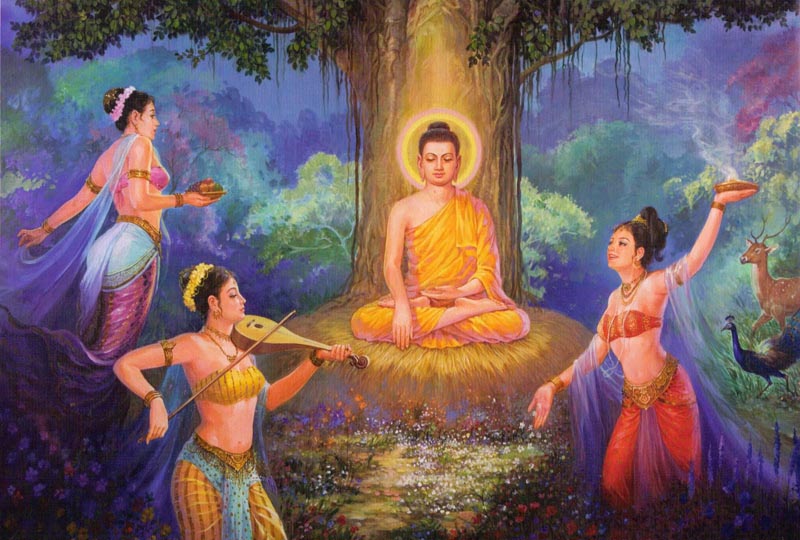
    Buddha and Sujata

    Buddha and Sujata

    Now at the time, in a nearby village called Senani, there lived a young, very beautiful and rich girl called Sujata, who wanted a husband of equal rank and a son. She had waited for many years and she was not successful. The people told her that she must go to certain banyan tree near the Neranjara river and pray to the tree-god to give her a husband and son. She did as the people told her and later on she got married to a young man and they had a lovely son. She was extremely happy and decided to fulfil her vow to the tree-god for giving her all that she had asked for.

    Sujata had a thousand cows, and she fed them with sweet creepers called valmee so that the cow’s milk was sweet. She milked these thousand cows and fed that milk to five hundred cows, and then fed their milk to two hundred and fifty cows and so on until she fed only eight cows. She did this to get the sweetest and most nourishing milk, to make delicious milk-rice as an offering to the tree-god.

    As she was doing this she was surprised to see her servant running back from cleaning and preparing the area at the foot of the banyan tree. Very happy and excited, the servant said, “My lady Sujata! The banyan god is meditating at the foot of the tree. How lucky you must be to have the god in person to accept your food.”

    Sujata too was happy and excited and danced with joy with the servant. They then took even more pains to prepare the milk-rice, pouring it into a golden bowl.

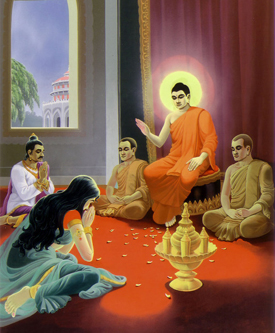
    Taking the delicious milk-rice both of them went to the banyan tree and Sujata saw what she perceived to be a holy man. He was handsome and golden looking and sat serenely in meditation. She did not know that he was in fact Ascetic Gotama. She bowed with respect and said, “Lord, accept my donation of milk-rice. May you be successful in obtaining your wishes as I have been.”

    Ascetic Gotama ate the sweet thick milk-rice and then bathed in the river Neranjara. This was the last food and bath he would have for seven weeks. When he finished he took the golden bowl and threw it in the river, saying, “If I am to succeed in becoming a Buddha today, let this bowl go upstream, but if not, let it go downstream.” The golden bowl went upstream, all the while keeping in the middle of the river.

    Life of the Buddha
    Source: BuddhaNat
    Link to this story

  2. Educating Compassion

    Comment

    Anathapindikaby Thanissaro Bhikkhu

    If you have any friends or family members who are sick or dying, I know of no one who would tell you to treat them in a hardhearted way. Everyone would agree that you should be as compassionate as you can. The problem is that there’s little agreement on how compassion translates into specific actions. For some people, compassion means extending life as long as possible; for others it means terminating life — through assisted suicide or euthanasia — when quality of life falls below a certain level. And neither of these two groups sees the other as compassionate at all. The first sees the second as criminal; the second sees the first as heartless and cruel.

    For those of us trying to negotiate the murky territory between these two extremes, there’s not much reliable guidance. Ours is a culture that doesn’t like to think about illness and death, and as a result, when faced with someone who’s sick or dying, we’re at a loss as to what to do. Some people will advise you simply to do what feels right, but feelings have a way of turning slippery and devious. Some things feel right simply because they make you feel good, regardless of whether they’re genuinely right for the other person. A desire to extend life may mask a deeper fear of your own death; a desire to terminate a miserable illness may rationalize your distress at having to witness suffering. Even if you’re told to act from a place of mindful presence, you may find that what seem to be your spontaneous inspirations are actually conditioned by hidden, unexamined assumptions about what life and death are all about.

    This is why the simple injunction to be compassionate or mindful in the presence of a sick or dying person isn’t enough. We need help in educating our compassion: specific advice on how to think through the implications of our actions in the face of life and death, and specific examples of how people who have contemplated these issues thoroughly have actually acted in the past.

    With this thought in mind, I searched through the Pali canon — the oldest extant record of the Buddha’s teachings — to see what lessons could be drawn from the Buddha’s example. After all, the Buddha often referred to himself as a doctor, and to his Dharma as medicine for the sufferings of the world. From his point of view, we’re all sick and dying on a subtle level, so we all deserve continual compassion. But what sort of advice did this doctor give when face-to-face with the flesh and blood suffering of illness and death? How did he treat people who were physically sick or dying? Continue reading

  3. The Buddha

    Comment

    This documentary by award-winning filmmaker David Grubin and narrated by Richard Gere, tells the story of the Buddha’s life, a journey especially relevant to our own bewildering times of violent change and spiritual confusion. It features the work of some of the world’s greatest artists and sculptors, who across two millenia, have depicted the Buddha’s life in art rich in beauty and complexity.

    Hear insights into the ancient narrative by contemporary Buddhists, including Pulitzer Prize winning poet W.S. Merwin and His Holiness the Dalai Lama. Join the conversation and learn more about meditation, the history of Buddhism, and how to incorporate the Buddha’s teachings on compassion and mindfulness into daily life.

  4. Queen Maha Maya’s Dream

    Comment

    Freedom is not given to us by anyone; we have to cultivate it ourselves. It is a daily practice… No one can prevent you from being aware of each step you take or each breath in and breath out. ~Thich Nhat Hạnh

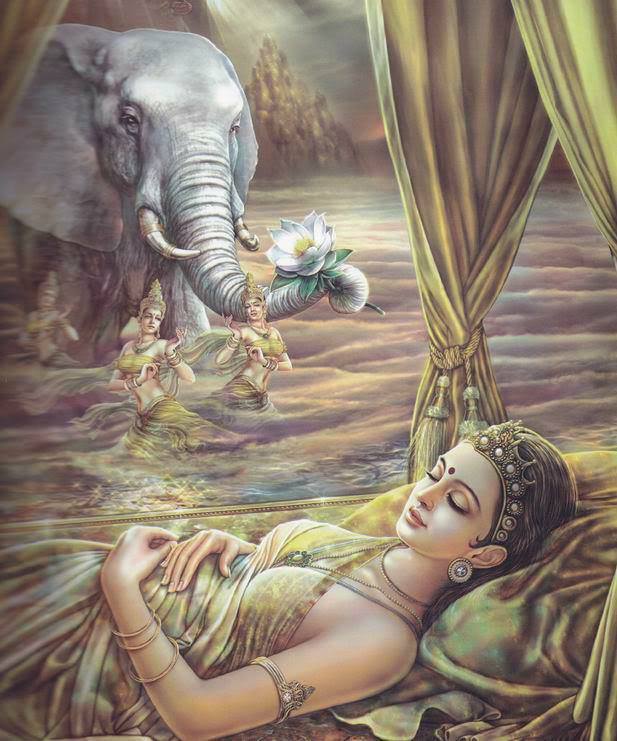
    Queen Siri Mahamaya Devi

    The Dream of Queen Siri Mahamaya Devi

    More than 2,500 years ago, there was a king called Suddhodana. He married a beautiful Koliyan princess named Maha Maya. The couple ruled over the Sakyas, a warrior tribe living next to the Koliya tribe, in the north of India, in what is now known as Nepal. The capital of the Sakya country was laid out across the foothills of the Himalayas and called Kapilavatthu.

    Queen Maha Maya was the daughter of King Anjana of the Koliyas. Such was her beauty that the name Maya, meaning “vision” was given to her. But it was Maya’s virtues and talents that were her most wonderful qualities, for she was endowed with the highest gifts of intelligence and piety. King Suddhodana was indeed worthy of his lovely wife. He himself was called “King of the Law” because he ruled according to the law. There was no other man among the Sakyas more honored and respected. The king was admired by his nobles and courtiers, as well as by the householders and merchants. Such was the noble family from which the Buddha was to arise.

    One full moon night, sleeping in the palace, the queen had a vivid dream. She felt herself being carried away by four devas (spirits) to Lake Anotatta in the Himalayas. After bathing her in the lake, the devas clothed her in heavenly cloths, anointed her with perfumes, and bedecked her with divine flowers. Soon after a white elephant, holding a white lotus flower in its trunk, appeared and went round her three times, entering her womb through her right side. Finally the elephant disappeared and the queen awoke, knowing she had been delivered an important message, as the elephant is a symbol of greatness in Nepal. The next day, early in the morning, the queen told the king about the dream. The king was puzzled and sent for some wise men to discover the meaning of the dream.

    The wise men said, “Your Majesty, you are very lucky. The devas have chosen our queen as the mother of the Purest-One and the child will become a very great being.” The king and queen were very happy when they heard this.

    They were so pleased that they invited many of the noblemen in the country to the palace to a feast to tell them the good news. Even the needy were not forgotten. Food and clothes were given to the poor people in celebration. The whole kingdom waited eagerly for the birth of the new prince, and Queen Maya enjoyed a happy and healthy pregnancy, living a pure life for herself and her unborn child.

    Life of the Buddha
    Source: BuddhaNet

  5. The tale of the two parrots

    Comment

    Buddha's MotherThis is a story of two parrots, who loved to travel far and wide in search of food and visit new places. These two beautiful birds were brothers named Radha and Potthapada. Once, they entered the palace gardens and were caught in a trap laid for birds. Both Radha and Potthapada were brought before the king, who just could not keep his eyes off the stunning birds. The king ordered his men that the birds be kept in a special cage made of gold. They were fed the choicest foods everyday.

    Radha and Potthapada were the toast of the king’s palace. Royal guests would stand by the golden cage and admire the birds. Life was very comfortable for them until the day a huge ape was brought to the palace. The ugly ape was named Kalabahu. Soon, all attention that was reserved for the parrots was now Kalabahu’s. People had not seen such a huge ape before. Kalabahu became the center of attraction of all the royal guests and palace officials. They would pour in to have a good look at the ape and his antics that made everyone roar with laughter. As a result, both the parrots started feeling neglected. Nobody cared whether they were fed on time or not.

    Potthapada, the younger of the two parrots, was deeply hurt. He confided in his elder brother, “Let us leave here and go elsewhere. Nobody cares for us anymore.” Radha, wiser of the two, replied, “Potthapada, my brother, do not feel so sad. Attention, praise and blame, and honor and dishonor are temporary facets of life. Soon, people will get tired of the ape’s antics and know your true worth.”

    And, sure enough, people started disliking the ape, as he began misbehaving and fooling around a bit too much. The king also found his acts offensive, and ordered Kalabahu to be sent back to the forest. People started paying all their attention to the well-behaved and beautiful parrots once again. And, did you know who the intelligent Radha was? He was Buddha in one of his earlier births.

    Moral: True worth and ability are always given their due ultimately.

    Source: http://www.jatakkatha.com

  6. Mara and the Buddha – Embracing our Suffering

    Comment


    by Thich Nhat Hanh, August 4, 2013

    I would like to tell you a story that took place a number of years ago. One day I saw the Venerable Ananda—you know who he is? Ananda is a cousin of the Buddha, a very handsome man with a very good memory. He memorized everything the Buddha said, and after the Buddha passed away, he repeated exactly what the Buddha said during his life. Then other monks tried to learn and memorize also. Later on, all this was put down into writing and that is why we have the Sutras today. “Sutras” means the teaching of the Buddha in written form. They exist in Pali, Sanskrit, Chinese, Tibetan, and in Vietnamese, but originally it was in a kind of Bengali, very close to Pali and Sanskrit.

    One day I saw the Venerable Ananda practicing walking meditation in front of the hut of the Buddha. You know, Ananda became a monk, a student of the Buddha. He was the attendant of the Buddha during many years. He took very good care of the Buddha. Of course, the Buddha loved him and there were people who were jealous of him. Sometimes Ananda was so concerned about the happiness of the Buddha that he forgot about himself. Sometimes he did not enjoy what was there in the present moment, being much younger than the Buddha.

    One day standing on the hill looking down, the Buddha saw beautiful rice fields. The rice was ripe, about to be harvested. But because Ananda was only thinking of how to make the Buddha comfortable, he didn’t see it. So the Buddha pointed to the rice fields below and said, “Ananda can you see it’s beautiful?” It was like a bell of mindfulness—suddenly Ananda saw that the rice fields down there were so beautiful. The Buddha smiled and said, “Ananda, I want the robes of the monks and the nuns to be designed in the form of rice fields—golden colors like the rice that is already ripe, small portions of the rice fields like that.” Ananda said, “Yes, that is possible, I will go tell my brothers and from now on we will make the sanghati, the robes of the monks and nuns, in the form of rice fields.”

    Another time when Ananda was with the Buddha, north of the Gangha River in the city of Vaisali, the Buddha pointed to the city, the trees, and the hills, and said to Ananda “Don’t you see Vaisali is beautiful?” Then Ananda took the time to look at the beauty of the city. Continue reading

  7. Bodhisattva – The Elephant

    Comment

    elephant


    A Tale of Self Sacrifice.

    At one time, the Bodhisattva took birth as a large Elephant. He lived in a forest far from civilization. The forest contained a lake that was both deep and wide and the entire wilderness was surrounded on all sides by an expansive desert. This beautiful oasis was well suited for the elephant as well as other smaller creatures. Delicious fruit grew on the trees, young shrubs carpeted the earth, and the whole area was bordered with high mountains. The Elephant lived alone as an ascetic and sustained his large body only on leaves and lotus roots, dedicating his time to contemplation on the virtues of contentment and tranquility.

    One day while wandering along the forests edge, the Bodhisattva Elephant heard the cries of humans coming from the desert. Their cries began to get louder; surely they were approaching the oasis.

    Urged by compassion, he ran towards them swiftly and when they came into sight he saw that it was a large group of men, women, and children, all nearly dead from starvation and thirst. Noticing that they were fearful of him, he called out in a human voice and stated that they need not be frightened. Upon hearing such peaceful and comforting words the people regained their composure and humbly greeted him.

    The elders explained that they had been banished by an angry king and that many of them had already died in the desert. The kind Elephant realized that all the fruit in the forest would not be enough to feed them for even a day. He resolved that he must offer his own flesh as food and his organs and intestines as bags to carry water on their journey. He then instructed the people on how to find the great lake and said that just beyond it they would find the corpse of an elephant that had fallen from a mountaintop, not telling them that it would be his own corpse. As the group set out towards the water, he quickly, by another route, started to ascend the mountain. Upon reaching the top he then, feeling great joy and oblivious of the impending painful death below, hurled himself over the edge of the precipice. The impact sounded like an earthquake throughout the entire forest. Continue reading

  8. The Buddha, in one of his former lives, was in Hell

    Comment

    JendhamuniholdingcameraJendhamuni: Even in Hell there was Compassion… This is a beautiful and powerful dhamma talk given by Ven. Thich Nhat Hanh. The story I will remember till my last breath.

    Today I would like to speak a little bit about Heaven, or Paradise, and Hell. I have been in Paradise, and I have been in Hell also, so I have some experience to share with you. I think if you remember well, you know that you have also been in Paradise, and you have also been in Hell. Hell is hot, and it is difficult.

    The Buddha, in one of his former lives, was in Hell. Before he became a Buddha he had suffered a lot in many lives. He made a lot of mistakes, like all of us. He made himself suffer, and he made people around him suffer. Sometimes he made very big mistakes, and that is why in one of his previous lives he was in Hell. There is a collection of stories about the lives of the Buddha, and there are many hundreds of stories like that. These stories are collected under the title Jataka Tales. Among these hundreds of stories, I remember one very vividly. I was seven years old, very young, and I read that story about the Buddha, and I was very shocked. But I did not fully understand that story.

    The Buddha was in Hell because he had done something wrong, extremely wrong, that caused a lot of suffering to himself and to others. That is why he found himself in Hell. In that life of his, he hit the bottom of suffering, because that Hell was the worst of all Hells. With him there was another man, and together they had to work very hard, under the direction of a soldier who was in charge of Hell. It was dark, it was cold, and at the same time it was very hot. The guard did not seem to have a heart. It did not seem that he knew anything about suffering. He did not know anything about the feelings of other people, so he just beat up the two men in Hell. He was in charge of the two men, and his task was to make them suffer as much as possible.

    I think that guard also suffered a lot. It looked like he didn’t have any compassion within him. It looked like he didn’t have any love in his heart. It looked like he did not have a heart. He behaved like a robber. When looking at him, when listening to him, it did not seem that one could contact a human being, because he was so brutal. He was not sensitive to people’s suffering and pain. That is why he was beating the two men in Hell, and making them suffer a lot. And the Buddha was one of these two men in one of his previous lives. Continue reading

  9. History of Magha Puja

    Comment


    History of Magha Puja
    Compiled by Ven. Munindathero Maha Nhor Tepmony
    Read by Jendhamuni Sos

    இڿڰۣ-ڰۣ¬~♥


    Magha Puja Day: The Day of Four Marvelous Events

    Magha Puja Day is one of the most important Buddhist holy day. It is also called as “The Day of Four Marvelous Events.” Why is it so important?

    Magha Puja Day has been announced to be one of the most important holy days in Buddhism because there were four marvelous events happening over 2,500 years ago. This day is an important Buddhist holy day because of Dhamma. The Lord Buddha taught the Dhamma Principles and his teachings for the assembled arahants in that day to disseminate and save the beings from sin.

    Magha Puja Day is the special holy day which usually falls on the full moon day of the 3rd lunar month, sometimes the Buddhists call “the day which the moon is occupying the Magha auspicious time”. The Buddhists usually do the activities and ceremonies on Magha Puja Day in the middle of the 3rd lunar month, but if there is 2 times of the 8th lunar month, the activities will delay to do in the middle of the 4th lunar month. The Magha Day is important because it is the meeting anniversary of the arahants who assembled without any schedule. This day is also called to be “The Day of Four Marvelous Events” which occurred at the Veluvana Maha Vihara after the Lord Buddha had enlightened for 9 months.

    meakbuchea855a Continue reading

Live & Die for Buddhism

candle

Me & Grandma

My Reflection

This site is a tribute to Buddhism. Buddhism has given me a tremendous inspiration to be who and where I am today. Although I came to America at a very young age, however, I never once forget who I am and where I came from. One thing I know for sure is I was born as a Buddhist, live as a Buddhist and will leave this earth as a Buddhist. I do not believe in superstition. I only believe in karma.

A Handful of Leaves

A Handful of Leaves

Tipitaka: The pali canon (Readings in Theravada Buddhism). A vast body of literature in English translation the texts add up to several thousand printed pages. Most -- but not all -- of the Canon has already been published in English over the years. Although only a small fraction of these texts are available here at Access to Insight, this collection can nonetheless be a very good place to start.

Major Differences

Major Differences in Buddhism

Major Differences in Buddhism: There is no almighty God in Buddhism. There is no one to hand out rewards or punishments on a supposedly Judgement Day ...read more

Problems we face today

jendhamuni pink scarfnature

Of the many problems we face today, some are natural calamities and must be accepted and faced with equanimity. Others, however, are of our own making, created by misunderstanding, and can be corrected...