
1. The Story of Samanera Sukha

    Comment

    Verse 145: Farmers1 channel the water; fletchers straighten the arrows; carpenters work the timber; the wise tame themselves.

    1. Farmers: lit., makers of irrigation canals.

    The Story of Samanera* Sukha

    While residing at the Jetavana monastery, the Buddha uttered Verse (145) of this book, with reference to a samanera named Sukha.

    Sukha was made a samanera at the age of seven years by Thera Sariputta. On the eighth day after being made a samanera he followed Thera Sariputta on his alms-round. While doing the round they came across some farmers irrigating their fields, some fletchers straightening their arrows and some carpenters making things like cart-wheels, etc. Seeing these, he asked Thera Sariputta whether these inanimate things could be guided to where one wished or be made into things one wished to make, and the thera answered him in the affirmative. The young samanera then pondered that if that were so, there could be no reason why a person could not tame his mind and practise Tranquillity and Insight Meditation.

    So, he asked permission from the thera to return to the monastery. There, he shut himself up in his room and practised meditation in solitude, Sakka and the devas also helped him in his practice by keeping the monastery very quiet. That same day, the eighth day after his becoming a samanera, Sukha attained arahatship. In connection with this, the Buddha said to the congregation of bhikkhus, “When a person earnestly practises the Dhamma, even Sakka and the devas give protection and help. I myself have kept Sariputta at the entrance so that Sukha should not be disturbed. The samanera, having seen the farmers irrigating their fields, the fletchers straightening their arrows and the carpenters making cart-wheels and other things, trains his mind and practises the Dhamma. Thus, he has now become an arahat.” Continue reading

  2. The Story of Thera Pilotikatissa

    Comment

    Verse 143: Rare in this world is the kind of person who out of a sense of shame restrains from doing evil and keeps himself awake like a good horse that gives no cause to be whipped.

    Verse 144: Like a good horse stirred at a touch of the whip, be diligent and get alarmed by endless round of rebirths (i.e., samsara). By faith, morality, effort, concentration, discernment of the Dhamma, be endowed with knowledge and practice of morality, and with mindfulness, leave this immeasurable dukkha (of samsara) behind.

    1. dhammavinicchayena (dhamma + vinicchaya): discernment of the Dharnma or Law. It is explained by the Commentary as karanakarana jananam, knowing right and wrong causes of things.

    The Story of Thera Pilotikatissa

    While residing at the Jetavana monastery, the Buddha uttered Verses (143) and (144) of this book, with reference to Thera Pilotikatissa.

    Once, Thera Ananda saw a shabbily dressed youth going round begging for food; he felt pity for the youth and made him a samanera. The young samanera left his old clothes and his begging plate on the fork of a tree. When he became a bhikkhu he was known as Pilotikatissa. As a bhikkhu, he did not have to worry about food and clothing as he was in affluent circumstances. Yet, sometimes he did not feel happy in his life as a bhikkhu and thought of going back to the life of a lay man. Whenever he had this feeling, he would go back to that tree where he had left his old clothes and his plate. There, at the foot of the tree, he would put this question to himself, “Oh shameless one! Do you want to leave the place where you are fed well and dressed well? Do you still want to put on these shabby clothes and go begging again with this old plate in your hand?” Thus, he would rebuke himself, and after calming down, he would go back to the monastery. Continue reading

  3. The Story of Santati the Minister

    Comment

    Verse 142: Though he is gaily decked, if he is calm, free from moral defilements, and has his senses controlled, if he is established in Magga Insight, if he is pure and has laid aside enmity (lit., weapons) towards all beings, he indeed is a brahmana, a samana, and a bhikkhu.

    1. According to the Commentary, in this context, brahmana, samana, and bhikkhu are all arahats.

    The Story of Santati the Minister

    While residing at the Jetavana monastery, the Buddha uttered Verse (142) of this book, with reference to Santati, the minister of King Pasenadi of Kosala.

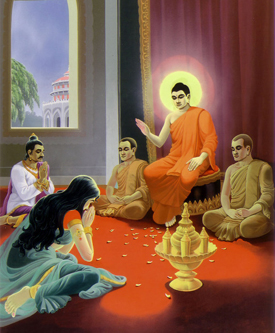
    On one occasion, Santati the minister returned after suppressing a rebellion on the border. King Pasenadi was so pleased with him that he honoured the minister with the gift of the riches and glory of a ruler together with a dancing girl to entertain him for seven days. For seven days, the king’s minister enjoyed himself to his heart’s content, getting intoxicated with drink and infatuated with the young dancer. On the seventh day, riding the ornamented royal elephant, he went down to the riverside for a bath. On the way, he met the Buddha going on an alms-round, and being drunk, he just bowed casually, as a sign of respect to the Buddha. The Buddha smiled, and Ananda asked the Buddha why he smiled. So, the Buddha said to Ananda, “Ananda, this minister will come to see me this very day and after I have given him a short discourse will become an arahat. Soon after becoming an arahat he will realize parinibbana.” Continue reading

  4. The Story of Bhikkhu Bahubhandika

    Comment

    Verse 141: Not going naked, nor having matted hair, nor smearing oneself with mud, nor fasting, nor sleeping on bare ground, nor covering oneself with dust, nor striving by squatting can purify a being, who has not yet overcome doubt.

    The Story of Bhikkhu Bahubhandika

    While residing at the Jetavana monastery, the Buddha uttered Verse (141) of this book, with reference to Bahubhandika, a bhikkhu with many possessions.

    Once there was a rich man in Savatthi. After the death of his wife, he decided to become a bhikkhu. But before he entered the Order, he built a monastery, which included a kitchen and a store room. He also brought his own furniture, utensils and a large stock of rice, oil, butter and other provisions. Whatever dishes he wanted was cooked for him by his servants. Thus, even as a bhikkhu he was living in comfort, and because he had so many things with him, he was known as ‘Bahubhandika.’ One day, other bhikkhus took him to the Buddha, and in his presence told the Buddha about the many things he had brought along with him to the monastery, and also how he was still leading the luxurious life of a rich man. So, the Buddha said to Bahubhandika, “My son, I have been teaching all of you to live an austere life; why have you brought so much property with you?” When reprimanded even this much, that bhikkhu lost his temper and said angrily, “Indeed, Venerable Sir! I will now live as you wish me to.” So saying, he cast off his upper robe. Continue reading

  5. The Story of Thera Maha Moggallana

    Comment

    Verse 137: He who does harm with weapons to those who are harmless and should not be harmed will soon come to any of these ten evil consequences:

    Verses 138, 139 & 140: He will be subject to severe pain, or impoverishment, or injury to the body (i.e., loss of limbs), or serious illness (e.g., leprosy), or lunacy, or misfortunes following the wrath of the king, or wrongful and serious accusations, or loss of relatives, or destruction of wealth, or the burning down of his houses by fire or by lightning. After the dissolution of his body, the fool will be reborn in the plane of continuous suffering (niraya).

    The Story of Thera Maha Moggallana

    While residing at the Jetavana monastery, the Buddha uttered Verses (137), (138), (139) and (140) of this book, with reference to Thera Maha Moggallana.

    Once, the Nigantha ascetics planned to kill Thera Maha Moggallana because they thought that by doing away with Thera Maha Moggallana the fame and fortune of the Buddha would also be diminished. So they hired some assassins to kill Thera Maha Moggallana who was staying at Kalasila near Rajagaha at that time. The assassins surrounded the monastery; but Thera Maha Moggallana, with his supernormal power, got away first through a key hole, and for the second time through the roof. Thus, they could not get hold of the Thera for two whole months. When the assassins again surrounded the monastery during the third month, Thera Maha Moggallana, recollecting that he had yet to pay for the evil deeds done by him during one of his past existences, did not exercise his supernormal power. So he was caught and the assassins beat him up until all his bones were utterly broken. After that, they left his body in a bush, thinking that he had passed away. But the Thera, through his jhanic power, revived himself and went to see the Buddha at the Jetavana monastery. When he informed the Buddha that he would soon realize parinibbana at Kalasila, near Rajagaha, the Buddha told him to go only after expounding the Dhamma to the congregation of bhikkhus, as that would be the last time they would see him. So, Thera Maha Moggallana expounded the Dhamma and left after paying obeisance seven times to the Buddha. Continue reading

  6. The Story of the Boa Constrictor Peta

    Comment

    Verse 136: A fool while doing evil deeds does not know them as being evil; but that fool suffers for his evil deeds like one who is burnt by fire.

    The Story of the Boa Constrictor Peta

    While residing at the Jetavana monastery, the Buddha uttered Verse (136) of this book, with reference to a boa constrictor peta*.

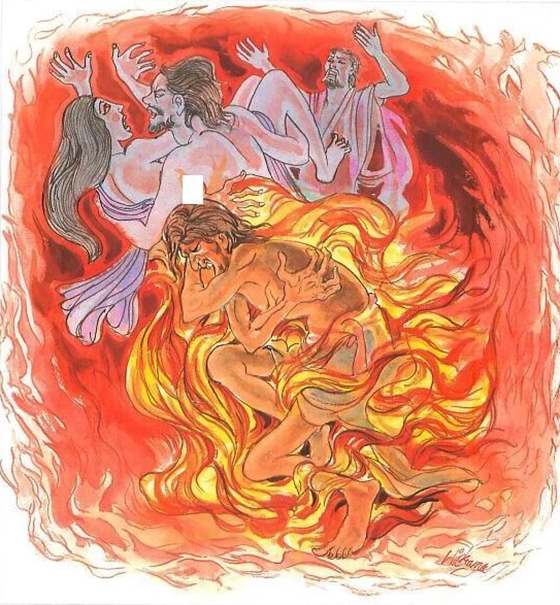
    Once, as Thera Maha Moggallana was coming down the Gijjhakuta hill with Thera Lakkhana he saw a boa constrictor peta and smiled, but he did not say anything. When they were back at the Jetavana monastery, Thera Maha Moggallana told Lakkhana, in the presence of the Buddha about the boa constrictor peta, with its long body burning in flames. The Buddha also said he himself had also seen that very peta soon after he had attained Buddhahood, but that he did not say anything about it because people might not believe him and thus they would be doing a great wrong to the Buddha. So out of compassion for these beings, the Buddha had kept silent. Then he continued, “Now that I have a witness in Moggallana, I will tell you about this boa constrictor peta. This peta was a thief during the time of Kassapa Buddha. As a thief and a cruel-hearted man, he had set fire to the house of a rich man seven times. And not satisfied with that, he also set fire to the perfumed hall donated by the same rich man to Kassapa Buddha, while Kassapa Buddha was out on an alms-round. As a result of those evil deeds he had suffered for a long time in niraya. Now, while serving out his term of suffering as a peta, he is being burnt with sparks of flames going up and down the length of his body. Bhikkhus, fools when doing evil deeds do not know them as being evil; but they cannot escape the evil consequences” Continue reading

  7. The Story of Some Ladies Observing the Moral Precepts

    Comment

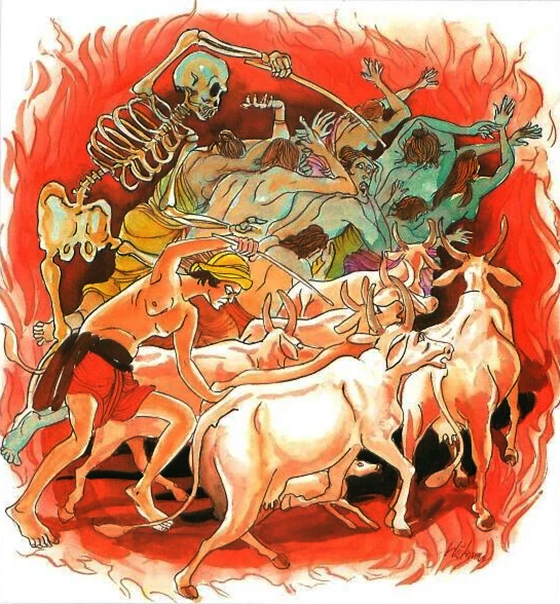
    Verse 135: As with a stick the cowherd drives his cattle to the pasture, so also, ageing and death drive the life of beings.

    The Story of Some Ladies Observing the Moral Precepts

    While residing at the Pubbarama monastery, the Buddha uttered Verse (135) of this book, with reference to five hundred ladies.

    Once, five hundred ladies from Savatthi came to the Pubbarama monastery to keep the Uposatha Sila vows. The donor of the monastery, the well-renowned Visakha, asked different age groups of ladies why they had come to keep the sabbath. She got different answers from different age groups for they had come to the monastery for different reasons. The old ladies came to the monastery to keep the sabbath because they hoped to gain the riches and glories of the devas in their next existence; the middle-aged ladies had come to the monastery because they did not want to stay under the same roof with the mistresses of their respective husbands. The young married ladies had come because they wanted their first born to be a son, and the young unmarried ladies had come because they wanted to get married to good husbands. Continue reading

  8. The Story of Thera Kondadhana

    Comment

    Verse 133: Do not speak harshly to anyone; those who are thus spoken to will retort. Malicious talk is indeed the cause of trouble (dukkha) and retribution will come to you.

    Verse 134: If you can keep yourself calm and quiet like a broken gong which is no longer resonant, you are sure to realize Nibbana, there will be no harshness in you.

    1. sarambkakatha: Malacious talk. According to the Commentary it means talk belittling others.

    The Story of Thera Kondadhana

    While residing at the Jetavana monastery, the Buddha uttered Verses (133) and (134) of this book, with reference to Thera Kondadhana.

    Since the day Kondadhana was admitted to the Order, the image of a female was always following him. This image was seen by others, but Kondadhana himself did not see it and so did not know about it.

    When he was out on an alms-round, people would offer two spoonfuls to him, saying, “This is for you, Venerable Sir, and this is for your female companion.” Seeing the bhikkhu going about with a woman, people went to King Pasenadi of Kosala and reported about the bhikkhu and the woman. They said to the king, “O king! Drive out the bhikkhu, who is lacking in moral virtues, from your kingdom.” So the king went to the monastery where that bhikkhu was staying and surrounded it with his men.

    Hearing noises and voices, the bhikkhus came out and stood at the door, and the image also was there not far from the bhikkhu. Knowing that the king had come, the bhikkhu went into the room to wait for him. When the king entered the room, the image was not there. The king asked the bhikkhu where the woman was and he replied that he saw no woman. The king wanted to make sure and he asked the bhikkhu to leave the room for a while. The bhikkhu left the room, but when the king looked out, again he saw the woman near the bhikkhu. But when the bhikkhu came back to the room the woman was nowhere to be found. The king concluded that the woman was not real and so the bhikkhu must be innocent. He therefore invited the bhikkhu to come to the palace every day for alms-food. Continue reading

  9. The Story of Many Youths

    Comment

    Verse 131: He who seeks his own happiness by oppressing others, who also desire to have happiness, will not find happiness in his next existence.

    Verse 132: He who seeks his own happiness by not oppressing others, who also desire to have happiness, will find happiness in his next existence.

    The Story of Many Youths

    While residing at the Jetavana monastery, the Buddha uttered Verses (131) and (132) of this book, with reference to a number of youths.

    Once, the Buddha was out on an alms-round at Savatthi when he came across a number of youths beating a snake with sticks. When questioned, the youths answered that they were beating the snake because they were afraid that the snake might bite them. To them the Buddha said, “If you do not want to be harmed, you should also not harm others: if you harm others, you will not find happiness in your next existence.”

    Then the Buddha spoke in verse as follows: Continue reading

  10. Chabbaggiya Bhikkhu Vatthu

    Comment

    Verse 130: All are afraid of the stick, all hold their lives dear. Putting oneself in another’s place, one should not beat or kill others.

    The Story of a Group of Six Bhikkhus

    While residing at the Jetavana monastery, the Buddha uttered Verse (130) of this book, with reference to a group of six bhikkhus.

    After coming to blows the first time, the same two groups of bhikkhus quarrelled again over the same building. As the rule prohibiting beating others had already been laid down, the group of six threatened the other group with upraised hands. The group of seventeen, who were junior to the chabbaggis, cried out in fright. The Buddha hearing about this laid down the disciplinary rule forbidding the raising of hands in threat.

    Then the Buddha spoke in verse as follows:

    Verse 130: All are afraid of the stick, all hold their lives dear. Putting oneself in another’s place, one should not beat or kill others.

    Dhammapada Verse 130
    Chabbaggiya Bhikkhu Vatthu

    Sabbe tasanti dandassa
    sabbesam jivitam piyam
    attanam upamam katva
    na haneyya na ghataye.

    Source: Tipitaka

Live & Die for Buddhism

candle

Me & Grandma

My Reflection

This site is a tribute to Buddhism. Buddhism has given me a tremendous inspiration to be who and where I am today. Although I came to America at a very young age, however, I never once forget who I am and where I came from. One thing I know for sure is I was born as a Buddhist, live as a Buddhist and will leave this earth as a Buddhist. I do not believe in superstition. I only believe in karma.

A Handful of Leaves

A Handful of Leaves

Tipitaka: The pali canon (Readings in Theravada Buddhism). A vast body of literature in English translation the texts add up to several thousand printed pages. Most -- but not all -- of the Canon has already been published in English over the years. Although only a small fraction of these texts are available here at Access to Insight, this collection can nonetheless be a very good place to start.

Major Differences

Major Differences in Buddhism

Major Differences in Buddhism: There is no almighty God in Buddhism. There is no one to hand out rewards or punishments on a supposedly Judgement Day ...read more

Problems we face today

jendhamuni pink scarfnature

Of the many problems we face today, some are natural calamities and must be accepted and faced with equanimity. Others, however, are of our own making, created by misunderstanding, and can be corrected...