
1. The Story of Lajadevadhita

    Comment

    Verse 118: If a man does what is good, he should do it again and again; he should take delight in it; the accumulation of merit leads to happiness.

    The Story of Lajadevadhita

    While residing at the Jetavana monastery, the Buddha uttered Verse (118) of this book, with reference to Laja, a female deva.

    At one time Thera Mahakassapa stayed in the Pippali cave and remained in sustained absorption in concentration (samapatti) for seven days. Soon after he had arisen from samapatti, wishing to give someone a chance of offering something to a thera just arisen from samapatti, he looked out and found a young maid frying corn in a field-hut. So he stood at her door for alms-food and she put all the pop corn into the bawl of the thera. As she turned back after offering pop corn to the thera, she was bitten by a poisonous snake and died. She was reborn in Tavatimsa deva world and was known as Laja (pop corn) devadhita.

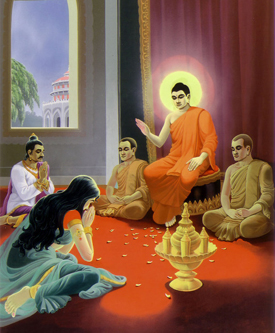
    Laja realized that she was reborn in Tavatimsa because she had offered pop corn to Thera Mahakassapa and felt very grateful to him. Then she concluded that she should keep on doing some services to the thera in order to make her good fortune more enduring. So, every morning she went to the monastery of the thera, swept the premises, filled up water pots, and did other services. At first, the thera thought that young samaneras had done those services; but one day, he found out that a female deva had been performing those services. So he told her not to come to the monastery any more, as people might start talking if she kept on coming to the monastery. Lajadevadhita was very upset; she pleaded with the thera and cried, “Please do not destroy my riches, my wealth.” The Buddha heard her cries and sent forth the radiance from his chamber and said to the female deva, “Devadhita, it is the duty of my son Kassapa to stop your coming to the monastery; to do good deeds is the duty of one who is anxious to gain merit.”

    Then the Buddha spoke in verse as follows:

    Verse 118: If a man does what is good, he should do it again and again; he should take delight in it; the accumulation of merit leads to happiness.
    At the end of the discourse, Lajadevadhita attained Sotapatti Fruition.

    Dhammapada Verse 118
    Lajadevadhita Vatthu

    Punnace puriso kayira
    kayira nam punappunam
    tamhi chandam kayiratha
    sukho punnassa uccayo.

    Source: Tipitaka

  2. The Story of Thera Seyyasaka

    Comment

    Verse 117: If a man does evil, he should not do it again and again; he should not take delight in it; the accumulation of evil leads to dukkha.

    The Story of Thera Seyyasaka

    While residing at the Jetavana monastery, the Buddha uttered Verse (117) of this book, with reference to Thera Seyyasaka.

    Once there was a thera by the name of Seyyasaka, who was in the habit of masturbating. When the Buddha heard about this, he rebuked the thera for doing something that would lead one farther away from the attainment of Magga and Phala. At the same time, the Buddha laid down the discipline prohibiting such indulgence in sexual pleasures, i.e., Samghadisesa Apatti, offences which require penance and suspension from the Order. Then, the Buddha added, “This kind of offence can only lead to evil results in this world as well as in the next.”

    Then the Buddha spoke in verse as follows:

    Verse 117: If a man does evil, he should not do it again and again; he should not take delight in it; the accumulation of evil leads to dukkha.

    Dhammapada Verse 117
    Seyyasakatthera Vatthu

    Pipance puriso kayira
    na nam kayira punappunam
    na tamhi chandam kayiratha
    dukkho papassa uccayo.

    Source: Tipitaka

  3. The Story of Culekasataka

    Comment

    Verse 116: One should make haste in doing good deeds; one should restrain one’s mind from evil; for the mind of one who is slow in doing good tends to take delight in doing evil.

    The Story of Culekasataka

    While residing at the Jetavana monastery, the Buddha uttered Verse (116) of this book, with reference to a brahmin couple by the name of Culekasataka.

    There was once a brahmin couple in Savatthi, who had only one outer garment between the two of them. Because of this they were also known as Ekasataka. As they had only one outer garment, both of them could not go out at the same time. So, the wife would go to listen to the discourse given by the Buddha during the day and the husband would go at night. One night, as the brahmin listened to the Buddha, his whole body came to be suffused with delightful satisfaction and he felt a strong desire to offer the outer garment he was wearing to the Buddha. But he realized that if he were to give away the only outer garment he had, there would be none left for him and his wife. So he wavered and hesitated. Thus, the first and the second watches of the night passed. Came the third watch and he said to himself, “If I am so miserly and hesitant, I will not be able to avoid falling to the four Lower Worlds (apayas); I shall now offer my outer garment to the Buddha.” So saying, he placed the piece of cloth at the feet of the Buddha and cried out “I have won” three times. Continue reading

  4. The Story of Theri Bahuputtika

    Comment

    Verse 115: Better than a hundred years in the life of a person who does not comprehend the Noble Dhamma (Dhammamuttamam), is a day in the life of one who comprehends the Noble Dhamma.

    1. dhammamuttamam: the Noble Dhamma or the Highest Dhamma (the Nine Transcendentals). The Nine Transcendentals are: four Maggas, four Phalas and Nibbana.

    The Story of Theri Bahuputtika

    While residing at the Jetavana monastery, the Buddha uttered Verse (115) of this book, with reference to Bahuputtika, a mother of many children.

    Once in Savatthi, there lived a couple, with their seven sons and seven daughters. All the children got married and the family was doing quite well. Then, the father died and the mother kept all the property without giving anything to the children. Her sons and daughters wanted the inheritance, so they said, to their mother, “What benefit do we get from our property? Can’t we make it multiply? Can’t we look after our mother?” They said such things again and again so their mother thought that her children would look after her, and she finally divided up the property without leaving anything for herself.

    After the division of the property, she first went to stay with her eldest son, but her daughter-in-law complained and said, “She has come and stayed with us, as if she has given us two shares!”, and such other things. So, Bahuputtika went to stay with her second son, and the same things were said. Thus, she went from one son to another, from one daughter to the next; but none of them was willing to take her on for a long stretch of time and none paid her due respect.

    The old lady was hurt and felt bitter against her children; she left her family and became a bhikkhuni. Because she was a mother of many children she came to he known as Bahuputtika. Bahuputika realized that she became a bhikkhuni only in her old age and that she must not be negligent, but must make use of the remaining period of her life to the utmost. So, for the whole night, she meditated on the Dhamma taught by the Buddha. The Buddha seeing her from the Jetavana monastery, through supernormal power, sent forth the radiance and appeared seated in front of her. Then the Buddha said to her, “The life of one who does not practise the Dhamma taught by me is useless, even if he were to live for a hundred years.”

    Then the Buddha spoke in verse as follows:

    Verse 115: Better than a hundred years in the life of a person who does not comprehend the Noble Dhamma (Dhammamuttamam), is a day in the life of one who comprehends the Noble Dhamma.
    End of Chapter Eight: The Thousand (Sahassavagga)

    Dhammapada Verse 115
    Bahuputtikattheri Vatthu

    Yo ca vassasatam jive
    apassam dhammamuttamam1
    ekaham jivitam seyyo
    passato dhammamuttamam.

    Source: Tipitaka

  5. The Story of Theri Kisagotami

    Comment

    Kisagotami

    Verse 114: Better than a hundred years in the life of a person who does not perceive the Deathless (Nibbana), is a day in the life of one who perceives the Deathless (Nibbana).

    The Story of Theri Kisagotami

    While residing at the Jetavana monastery, thc Buddha uttered Verse (114) of this book, with reference to Kisagotami.

    Kisagotami was the daughter of a rich man from Savatthi; she was known as Kisagotami because of her slim body. Kisagotami was married to a rich young man and a son was born to them. The boy died when he was just a toddler and Kisagotami was stricken with grief. Carrying the dead body of her son, she went about asking for medicine that would restore her son to life from everyone she happened to meet. People began to think that she had gone mad. But a wise man seeing her condition thought that he should be of some help to her. So, he said to her, “The Buddha is the person you should approach, he has the medicine you want; go to him.” Thus, she went to the Buddha and asked him to give her the medicine that would restore her dead son to life. Continue reading

  6. The Story of Theri Patacara

    Comment

    Patacara

    Verse 113: Better than a hundred years in the life of a person who does not perceive the arising and the dissolving of the five aggregates (khandhas), is a day in the life of one who perceives the arising and dissolving of the five aggregates.

    1. Udayabbayam: the arising and the dissolving of the five aggregates (khandhas). Udayabbayanana is the knowledge acquired through Insight Development Practice, indicating the impermanent characteristics of the five aggregates.

    The Story of Theri Patacara

    While residing at the Jetavana monastery, the Buddha uttered Verse (113) of this book, with reference to Patacara.

    Patacara was the daughter of a rich man from Savatthi. She was very beautiful and was guarded very strictly by her parents. But one day, she eloped with a young male attendant of the family and went to live in a village, as a poor man’s wife. In due course she became pregnant and as the time for confinement drew near, she asked permission from her husband to return to her parents in Savatthi, but her husband discouraged her. So, one day, while her husband was away, she set out for the home of her parents. Her husband followed her and caught up with her on the way and pleaded with her to return with him; but she refused. It so happened that as her time was drawing so near, she had to give birth to a son in one of the bushes. After the birth of her son she returned home with her husband. Continue reading

  7. The Story of Thera Sappadasa

    Comment

    Verse 112: Better than a hundred years in the life of a person who is idle and inactive, is a day in the life of one who makes a zealous and strenuous effort (in Tranquillity and Insight Development Practice).

    1. kusito: an idle person; according to the Commentary, an idle person is one who passes his time only in evil thoughts.

    The Story of Thera Sappadasa

    While residing at the Jetavana monastery, the Buddha uttered Verse (112) of this book, with reference to Thera Sappadasa.

    Once a bhikkhu was not feeling happy with the life of a bhikkhu; at the same time he felt that it would be improper and humiliating for him to return to the life of a householder. So he thought it would be better to die. So thinking, on one occasion, he put his hand into a pot where there was a snake but the snake did not bite him. This was because in a past existence the snake was a slave and the bhikkhu was his master. Because of this incident the bhikkhu was known as Thera Sappadasa. On another occasion, Thera Sappadasa took a razor to cut his throat; but as he placed the razor on his throat he reflected on the purity of his morality practice throughout his life as a bhikkhu and his whole body was suffused with delightful satisfaction (piti) and bliss (sukha). Then detaching himself from piti, he directed his mind to the development of Insight Knowledge and soon attained arahatship, and he returned to the monastery.

    On arrival at the monastery, other bhikkhus asked him where he had been and why he took the knife along with him. When he told them about his intention to take his life, they asked him why he did not do so. He answered, “I originally intended to cut my throat with this knife, but I have now cut off all moral defilements with the knife of Insight Knowledge.” The bhikkhus did not believe him; so they went to the Buddha and asked. “Venerable Sir, this bhikkhu claims, that he has attained arahatship as he was putting the knife to his throat to kill himself. Is it possible to attain Arahatta Magga within such a short time?” To them the Buddha said, “Bhikkhus! Yes, it is possible; for one who is zealous and strenuous in the practice of Tranquillity and Insight Development, arahatship can be gained in an instant. As the bhikkhu walks in meditation, he can attain arahatship even before his raised foot touches the ground.”

    Then the Buddha spoke in verse as follows:

    Verse 112: Better than a hundred years in the life of a person who is idle and inactive, is a day in the life of one who makes a zealous and strenuous effort (in Tranquillity and Insight Development Practice).

    Dhammapada Verse 112
    Sappadasatthera Vatthu

    Yo ca vassasatam jive
    kusito1 hinaviriyo
    ekaham jivitam seyyo
    viriyamarabhato dalham.

    Source: Tipitaka

  8. The Wheel-turning Emperor (Excerpt) Cakkavatti Sutta

    Comment

    Introduction

    The body of this sutta consists of a narrative illustrating the power of skillful action. The narrative states that, in the past, unskillful behavior was unknown among the human race. As a result, people lived for an immensely long time—80,000 years—endowed with great beauty, wealth, pleasure, and strength. Over the course of time, though, they began behaving in various unskillful ways. This caused the human life span gradually to shorten, to the point where it now stands at 100 years, with human beauty, wealth, pleasure, and strength decreasing proportionately. In the future, as morality continues to degenerate, human life will continue to shorten to the point were the normal life span is ten years, with people reaching sexual maturity at five. “Among those human beings, the ten courses of action (see AN 10:176) will have entirely disappeared.… The word ‘skillful‘ will not exist, so from where will there be anyone who does what is skillful? Those who lack the honorable qualities of motherhood, fatherhood, contemplative-hood, & brahman-hood will be the ones who receive homage.… Fierce hatred will arise, fierce malevolence, fierce rage, & murderous thoughts: mother for child, child for mother, father for child, child for father, brother for sister, sister for brother.”

    Ultimately, conditions will deteriorate to the point of a “sword-interval,” in which swords appear in the hands of all human beings, and they hunt one another like game. A few people, however, will take shelter in the wilderness to escape the carnage, and when the slaughter is over, they will come out of hiding and resolve to take up a life of skillful and virtuous action again. With the recovery of virtue, the human life span will gradually increase again until it reaches 80,000 years, with people attaining sexual maturity at 500. Only three diseases will be known at that time: desire, lack of food, and old age. Another Buddha—Metteyya (Maitreya)—will gain awakening, his monastic Saṅgha numbering in the thousands. The greatest king of the time, Saṅkha, will go forth into homelessness and attain arahantship under Metteyya’s guidance.

    The story, after chronicling the ups and downs of human wealth, life span, etc., concludes with the following lesson on kamma and skillful action. Continue reading

  9. The Story of Khanu-Kondanna

    Comment

    Verse 111: Better than a hundred years in the life of an ignorant person, who has no control over his senses, is a day in the life of a wise man who cultivates Tranquillity and Insight Development Practice.

    The Story of Khanu-Kondanna

    While residing at the Jetavana monastery, the Buddha uttered Verse (111) of this book, with reference to Khanu Kondanna.

    Thera Kondanna, after taking a subject of meditation from the Buddha, went into the jungle to practise meditation and there attained arahatship. Coming back to pay homage to the Buddha, he stopped on the way because he was very tired. He sat on a large stone-slab, his mind fixed in jhana concentration. At that moment five hundred robbers after looting a large village came to the place where the thera was. Taking him for a tree stump they put their bundles of loot all over and around the body of the thera. When day broke they realized that what they took to be a tree stump was, in fact, a living being. Then again, they thought it was an ogre and ran away in fright.

    The thera revealed to them that he was only a bhikkhu and not an ogre and told them not to get frightened. The robbers were awed by his words, and asked his pardon for having wronged him. Soon after wards, all the robbers requested the thera to admit them into the Order. From that time, Thera Kondanna came to be known as “Khanu Kondanna” (tree-stump Kondanna)

    The thera accompanied by the new bhikkhus went to the Buddha and told him all that had happened. To them the Buddha said, “To live for a hundred years in ignorance, doing foolish things, is useless; now that you have seen the Truth and have become wise, your life of one day as a wise man is much more worthwhile.”

    Then the Buddha spoke in verse as follows:

    Verse 111: Better than a hundred years in the life of an ignorant person, who has no control over his senses, is a day in the life of a wise man who cultivates Tranquillity and Insight Development Practice.

    Dhammapada Verse 111
    Khanu Kondannatthera Vatthu

    Yo ca vassasatam jive
    duppanno asamahito
    ekaham jivitam seyyo
    pannavantassa jhayino.

    Source: Tipitaka

  10. The Story of Samanera Samkicca

    Comment

    Verse 110: Better than a hundred years in the life of an immoral person who has no control over his senses, is a day in the life of a virtuous person who cultivates Tranquillity and Insight Development Practice.

    The Story of Samanera Samkicca

    While residing at the Jetavana monastery, the Buddha uttered Verse (110) of this book, with reference to Samanera Samkicca.

    On one occasion, thirty bhikkhus each took a subject of meditation from the Buddha and left for a large village, one hundred and twenty yojanas away from Savatthi. At that time, five hundred robbers were staying in a thick jungle, and they wanted to make an offering of human flesh and blood to the guardian spirits of the forest. So they came to the village monastery and demanded that one of the bhikkhus be given up to them for sacrifice to the guardian spirits. From the eldest to the youngest, each one of the bhikkhus volunteered to go. With the bhikkhus, there was also a young samanera by the name of Samkicca, who was sent along with them by Thera Sariputta. This samanera was only seven years old, but had already attained arahatship. Samkicca said that Thera Sariputta, his teacher, knowing this danger in advance, had purposely sent him to accompany the bhikkhus, and that he should be the one to go with the robbers. So saying, he went along with the robbers. The bhikkhus felt very bad for having let the young samanera go. The robbers made preparations for the sacrifice; when everything was ready, their leader came to the samanera, who was then seated, with his mind fixed on jhana concentration. The leader of the robbers lifted his sword and struck hard at the young samanera, but the blade of the sword curled up without cutting the flesh. He straightened up the blade and struck again; this time, it bent upwards right up to the hilt without harming the samanera. Seeing this strange happening, the leader of the robbers dropped his sword, knelt at the feet of the samanera and asked his pardon. All the five hundred robbers were amazed and terror-stricken; they repented and asked permission from Samkicca to become bhikkhus. He complied with their request.

    The young samanera accompanied by five hundred new bhikkhus returned to the village monastery and the thirty bhikkhus felt very much relieved and happy on seeing him. Then Samkicca and the five hundred bhikkhus continued on their way to pay respect to Thera Sariputta, his teacher, at the Jetavana monastery. After seeing Thera Sariputta they went to pay homage to the Buddha. When told what had happened, the Buddha said, “Bhikkhus, if you rob or steal and commit all sorts of evil deeds, your life would be useless, even if you were to live a hundred years. Living a virtuous life even for a single day is much better than a hundred years of a life of depravity.

    Then the Buddha spoke in verse as follows:

    Verse 110: Better than a hundred years in the life of an immoral person who has no control over his senses, is a day in the life of a virtuous person who cultivates Tranquillity and Insight Development Practice.
    At the end of the discourse, the five hundred bhikkhus attained arahatship.

    Dhammapada Verse 110
    Samkiccasamanera Vatthu

    Vo ca vassasatam jive
    dussilo asamahito
    ekaham jivitam seyyo
    silavantassa jhayino.

    Source: Tipitaka

Live & Die for Buddhism

candle

Me & Grandma

My Reflection

This site is a tribute to Buddhism. Buddhism has given me a tremendous inspiration to be who and where I am today. Although I came to America at a very young age, however, I never once forget who I am and where I came from. One thing I know for sure is I was born as a Buddhist, live as a Buddhist and will leave this earth as a Buddhist. I do not believe in superstition. I only believe in karma.

A Handful of Leaves

A Handful of Leaves

Tipitaka: The pali canon (Readings in Theravada Buddhism). A vast body of literature in English translation the texts add up to several thousand printed pages. Most -- but not all -- of the Canon has already been published in English over the years. Although only a small fraction of these texts are available here at Access to Insight, this collection can nonetheless be a very good place to start.

Major Differences

Major Differences in Buddhism

Major Differences in Buddhism: There is no almighty God in Buddhism. There is no one to hand out rewards or punishments on a supposedly Judgement Day ...read more

Problems we face today

jendhamuni pink scarfnature

Of the many problems we face today, some are natural calamities and must be accepted and faced with equanimity. Others, however, are of our own making, created by misunderstanding, and can be corrected...