The Buddha was always accompanied by an attendant whose job it was to run messages for him, prepare his seat and to attend to his personal needs. For the first twenty years of his ministry, he had several attendants, Nagasamala, Upavana, Nagita, Cunda, Radha and others, but none of them proved to be suitable. One day, when he decided to replace his present attendant, he called all the monks together and addressed them: “I am now getting old and wish to have someone as a permanent attendant who will obey my wishes in every way. Which of you would like to be my attendant?” All the monks enthusiastically offered their services, except Ananda, who modestly sat at the back in silence. Later, when asked why he had not volunteered he replied that the Buddha knew best who to pick. When the Buddha indicated that he would like Ananda to be his personal attendant, Ananda said he would accept the position, but only on several conditions. The first four conditions were that the Buddha should never give him any of the food that he received, nor any of the robes, that he should not be given any special accommodation, and that he would not have to accompany the Buddha when he accepted invitations to people’s homes. Ananda insisted on these four conditions because he did not want people to think that he was serving the Buddha out of desire for material gain. The last four conditions were related to Ananda’s desire to help in the promotion of the Dharma. These conditions were: that if he was invited to a meal, he could transfer the invitation to the Buddha; that if people came from outlying areas to see the Buddha, he would have the privilege of introducing them; that if he had any doubts about the Dharma, he should be able to talk to the Buddha about them at any time and that if the Buddha gave a discourse in his absence, he would later repeat it in his presence. The Buddha smilingly accepted these conditions and thus began a relationship between the two men that was to last for the next twenty-five years.
Ananda was born in Kapilavatthu and was the Buddha’s cousin, being the son of Amitodana, the brother of the Buddha’s father, Suddhodana. It was during the Buddha’s first trip back to Kapilavatthu after his enlightenment that Ananda, along with his brother Anuruddha and his cousin Devadatta, became a monk. He proved to be a willing and diligent student and within a year he became a Stream-Winner. The monk’s life gave Ananda great happiness and his quiet, unassuming nature meant that he was little noticed by the others until he was selected to be the Buddha’s personal attendant. While some people develop the qualities that lead to enlightenment through meditation or study, Ananda did it through the love and concern he had for others. Just before the Buddha attained final Nirvana, Ananda began to cry, saying to himself: “Alas, I am still a learner with much still to do. And the teacher is passing away, he who was so compassionate to me.” The Buddha called Ananda into his presence and reassured him that he had developed his mind to a very high degree through his selflessness and love and that if he made just a bit more effort he too would attain enlightenment.

“Enough, Ananda, do not weep and cry. Have I not already told that all things that are pleasant and delightful are also changeable, subject to separateness and impermanence? So how could they not pass away? Ananda, for a long time you have been in my presence, showing loving-kindness with body, speech and mind, helpfully, blessedly, whole-heartedly, and unstingily. You have made much merit, Ananda. Make an effort and very soon you will be free from the defilements.”
Ananda’s selflessness expressed itself in three ways – through his service to the Buddha, through his unstinting kindness to his fellow disciples, both ordained and lay, and also to future generations through the crucial role he had to play in the preservation and transmission of the Dharma.
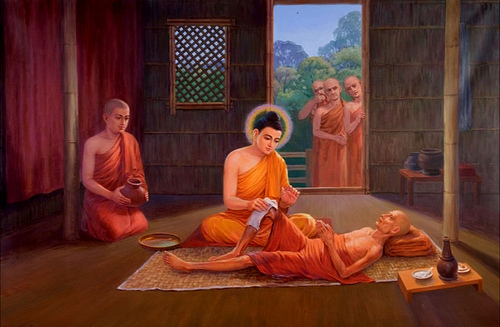
As the Buddha’s personal attendant Ananda strived to free the Buddha from as many mundane activities as possible so he could concentrate on teaching the Dharma and helping people. To that end, he washed and mended the Buddha’s robe, tidied his living quarters, washed his feet, massaged his back and when he was meditating or talking, stood behind him keeping him cool with a fan. He slept near the Buddha so as to always be at hand and accompanied him when he did his round of the monasteries. He would call monks whom the Buddha wished to see and kept people away when the Buddha wished to rest or to be alone. In his role as servant, secretary, go-between and confidant, Ananda was always patient, tireless and unobtrusive, usually anticipating the Buddha’s needs.
 Although Ananda’s main job was to take care of the Buddha’s needs, he always had time to be of service to others as well. He would often give talks on Dharma and indeed such a skilful teacher was he that sometimes the Buddha would ask him to give a talk in his place, or finish a talk that he had begun.[ N2 ] We are told that when the Buddha would have his afternoon rests, Ananda would take advantage of the spare time to go and visit those who were sick, to talk to them, cheer them up or try to get medicine for them. Once he heard of a very poor family struggling to bring up two young sons. Knowing that the boys faced a very grim future and feeling that something had to be done to help them, Ananda got permission from the Buddha to ordain them, thus giving them a chance in life.[ N3 ]
Life in the Sangha was not always easy for nuns. Most monks kept away from them, not wanting to be tempted. Some even discriminated against them. Ananda, on the other hand, was always ready to help them. It was he who encouraged the Buddha to ordain the first nuns, he was always ready to give Dharma talks to nuns and laywomen and encourage them in their practice, and they in turn often sought him out because of his sympathy for them.[ N4 ]
The Buddha once said that of all his disciples, Ananda was pre-eminent of those who had heard much Dharma, who had a good memory, who had mastered the sequential order of what he had remembered and who was energetic.[ N5 ] The Buddha could not write, indeed, although writing was known at the time, it was little used. Both during his life and for several centuries after his final Nirvana, his words were committed to memory and transmitted from one person to another. Ananda’s highly developed memory, plus the fact that he was constantly at the Buddha’s side, meant that he, more than any other person, was responsible for preserving and transmitting the Buddha’s teachings. By this, it is not meant that Ananda remembered the Buddha’s words verbatim – this would have been neither possible nor necessary, as understanding the Dharma is not dependent on the arrangement of words and sentences but on the comprehension of the meaning of the words. Rather, Ananda remembered the gist of what the Buddha had said, to whom he said it, particularly important or prominent phrases, similes or parables that were used and also the sequence in which all the ideas were presented. Ananda would repeat what he had heard and remembered to others and gradually a large body of oral teachings developed. This meant that people far from the Buddha’s presence could hear his teachings without the aid of books or the necessity of having to travel long distances.
 After the Buddha’s final Nirvana five hundred enlightened monks convened a Council at Rajagaha for the purpose of collecting all the Buddha’s teachings and committing them to memory so they could be handed down to future generations. Because he knew so much Dharma it was essential that Ananda be present, but he was not yet enlightened. Now that he no longer had to look after the Buddha’s needs, he had more time to meditate and so he began to practise with exceptional diligence, hoping that he could attain enlightenment before the Council started. As the time for the Council’s commencement got closer, he practised harder and harder. During the evening before the Council he sat meditating, convinced that he would not be able to attain enlightenment by the next morning. So he gave up and decided to lie down and sleep. As his head touched the pillow he became enlightened. Ananda was warmly welcomed at the Council the next day and over the following months he recited thousands of discourses that he had heard, commencing each recitation with the words: ‘Thus have I heard’ (Evam me sutam). Because of his enormous contributions to the preservation of the Dharma, Ananda was sometimes known as: ‘The Keeper of the Dharma Store’ (Dharmabhandagarika). Because of his qualities of kindness, patience and helpfulness, Ananda was one of those rare people who seemed to be able to get along with everybody and whom everybody liked. Just before his final Nirvana, the Buddha praised Ananda in the company of the monks by thanking him for his years of loyal and loving friendship and service. “Monks, all those who were fully enlightened Buddhas in the past had a chief attendant like Ananda, as will all those who will be fully enlightened Buddhas in the future. Ananda is wise. He knows when it is the right time for monks, nuns, laymen, laywomen, kings, ministers, the leaders of other sects or their pupils to come and see me. Ananda has four remarkable and wonderful qualities. What four? If a company of monks comes to see Ananda, they are pleased at the sight of him, and when he teaches Dharma to them they are pleased, and when he finishes they are disappointed. And it is the same for nuns, laymen and laywomen.”[ N6 ]
It is not known when or where Ananda passed away but, according to tradition, he lived to a ripe old age. When Fa Hien, the famous Chinese pilgrim, visited India in the 5th century CE, he reported seeing a stupa containing Ananda’s ashes, and that nuns in particular had high regard for his memory.
Source: BuddhaNet