
1. Who is Buddha – Major Differences in Buddhism
    Comment

    1. There is no almighty God in Buddhism. There is no one to hand out rewards or punishments on a supposedly Judgement Day.
    2. Buddhism is strictly not a religion in the context of being a faith and worship owing allegiance to a supernatural being.

    3. No saviour concept in Buddhism. A Buddha is not a saviour who saves others by his personal salvation. Although a Buddhist seeks refuge in the Buddha as his incomparable guide who indicates the path of purity, he makes no servile surrender. A Buddhist does not think that he can gain purity merely by seeking refuge in the Buddha or by mere faith in Him. It is not within the power of a Buddha to wash away the impurities of others.

    4. A Buddha is not an incarnation of a god/God (as claimed by some Hindu followers). The relationship between a Buddha and his disciples and followers is that of a teacher and student.

    5. The liberation of self is the responsibility of one’s own self. Buddhism does not call for an unquestionable blind faith by all Buddhist followers. It places heavy emphasis on self-reliance, self discipline and individual striving.

    6. Taking refuge in The Triple Gems i.e. the Buddha, the Dharma and the Sangha; does not mean self-surrender or total reliance on an external force or third party for help or salvation.

    7. Dharma (the teachings in Buddhism) exists regardless whether there is a Buddha. Sakyamuni Buddha (as the historical Buddha) discovered and shared the teachings/ universal truths with all sentient beings. He is neither the creator of such teachings nor the prophet of an almighty God to transmit such teachings to others.

    8. Especially emphasized in Mahayana Buddhism, all sentient beings have Buddha Nature/ Essence. One can become a Buddha (a supreme enlightened being) in due course if one practises diligently and attains purity of mind (ie absolutely no delusions or afflictions).

    9. In Buddhism, the ultimate objective of followers/practitioners is enlightenment and/or liberation from Samsara; rather than to go to a Heaven (or a deva realm in the context of Buddhist cosmology).

    10. Karma and Karma Force are cornerstones in Buddhist doctrines. They are expounded very thoroughly in Buddhism. Karma refers to an important metaphysical concept concerned with action and its consequences. This law of karma explains the problem of sufferings, the mystery of the so-called fate and predestination of some religions, and above all the apparent inequality of mankind. Continue reading
  2. The Significance of Vesak – Buddha Day

    Comment

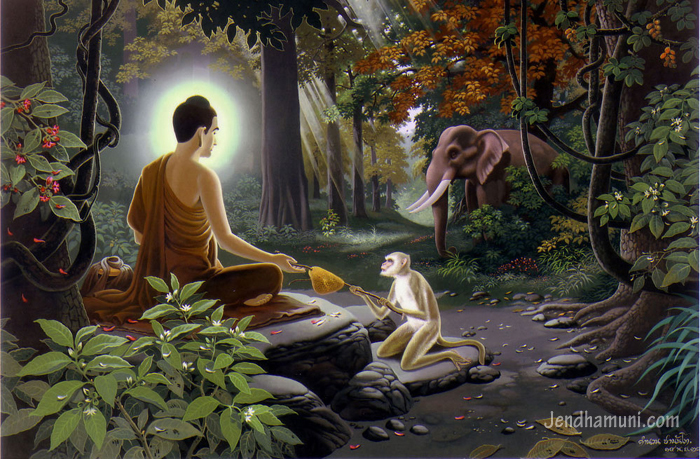
    buddha and animals

    The significance of Vesak lies with the Buddha and his universal peace message to mankind.

    As we recall the Buddha and his Enlightenment, we are immediately reminded of the unique and most profound knowledge and insight which arose in him on the night of his Enlightenment. This coincided with three important events which took place, corresponding to the three watches or periods of the night.

    During the first watch of the night, when his mind was calm, clear and purified, light arose in him, knowledge and insight arose. He saw his previous lives, at first one, then two, three up to five, then multiples of them .. . ten, twenty, thirty to fifty. Then 100, 1000 and so on…. As he went on with his practice, during the second watch of the night, he saw how beings die and are reborn, depending on their Karma, how they disappear and reappear from one form to another, from one plane of existence to another. Then during the final watch of the night, he saw the arising and cessation of all phenomena, mental and physical. He saw how things arose dependent on causes and conditions. This led him to perceive the arising and cessation of suffering and all forms of unsatisfactoriness paving the way for the eradication of all taints of cravings. With the complete cessation of craving, his mind was completely liberated. He attained to Full Enlightenment. The realisation dawned in him together with all psychic powers. Continue reading

  3. Our Duties and Responsibility

    44

    With the certain knowledge that death will ultimately overtake us one day, we should decide, with the same calmness, courage and confidence, to discharge our duties and responsibilities towards our immediate dependents. We should not leave things for tomorrow when they can be done today. We should make good use of time and spend our lives usefully. Our duties to our wives, husbands and children deserves priority and should be performed in due time. We should execute our last will and testament, without waiting for the last moment, so that we may not cause undue distress, difficulties and problems to our families due to our neglect. Death may call at any time – it is no respecter of person or time. We should be able to face this ultimate event bravely with hope and confidence if we prepare for the next existence.

    Venerable Dr. K. Sri Dhammananda

  4. Death is inevitable

    20

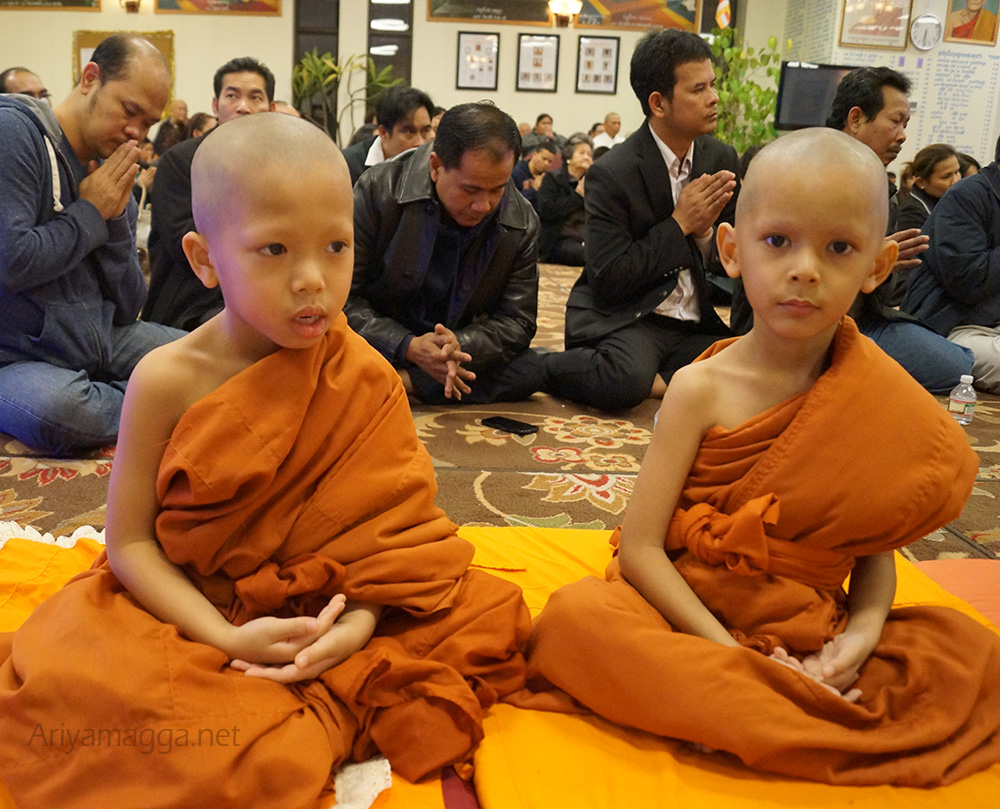
    From left: Novice Ananda and Novice Kyle.

    Realizing that death is inevitable, the one who loves life on earth will go into a devout prayer expressing the hope that his soul will survive in heaven. No man can be happy in such a tempest of fear and hope. Yet it is hard to despise or ignore these manifestations of the instinct for self-preservation. There is however a method of overcoming this fear. Forget the concept of self; turn one’s love of the inward outwards, i.e. provide humanitarian service and to shower love on others. Whoever constantly keeps in mind the fact that he would someday be subjected to death and that death is inevitable, would be eager to fulfill his duties to his fellow human beings before death, and this would certainly make him heedful in respect of this world and the next. Being engrossed in service to others, you will soon release yourself from the heavy selfish attachments, hopes, vanity, pride and self-righteousness. ~By Venerable Dr. K. Sri Dhammananda

  5. Anger

    131

    Give up anger; renounce pride;
    transcend all worldly attachments.
    No sufferings touch the person
    who is not attached to name and form,
    who calls nothing one’s own.
    Whoever restrains rising anger like a chariot gone astray,
    that one I call a real driver;
    others merely hold the reins.

    Overcome anger by love; overcome wrong by good;
    overcome the miserly by generosity, and the liar by truth.
    Speak the truth; do not yield to anger;
    give even if asked for a little.
    These three steps lead you to the gods. Continue reading

  6. The Rabbit

    53

    Buddha used to be a rabbit in one of his previous lifetimes

    A Tale of Selfless Generosity.

    In this lifetime the Bodhisattva was born as an animal, a rabbit. Yet even as a rabbit, he possessed incredible virtue, goodness, beauty, and vigor; so much so that the other animals viewed him as their king. None feared him and none caused him fear. Among his devoted following, three animals in particular became his closest students and companions. They were an otter, a jackal, and a monkey, who through the Bodhisattva’s teaching, forgot their lower animal nature and became infinitely compassionate themselves.

    As instructed by the rabbit in a teaching one night, it was customary that on the next day, a holy day, to offer alms to anyone who passes through their forest. Later that night, the rabbit was distraught as he realized he had nothing to offer. His three companions had ample means to feed a guest, but the rabbit had nothing but the meager blades of grass he ate to sustain himself, which were far too bitter to offer a visitor. Then he realized he could offer his own flesh as food and without hesitation, decided this was what he would do. Continue reading

  7. Buddhist Era

    59

    This year, Khmer New Year (Year of the Snake) falls on Sunday April 14. However, the new Buddhist Era (B.E. 2557) does not fall on the same day as Khmer New Year. I see many Khmer Buddhists around the globe, got this mixed up. New Buddhist Era always enter one day after the Buddha’s Day or Vesakha Puja, the day Buddha was born, the day he attained enlightenment, and the day he passed away. So this year, Vesakha Puja will occur on May 24th, 2013. Therefore Buddhist Era 2557 will fall on May 25, 2013, not on April 14, like Khmer New Year. I hope you are willing to correct this important mistake in the future. ~Jendhamuni

  8. The Practice of Compassion

    23

    The practice of compassion begins at home. We have our parents, our children, and our brothers and sisters, who perhaps irritate us the most, and we begin our practice of loving-kindness and compassion with them. Then gradually we extend our compassion out into our greater community, our country, neighbouring countries, the world, and finally to all sentient beings equally without exception.

    Extending compassion in this way makes it evident that it is not very easy to instantly have compassion for “all sentient beings.” Theoretically it may be comfortable to have compassion for “all sentient beings,” but through our practice we realize that “all sentient beings” is a collection of individuals. When we actually try to generate compassion for each and every individual, it becomes much more challenging. But if we cannot work with one individual, then how can we work with all sentient beings? Therefore it is important for us to reflect more practically, to work with compassion for individuals and then extend that compassion further.

    ~ Dilgo Khyentse Rinpoche, Trainings in Compassion

  9. Everyone is responsible for his/her own actions

    42

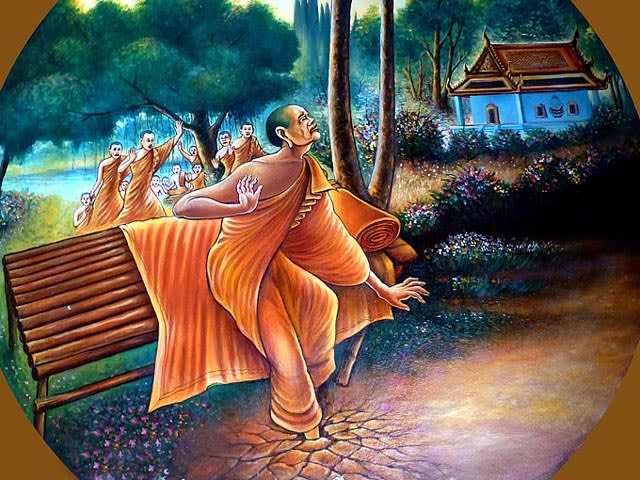
    Photo caption: Devadatta is taken to hell (avici), alive, by Mother Earth after his three attempts to kill the Buddha had failed.

    Buddhism teaches that everyone is responsible for his own good and bad deeds, and that each individual can mould his own destiny. Says the Buddha, “These evil deeds were only done by you, not by your parents, friends, or relatives; and you yourself will reap the painful results.”

    Buddhism is a gentle religion where equality, justice and peace reign supreme. To depend on others for salvation is negative, but to depend on oneself is positive. Dependence on others means surrendering one’s intelligence and efforts.

    In Buddhism, actions are merely termed as unskillful or unwholesome, not as sinful. Buddhists do not regard man as sinful by nature of ‘in rebellion against god’. Every human being is a person of great worth who has within himself a vast store of good as well as evil habits. The good in a person is always waiting for a suitable opportunity to flower and to ripen. Remember the saying, ‘There is so much that is good in the worst of us and so much that is bad in the best of us.’

    By Venerable K. Sri Dhammananda

  10. Why Lotus Flower is very Special

    36

    Lotuses are symbols of purity and ‘spontaneous’ generation and hence symbolize divine birth. According to the Lalitavistara, ‘the spirit of the best of men is spotless, like the new lotus in the [muddy] water which does not adhere to it’, and, according to esoteric Buddhism, the heart of the beings is like an unopened lotus: when the virtues of the Buddha develop therein the lotus blossoms. This is why the Buddha sits on a lotus in bloom. In Tantrism, it is the symbol of the feminine principle. The lotuses are usually differentiated by their colour and grouping, in three or five flowers, which may or may not be combined with leaves.

    White lotus
    This symbolizes Bodhi, the state of total mental purity and spiritual perfection, and the pacification of our nature. It generally has eight petals corresponding to the Noble Eightfold Path of the Good Law. It is the lotus found at the heart of the Garbhadhatu Mandala, being the womb or embryo of the world. It is characteristic of the esoteric sects, and the lotus of the Buddhas.

    Red lotus
    This symbolizes the original nature of the heart (hrdaya). It is the lotus of love, compassion, passion, activity and all the qualities of the heart. It is the lotus of Avalokitesvara. Continue reading

Live & Die for Buddhism

candle

Me & Grandma

My Reflection

This site is a tribute to Buddhism. Buddhism has given me a tremendous inspiration to be who and where I am today. Although I came to America at a very young age, however, I never once forget who I am and where I came from. One thing I know for sure is I was born as a Buddhist, live as a Buddhist and will leave this earth as a Buddhist. I do not believe in superstition. I only believe in karma.

A Handful of Leaves

A Handful of Leaves

Tipitaka: The pali canon (Readings in Theravada Buddhism). A vast body of literature in English translation the texts add up to several thousand printed pages. Most -- but not all -- of the Canon has already been published in English over the years. Although only a small fraction of these texts are available here at Access to Insight, this collection can nonetheless be a very good place to start.

Major Differences

Major Differences in Buddhism

Major Differences in Buddhism: There is no almighty God in Buddhism. There is no one to hand out rewards or punishments on a supposedly Judgement Day ...read more

Problems we face today

jendhamuni pink scarfnature

Of the many problems we face today, some are natural calamities and must be accepted and faced with equanimity. Others, however, are of our own making, created by misunderstanding, and can be corrected...