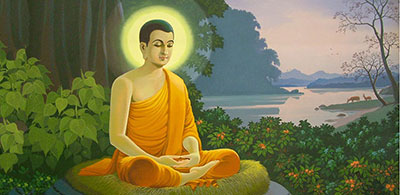
How do you let go of things? This means you leave them as they are; it does not mean you annihilate them or throw them away. It is more like setting down and letting them be. Through the practice of letting go we realise that there is the origin of suffering, which is the attachment to desire, and we realise that we should let go of these three kinds of desire. Then we realise that we have let go of these desires; there is no longer any attachment to them.
When you find yourself attached, remember that ‘letting go’ is not ‘getting rid of’ or ‘throwing away’. If I’m holding onto this clock and you say, ‘Let go of it!’, that doesn’t mean ‘throw it out’. I might think that I have to throw it away because I’m attached to it, but that would just be the desire to get rid of it. We tend to think that getting rid of the object is a way of getting rid of attachment. But if I can contemplate attachment, this grasping of the clock, I realise that there is no point in getting rid of it – it’s a good clock; it keeps good time and is not heavy to carry around. The clock is not the problem. The problem is grasping the clock. So what do I do? Let it go, lay it aside – put it down gently without any kind of aversion. Then I can pick it up again, see what time it is and lay it aside when necessary. — BuddhaNet
Harmony: When there is Right Effort, Right Mindfulness and Right Concentration, then one is fearless. There is fearlessness because there is nothing to be frightened of. One has the guts to look at things and not take them in the wrong way; one has the wisdom to contemplate and reflect upon life; one has the security and confidence of sila, the strength of one’s moral commitment and the determination to do good and refrain from doing evil with body and speech. In this way, the whole thing holds together as a path for development. It is a perfect path because everything is helping and supporting; the body, the emotional nature (the sensitivity of feeling), and the intelligence. They are all in perfect harmony, supporting each other. Source: BuddhaNet
Living 24 hours with mindfulness is more worthwhile than living 100 years without it. – The Buddha
Birds teach a great life lesson. All you have to do is listen to their song. — Unknown
A bird does not sing because it has an answer, it sings because it has a song. — Maya Angelou
Relationships are like birds. If you hold tightly, they die. If you hold loosely, they fly. But if you hold with care, they remain with you forever. — Unknown
The bird is powered by its own life and by its motivation. — Unknown
Nurture your soul with positive thoughts and internal happiness will blossom before your eyes. — Melanie Koulouris
Mindfulness is simply being aware of what is happening right now without wishing it were different; enjoying the pleasant without holding on when it changes (which it will); being with the unpleasant without fearing it will always be this way (which it won’t). – James Baraz
Living 24 hours with mindfulness is more worthwhile than living 100 years without it. – The Buddha
Each step along the Buddha’s path to happiness requires practising mindfulness until it becomes part of your daily life. – Henepola Gunaratana
Meditate … do not delay, lest you later regret it. – The Buddha
Ardently do today what must be done. Who knows? Tomorrow, death comes. – The Buddha
Mindfulness is the aware, balanced acceptance of the present experience. It isn’t more complicated than that. It is opening to or receiving the present moment, pleasant or unpleasant, just as it is, without either clinging to it or rejecting it. – Sylvia Boorstein Continue reading