When you plan to get even
106
September 11, 2014
When you plan to get even
with someone,
you are only letting that person
continue to hurt you.
~Unknown


When you plan to get even
with someone,
you are only letting that person
continue to hurt you.
~Unknown
Dolphin birth captured underwater on video. Giving birth to baby dolphin.
Birth lasted 1 hour and 10 minutes.
Please help us sign the petition to save the Monarch Butterflies
During recent decades, large commercial farms across the continent have
been spraying their fields with chemicals that kill weeds such as
milkweed without harming the crops. Less milkweed has meant many fewer
butterflies. Commercial farmers and Monsanto, the chemical company that
manufactures one of the most widely used weed-killing chemicals, are
unlikely to stop destroying milkweed without a lot of pressure from the
American people and government, and time may be running out.
Video showing the complete life cycle of the Monarch Butterfly
Monarch butterflies are the most beautiful of all butterflies, some say, and are considered the “king” of the butterflies, hence the name “monarch”. There are lots of very cool things to learn about the monarch butterfly and we’ll try to get through most of them here.
The Life Cycle(s) of a Monarch Butterfly
Monarch butterflies go through four stages during one life cycle, and through four generations in one year. It’s a little confusing but keep reading and you will understand. The four stages of the monarch butterfly life cycle are the egg, the larvae (caterpillar), the pupa (chrysalis), and the adult butterfly. The four generations are actually four different butterflies going through these four stages during one year until it is time to start over again with stage one and generation one.
In February and March, the final generation of hibernating monarch butterflies comes out of hibernation to find a mate. They then migrate north and east in order to find a place to lay their eggs. This starts stage one and generation one of the new year for the monarch butterfly.
In March and April the eggs are laid on milkweed plants. They hatch into baby caterpillars, also called the larvae. It takes about four days for the eggs to hatch. Then the baby caterpillar doesn’t do much more than eat the milkweed in order to grow. After about two weeks, the caterpillar will be fully-grown and find a place to attach itself so that it can start the process of metamorphosis. It will attach itself to a stem or a leaf using silk and transform into a chrysalis. Although, from the outside, the 10 days of the chrysalis phase seems to be a time when nothing is happening, it is really a time of rapid change. Within the chrysalis the old body parts of the caterpillar are undergoing a remarkable transformation, called metamorphosis, to become the beautiful parts that make up the butterfly that will emerge. The monarch butterfly will emerge from the pupa and fly away, feeding on flowers and just enjoying the short life it has left, which is only about two to six weeks. This first generation monarch butterfly will then die after laying eggs for generation number two.
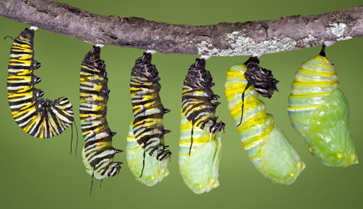 |
| Monarch Caterpillar Becoming a Chrysalis |
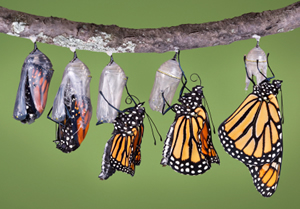 |
| Monarch Emerging from a Chrysalis |
The second generation of monarch butterflies is born in May and June, and then the third generation will be born in July and August. These monarch butterflies will go through exactly the same four stage life cycle as the first generation did, dying two to six weeks after it becomes a beautiful monarch butterfly.
The fourth generation of monarch butterflies is a little bit different than the first three generations. The fourth generation is born in September and October and goes through exactly the same process as the first, second and third generations except for one part. The fourth generation of monarch butterflies does not die after two to six weeks. Instead, this generation of monarch butterflies migrates to warmer climates like Mexico and California and will live for six to eight months until it is time to start the whole process over again.
It is amazing how the four generations of monarch butterflies works out so that the monarch population can continue to live on throughout the years, but not become overpopulated. Mother Nature sure has some cool ways of doing things, doesn’t she?
Source: Monarch-butterfly.com
Young ragpickers collect clothes, coins, wooden materials and other usable items cluttered at the bank of the Jawahar Lal Nehru lake after the immersion of Lord Ganesh idols to mark the end of the Ganesh festival, in Bhopal, India, September 9, 2014. Despite of the warning of the district administration not to immerse idols in the lake to protect the environment, hundreds of idols have been immersed by devotees, resulting in a huge pollution of the lakes in India. (EPA/SANHEEV GUPTA)

I love smiles, and my wish is to see more smiles, real smiles, for there are many kinds—sarcastic, artificial, or diplomatic. Some smiles don’t arouse any satisfaction, and some even engender suspicion or fear. An authentic smile, though, arouses an authentic feeling of freshness, and I think the smile belongs only to human beings. If we want those smiles, we must create the reasons that make them appear. ~Dailai Lama

By Editor, All About Wildlife, August 27, 2014
These Beautiful Flying Insects Are In Major Trouble. Here’s What You Can Do.
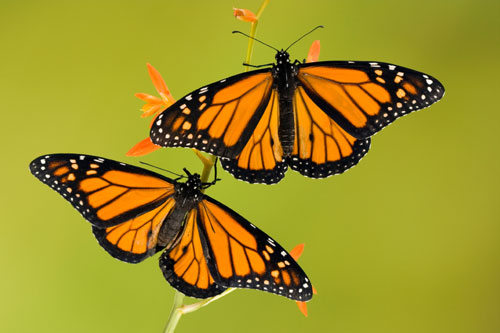
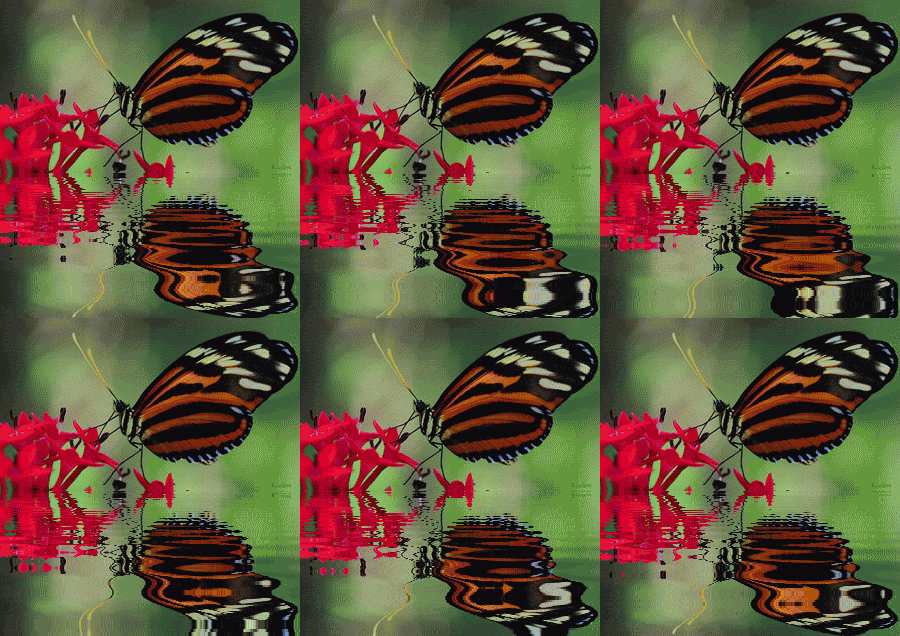
All across North America and Mexico, the numbers of monarch butterflies are dwindling. A conservation organization called the Xerces Society estimates that the monarch population has declined by 90 percent over the last 20 years. There are several reasons for this decline including global climate change and habitat loss, but the biggest factor seems to be a decrease in the amount of milkweed available to the butterflies. Milkweed is a plant that grows in open areas—on the edges of fields and in fields that have become overgrown. Monarch butterflies lay their eggs on milkweed, and the young caterpillars that hatch out of those eggs feed on its leaves.
During recent decades, large commercial farms across the continent have been spraying their fields with chemicals that kill weeds such as milkweed without harming the crops. Less milkweed has meant many fewer butterflies. Commercial farmers and Monsanto, the chemical company that manufactures one of the most widely used weed-killing chemicals, are unlikely to stop destroying milkweed without a lot of pressure from the American people and government, and time may be running out.
 |
| Monarch Butterflies Are Getting Increasing Scarce. Photo: Keenan Adams, USFWS |
Faced with the possible extinction of one of America’s most well-loved flying insects, conservation groups including the Xerces Society are asking Americans to sign a petition requesting that the U.S. Fish & Wildlife Service seek to list the monarch butterfly as Threatened under the U.S. Endangered Species Act. An Endangered Species Act listing would give wildlife protectors a lot more clout in convincing Big Agriculture to change the destructive way it does business.
If you would like to sign the petition or would like to call someone else’s attention to it, you can find it here.
Keep close to Nature’s heart… and break clear away, once in awhile, and climb a mountain
or spend a week in the woods. Wash your spirit clean. ~John Muir
Feelings, whether of compassion or irritation, should be welcomed, recognized,
and treated on an absolutely equal basis; because both are ourselves.
Root out the violence in your life, and learn to live compassionately
and mindfully. Seek peace. When you have peace within, real peace
with others is possible. ~Thich Nhat Hanh


There are moments when troubles enter our lives and we can do
nothing to avoid them. But they are there for a reason.
Only when we have overcome them will we understand
why they were there. ~Paulo Coelho
Anger is born from ignorance, and is a strong ally of ignorance.
I have to deal with my anger with care, with love,
with tenderness, with nonviolence. ~Thich Nhat Hanh